
Forage Equipment Guide
A six-dimension comparison of initial investment, transport efficiency, power requirements, forage quality, terrain adaptability, and total operating cost — built for grassland operations choosing between round and square baling systems.
The baler that costs less to buy is rarely the baler that costs less to operate — and on natural grassland, the difference compounds across every cut of every season.
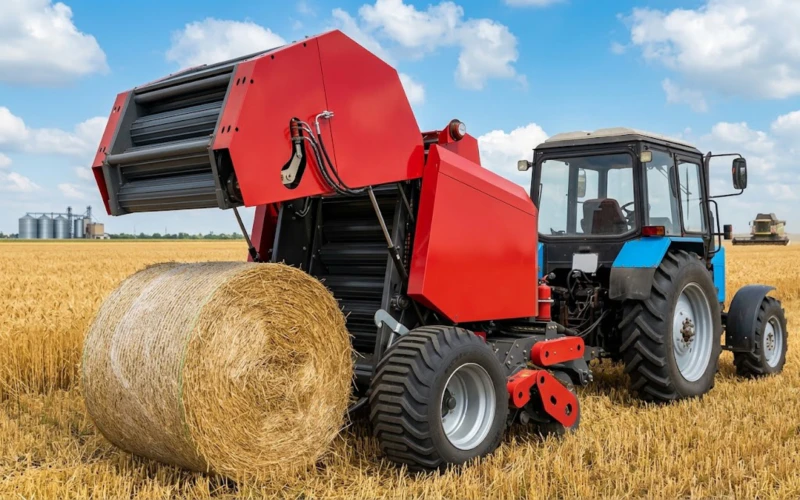
Every natural grassland hay operation eventually faces the same question: round or square? The debate has continued for decades because neither format is universally superior — each has genuine advantages in specific operational contexts, and the wrong choice in either direction carries real financial consequences that accumulate silently across seasons. A round baler bought for the wrong application produces bales that cost too much to store, transport, or feed. A square baler bought for the wrong scale introduces power and maintenance demands that overwhelm the equipment budget. Getting this decision right requires understanding not just the machines, but the economics of how each format performs across the specific conditions of your grassland operation.
This comparison is structured around the six dimensions that most directly determine total cost and operational suitability for natural grassland hay production: initial investment, per-trip transport efficiency, tractor power requirements, forage quality preservation, terrain adaptability, and total annual operating cost. By the end, you will have a clear framework for the decision that applies to your scale, terrain, and market — rather than a generic answer that ignores the variables that actually drive the outcome on your operation.
Natural grassland hay production is our speciality. Browse our complete range of hay balers to see the models referenced in this comparison.
1. How Each System Works — and Why the Difference Matters
The Round Baling Cycle
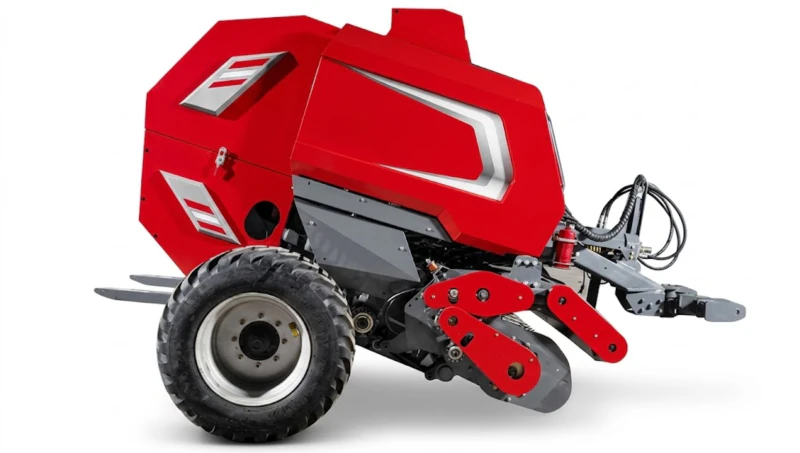
A round baler picks up the windrow with a spring-tine pickup reel and feeds material into a cylindrical compression chamber formed by a ring of rollers or drums rotating around the bale’s growing circumference. As the bale grows to the target diameter, the compression system builds internal pressure until the set density is reached, at which point the machine automatically applies net wrap or twine, ejects the finished bale, and closes the chamber for the next cycle — all without the tractor stopping. The entire pickup-compress-wrap-eject sequence on a modern commercial round baler takes 20–35 seconds at peak throughput, producing 40–100 bales per hour on thick grassland swaths.
The round bale format has one fundamental structural characteristic that governs almost every operational advantage and disadvantage: the cylindrical shape. A cylinder can be ejected from the rear of the machine without interrupting forward travel, rolled across a field surface without damage, and stored outdoors with minimal contact area on the ground. It cannot be stacked as efficiently as a rectangular bale, and its curved surface wastes space in a standard rectangular shipping container. Every downstream consequence of choosing round baling traces back to this shape.
The Square Baling Cycle
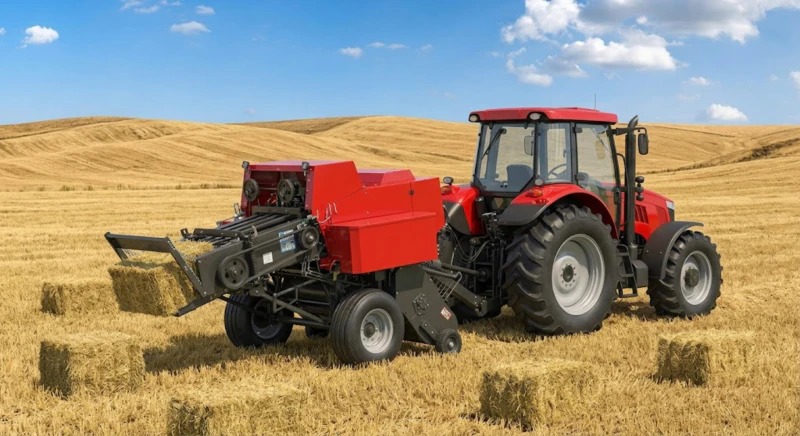
Large square balers — the type relevant for commercial grassland operations — pick up the windrow and feed it through a pre-compression chamber into a rectangular baling chamber where a hydraulic or mechanical plunger compresses the material in strokes, building the bale layer by layer to the set length. When the bale reaches the target length, a knotting system ties the twine that holds the bale’s shape, and the finished rectangular bale exits the rear of the machine onto the field. The baling cycle requires significantly more tractor power than equivalent round baling — typically 100–180 HP for commercial large square balers versus 55–110 HP for commercial round balers of comparable output — and the knotting system introduces a mechanical complexity point that is the primary source of large square baler downtime in field conditions.
The square bale format’s structural advantage is its rectangular geometry: bales stack flat, interlock under their own weight, fill rectangular storage spaces with near-zero wasted volume, and pack into shipping containers or truck beds at the maximum density that the bale weight allows. For operations producing hay for export markets where container loading density determines freight cost per tonne, this packing efficiency advantage over round bales is a genuine and substantial commercial differentiator.
2. Six-Dimension Comparison
Dimension 1 — Initial Investment
A commercial round baler in the 9YG-1.25 or S9000 class — with sensor density control, 2240mm pickup, 18-roller drum chamber, and automatic net wrap — represents a capital investment substantially below an equivalent-output large square baler. The mechanical simplicity of the round baling cycle (a rotating compression ring versus a reciprocating plunger with knotting mechanism) results in lower manufacturing cost, which translates to lower purchase price for the buyer. The tractor required to run a commercial round baler at 55–100 HP is also in a lower price tier than the 130–180 HP tractor that a commercial large square baler requires for sustained full-capacity operation.
For operations that already own a tractor in the 55–80 HP range — the most common situation for mid-scale natural grassland farms — the round baler can be deployed with the existing equipment fleet. The large square baler typically requires a new, higher-power tractor purchase alongside the baler investment, doubling the effective capital commitment for the transition to square baling. This tractor upgrade cost is rarely included in comparisons that focus only on the baler price.
Capital comparison summary: For most natural grassland operations in the 100–500 ha/season range, the round baling system requires 40–60% of the total capital commitment of an equivalent-output square baling system when the required tractor is included in both calculations.
Dimension 2 — Transport Efficiency Per Trip
This is the dimension where the square bale’s geometric advantage is most commercially significant. A standard 40-foot shipping container can hold approximately 22–24 large square bales at 500 kg each (11–12 tonnes), filling the container to near-maximum payload. The same container loaded with round bales — where the cylindrical profile leaves triangular void space at every bale-to-bale contact zone — carries approximately 8–12 tonnes of product depending on bale diameter and whether custom curved filler panels are used. On a freight cost of USD 3,000–5,000 per container, the round bale’s lower packing efficiency adds USD 400–1,000 per container in effective freight cost per tonne compared to square bales at equivalent product weight.
For domestic transport on flat-bed trucks and farm trailers, the gap is smaller but still present. Square bales stack two or three high on a standard trailer and interlock under their own weight, reaching the truck’s legal payload limit before running out of stacking height. Round bales placed side-by-side on a trailer reach the trailer’s dimensional limit before the weight limit — meaning you are paying to transport air in the spaces between round bales. For operations selling locally where road transport distance is under 200 km, this difference is manageable. For operations selling into long-distance or international markets, the square bale’s transport efficiency advantage is a genuine per-tonne cost differential that accumulates into a meaningful annual figure at commercial production volumes.
Dimension 3 — Tractor Power Requirements
Natural grassland hay operations in most regions run tractors in the 40–80 HP range — a fleet size appropriate for a 100–600 ha annual production program. This is precisely the power range that commercial round balers from the 9YG-1.0 to the S9000 series are designed to work within. The fit between the existing tractor fleet and the round baler’s power requirement is one of the most practically significant arguments for round baling in natural grassland contexts: the investment in the baler alone unlocks the full productivity of equipment already on the farm.
Large square balers require 100–180 HP for sustained commercial operation. Operations that do not own a tractor in this power range face an equipment gap that typically costs as much or more to fill as the baler itself. Operations that do own high-power tractors — often because they also run other large-scale field operations like deep ripping or heavy cultivation — may already have the power available for square baling without additional investment. For this reason, the tractor power dimension is one of the most operation-specific factors in the round vs. square decision: the right answer depends almost entirely on what is already in the machine shed.
The PTO shaft connecting tractor to baler carries the full power demand of the baling cycle — including the peak torque spikes that occur when the pickup encounters dense windrow sections, the baler chamber reaches maximum compression, or the knotting mechanism engages. A correctly specified pto shaft rated for the baler’s torque range and balanced for the operating speed is the mechanical link that keeps the tractor’s power delivery smooth and the baler’s density control system accurate — in both round and square baling applications.
Dimension 4 — Forage Quality Preservation
Round bales stored outdoors under net wrap lose significantly less dry matter and nutritional quality than twine-bound square bales stored on the same outdoor surface. The mechanism is the round bale’s geometry: the curved upper surface sheds rain naturally, and net wrap seals the full perimeter against weather infiltration. Square bales stored outdoors accumulate moisture along every flat top surface and at every corner where rain penetrates the twine binding. Field measurements from comparative outdoor storage trials consistently show 12–20% lower dry matter loss for net-wrapped round bales versus twine-bound square bales at the same storage duration under equivalent weather conditions.
This advantage reverses when both bale types are stored under cover in a barn or shed. In covered storage, the square bale’s superior packing density means more tonnes of hay can be stored per square metre of barn floor area, reducing the covered storage infrastructure cost per tonne stored. For operations with adequate covered storage, the round bale’s outdoor storage advantage is irrelevant. For operations that rely on outdoor storage — the practical reality for most large natural grassland hay programs where production volumes exceed covered storage capacity — the round bale’s weather resistance is a genuine quality and financial advantage.
Dimension 5 — Terrain Adaptability
Natural grassland terrain is rarely flat. Slopes, undulations, drainage channels, and soft ground after rainfall are standard field conditions in most natural pasture environments. Round balers — being lighter, lower-profile, and connected to the tractor on a fixed hitch — follow terrain changes with minimal mechanical stress on the machine or the hitch connection. The bale can be ejected on a slope without the rollout risk of a heavy rectangular bale, and the lighter implement weight means less soil compaction during wet-weather operation when the ground is most vulnerable.
Large square balers on slopes face the additional challenge of bale ejection stability: a 500 kg rectangular bale ejected on a 10° slope will slide or roll in the direction of the slope, potentially interfering with subsequent baling passes or causing unsafe handling situations during collection. Square baler operation on slopes above 8–10° requires careful headland planning and often additional bale collection equipment to prevent bale movement after ejection. The round baler’s continuous bale ejection system and lighter bale weights make slope operation more straightforward across the terrain variation typical of natural grassland environments.
Dimension 6 — Total Annual Operating Cost
Total annual operating cost encompasses fuel, labour, maintenance and repair, consumables (net wrap, twine), and depreciation on the baler and tractor. The round baling system’s cost advantage on most natural grassland operations stems from three compounding factors: the lower power requirement reduces fuel consumption per bale; the simpler mechanical design reduces the frequency and cost of maintenance interventions; and the single-operator design matches the labour availability of most family or small commercial farm operations where a dedicated baler operator plus a separate tractor operator for square baling is a staffing constraint rather than just a cost.
The square baler’s total cost advantage is concentrated in the transport and storage efficiency that its format enables — lower freight cost per tonne on long-distance shipments, higher value per square metre of covered storage, and the ability to mechanically handle and stack bales with standard agricultural forklifts and telehandlers that are already on most farms. For operations where transport and storage cost is the dominant economic variable — typically those selling into markets more than 500 km away or exporting — the square bale’s format advantages can outweigh the higher capital and operating cost of the baling system itself.
| Dimension | Round Baler | Large Square Baler |
|---|---|---|
| Initial investment | ✓ Lower — tractor often already owned | Higher — new high-HP tractor often required |
| Transport efficiency | Lower — void space reduces load per trip | ✓ Higher — rectangular stacking fills capacity |
| Tractor power needed | ✓ 55–100 HP — fits most grassland fleets | 130–180 HP — requires high-power tractor |
| Outdoor forage quality | ✓ Better — net wrap sheds rain, lower DM loss | Higher DM loss unless covered storage used |
| Terrain adaptability | ✓ Better on slopes and soft ground | Slope limits on bale ejection and handling |
| Annual operating cost | ✓ Lower fuel, maintenance and labour cost | Higher running cost; offset by transport savings |
3. Three Scenarios Where Each Format Wins
Round Baler Wins: Natural Grassland at 50–500 ha/season, Sold Domestically
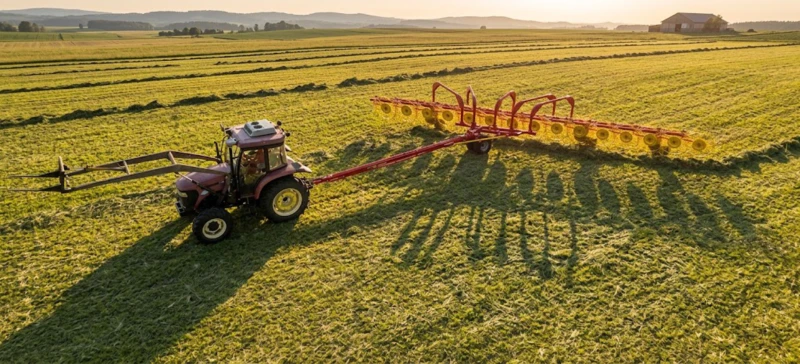
The natural home of the round baler on grassland is the mid-scale domestic market operation where hay is sold within 300 km of the farm, stored outdoors for 30–90 days between cutting and sale, produced on terrain that includes moderate slopes and seasonal soft patches, and run by one or two operators with a 55–80 HP tractor fleet. This profile describes the majority of natural grassland hay operations in Inner Mongolia, the North American prairie belt, Central Asia, and Australian grassland regions. In all these contexts, the round baler’s lower capital cost, terrain flexibility, outdoor storage advantage, and single-operator productivity profile align precisely with the operational constraints and economics of the typical operation. The return on investment period for a commercial round baler in this setting is typically 2–4 seasons of hay production.
Square Baler Wins: Export-Oriented Operations Above 1000 ha/season with Covered Storage
The large square baler’s economic argument becomes compelling when three conditions are simultaneously met: annual production volume above 1000 ha (so the capital cost dilutes across enough bales to reach competitive per-bale depreciation), sales into markets where shipping container loading efficiency directly determines FOB price competitiveness (typically export to Asia or Europe), and adequate covered storage so that the outdoor storage quality disadvantage of square baling does not erode the quality premium that justifies the investment. When all three conditions are present, the square bale’s transport efficiency advantage can generate enough per-tonne freight cost saving to pay the additional capital and operating cost of the square baling system within 3–5 seasons. When any of these conditions is absent, the round baler’s total cost advantage reasserts.
Mixed Systems: Large Operations with Both Domestic and Export Markets
The most productive configuration for large commercial grassland hay operations serving both domestic and export markets is often a mixed system: round balers for the volume production that supplies the domestic market, and square balers reserved for the export-grade product that justifies the higher transport cost efficiency. This approach allows the round baling equipment — lower capital cost, better terrain adaptability, superior outdoor storage performance — to handle the majority of annual production, while the square baling system is deployed specifically for the high-value export lots where its format advantages directly translate into market price premium. Many large Inner Mongolian grassland enterprises operate exactly this configuration, running three to five round balers alongside one large square baler, calibrating the proportion to match their domestic versus export volume split each season.
4. The Hidden Variables Most Comparisons Ignore
Bale Handling Infrastructure
A round bale can be moved from field to storage with a simple spike or cradle attachment on a front-end loader — equipment most farms already own. It can be rolled short distances by one person, ejected from the baler without stopping forward travel, and stored in an outdoor row without any structural support. A large square bale at 500 kg requires a telehandler or high-capacity forklift to move, stack, and load onto transport vehicles. Operations that do not already own this equipment face an additional infrastructure investment on top of the baler and tractor purchase. When this handling infrastructure cost is included in the total capital comparison, the gap between round and square baling systems widens considerably beyond what a baler-only price comparison reveals.
Maintenance Complexity and In-Season Downtime Risk
The knotting mechanism of a large square baler is the most mechanically complex element in the baling system — a precisely timed series of hooks, needles, and bill hooks that must coordinate to tie two knots simultaneously under tension on every bale. Knotting failures are the single most common cause of large square baler downtime in commercial operation. When a knotting failure occurs during a critical baling window — when weather conditions allow only 8–12 hours of productive baling before the next rain event — the time cost of diagnosing and repairing the knotter is measured in missed production rather than just in workshop labour. The round baler’s net wrap system is far simpler mechanically and significantly less likely to fail during the baling window, making round baling the lower in-season downtime risk for operations where weather-constrained baling windows are the primary production constraint.
Labour Availability and the Single-Operator Advantage
Natural grassland operations in remote regions — the Mongolian steppe, Central Asian grasslands, Australian outback stations, North American high plains — consistently face skilled labour availability as a practical constraint on operational scale. A commercial round baler in the 9YG or S9000 series requires one operator for the full baling cycle: one tractor driver manages pickup, baling, net wrap, and bale ejection without assistance. Large square baler systems at commercial throughput typically require one baler operator plus a separate tractor and operator for bale collection behind the baler, or a dedicated bale sledge operator — increasing the labour demand at exactly the moment when all available operators are already committed to other harvest tasks. For operations where labour availability limits operational scale, the round baler’s single-operator design is a genuine capacity multiplier, not just a cost line item.
5. The Per-Bale Cost Calculation: An Illustrative Example
To move from qualitative comparison to a concrete financial framework, consider a 300 ha/season natural grassland hay operation in a region where hay sells domestically at USD 150 per tonne average, transport to market is 200 km by flat-bed truck, storage is primarily outdoor with 60-day average holding period before sale, and the operation has two existing 75 HP tractors. The following illustrative figures are not manufacturer cost data — they are representative estimates to demonstrate the calculation framework. Actual figures will vary by region, fuel cost, labour rate, and specific equipment models.
| Cost Category | Round Baling System | Square Baling System |
|---|---|---|
| Baler capital (annualised) | Lower — existing tractor used | Higher — new 150 HP tractor required |
| Fuel per tonne baled | Lower (55–75 HP consumption) | Higher (150 HP sustained load) |
| Labour (operators per machine) | 1 operator | 2 operators (baler + collection) |
| Outdoor storage DM loss | ~5–8% (net wrap) | ~12–20% (twine, outdoors) |
| Transport (200 km domestic) | Modest void-space penalty | Slightly more efficient per trip |
| Overall verdict (this scenario) | ✓ Lower total cost | Higher total cost for this operation profile |
In this 300 ha/season domestic-market scenario, the round baling system’s advantages in capital, fuel, labour, and outdoor storage quality outweigh the square baler’s transport efficiency edge on 200 km domestic transport. The crossover point — where the square baler’s transport savings begin to offset its higher system cost — typically appears at transport distances above 800–1000 km or for export volumes exceeding 1000 ha/season with covered storage. Below these thresholds, the round baling system delivers lower total cost per tonne of hay sold across most natural grassland operation profiles.
6. Making the Decision: Four Questions That Determine the Right Answer
The round vs. square decision on natural grassland is ultimately determined by four operational realities that are specific to each farm. Answer these questions honestly and the right format becomes clear:
What tractor power do you currently own — and what would adding a square baler system actually cost?
Include the tractor upgrade cost in your square baler total investment. If you own 55–80 HP tractors and would need to buy 150 HP to run a commercial square baler, the effective capital comparison changes dramatically.
Where does your hay go — and how far does it travel to get there?
Domestic sales under 500 km and farm-gate or regional market sales rarely generate enough transport efficiency saving from square baling to offset the higher system cost. Export sales and long-distance domestic transport above 800 km shift the calculation materially in favour of the square format.
How do you store your hay between cutting and sale?
Primarily outdoor storage for more than 30 days tips the quality and DM-loss calculation strongly toward net-wrapped round bales. Covered storage that can accommodate the full production volume neutralises this advantage and allows the square format’s packing density to deliver real infrastructure cost savings.
How many reliable operators can you put on the harvest system during peak cutting windows?
In labour-constrained environments where one or two operators handle all harvest tasks, the round baler’s single-operator capability is a capacity multiplier. If you have four or more operators available during harvest and the bale collection system is already resourced, the labour advantage of round baling is less decisive.
For most natural grassland hay operations in the 50–500 ha/season range serving domestic or regional markets, honest answers to these four questions will point toward the round baler — not because the round baler is universally superior, but because most grassland operations’ real operational profile aligns more closely with the conditions under which round baling delivers superior total economics. For operations that answer question 2 with “export market” and question 3 with “covered barn storage”, the re-evaluation toward square baling is warranted and potentially financially decisive.
Not Sure Which System Fits Your Grassland Operation?
Our team works with grassland hay producers across every scale and market — from 50 ha family farms to 5000 ha commercial enterprises. We can help you model the per-bale cost for your specific operation before you commit.