Bale Quality Troubleshooting
A loose bale core is not a random quality defect. It is a predictable consequence of specific decisions made during the baling cycle — about starting density, PTO speed stability, pickup feed rate, and the first material layer that enters the chamber. Every one of those decisions is controllable.
Open a bale with a loose core and you are looking at the record of what happened in the first 30 seconds of its formation — not the last 30. The outer shell is almost always well-formed. The failure was at the start.
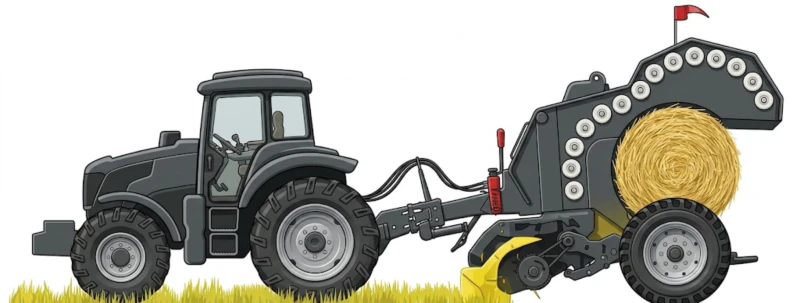
Pick up a round bale that has collapsed under the weight of adjacent bales in a storage row and the failure point is almost always the same — a soft, poorly consolidated core surrounded by a dense, well-formed outer shell. The outer layers are correct. The net wrap is intact. The bale’s diameter and shape look normal from the outside. But when the outer material is pushed inward it compresses easily, revealing a cavity or a zone of loosely packed material at the bale’s geometric centre that should be the densest part of the bale structure. Core loosening is the most common structural bale defect in commercial round baling operations, and it is widely misunderstood as a random quality variation when in fact it is a predictable outcome of specific, identifiable causes that can all be corrected.
Understanding why core loosening happens requires understanding how a round bale forms from the inside out. The bale nucleus — the tight roll of material that forms in the first 15–30 seconds of the baling cycle — is the structural foundation for everything that follows. If the nucleus is correctly formed, each subsequent layer of material wraps around it under progressively increasing compression as the bale grows and the drum ring’s grip on the outer surface tightens. If the nucleus is loose — formed from too little material, at too low a compression force, or with a feed rate that was inconsistent during those first critical seconds — every subsequent layer wraps around a soft core that cannot resist the compression of outer layers. The result is a bale that is dense at the circumference and hollow or loose at the centre, structurally weaker than its outer appearance suggests, and prone to collapse under axial stacking load.
This guide identifies the six most common causes of round bale core loosening, explains the mechanism behind each, and provides the operational adjustments that prevent each cause from recurring. For the round baler equipment and density control systems that prevent core loosening at the design level, see our range of commercial round balers.
1. How a Round Bale Core Forms — and Why the First 30 Seconds Are Decisive
The Core Formation Sequence
When material first enters a fixed-chamber round baler, it is caught between the rotating drum surfaces and tumbled — not compressed — until enough material has accumulated to form a coherent roll. This initial tumbling phase, lasting 5–15 seconds at normal working speed, produces the bale nucleus: a loosely coiled cylinder of material whose diameter grows as more material is added until it contacts the full ring of drums simultaneously. Once the nucleus contacts all drums, compression begins in earnest — the drums now grip the full bale circumference and apply compression force to every new layer added from that point forward.
The density of the nucleus at the moment it first contacts all drums simultaneously determines the structural starting point for all subsequent compression. A dense nucleus — formed from a consistent, uninterrupted flow of material through the first 15–30 seconds — provides a firm substrate that resists the inward collapse that later compression forces apply to the bale structure. A loose nucleus — formed from insufficient material flow, interrupted feed, or material that entered the chamber too dry or too stemmy to coil coherently — cannot resist inward collapse. As the outer layers of the bale are compressed more tightly, they push inward against the loose nucleus, which yields rather than resisting, creating a concave depression at the bale’s centre that grows more pronounced as the bale approaches its final diameter and maximum compression is applied.
Why the Core Is Always the Weakest Zone
Even in a correctly formed bale, the core is the least compressed zone — not because formation failed, but because the drum ring applies its maximum grip only when the bale’s outer diameter is large enough to contact all drums at full compression angle. In the nucleus formation phase, the drums contact only a small-diameter roll whose curvature is too tight for the full drum ring to engage simultaneously, so the compression force per unit area is lower than in the outer layers. This geometric constraint means the core is inherently lower-density than the outer layers in any round baler, and the difference between a structurally sound bale and a core-loosening bale is whether that core density is adequate to bear stacking loads — not whether it matches outer-layer density, which it never will.
2. The Six Causes of Core Loosening — and How to Fix Each
Starting on a Thin or Sparse Windrow Section
Mechanism: The bale nucleus forms from whatever material is present in the first 15–30 seconds of forward travel after the previous bale was ejected. If the baler restarts on a sparse windrow section — a windrow gap between swath ends, a thin section at the field headland, or the uneven beginning of a new windrow — the nucleus forms from insufficient material and never reaches adequate density before the outer compression phase begins. The thin nucleus is structurally too weak to bear the inward pressure of outer-layer compression, and core loosening results regardless of how dense the outer layers become.
Prevention: Always restart baling on a well-formed, consistent section of windrow — not at the headland end where material has been displaced by the rake’s turning manoeuvre, and not in the gap immediately following a windrow junction where material density is typically lowest. After bale ejection, advance the baler 3–5 metres before re-engaging the PTO if the next windrow section appears thin. The short delay adds 10–15 seconds per bale cycle but eliminates the loose-core defect on windrow-sparse restarts.
Quick test: Open three consecutive bales from a section where the windrow was noted to be thin during baling. If core loosening is concentrated in these bales but absent in adjacent bales from dense windrow sections, windrow density at restart is the cause.
Excessive Baling Speed at Cycle Start
Mechanism: Moving the baler at high forward speed during nucleus formation feeds material into the chamber faster than the tumbling action can coil it into a coherent roll. Material tumbles through the chamber in a disorganised mass that does not consolidate into a tight nucleus before the first drum contacts force the growing mass into its final diameter. The result is a large-diameter but loosely packed nucleus — analogous to a loosely wound ball versus a tightly rolled one of the same size — that produces core loosening despite adequate material volume at the start of the cycle.
Prevention: Reduce forward speed by 30–50% for the first 10 seconds after bale ejection and PTO re-engagement, then gradually return to normal working speed as the nucleus forms and drum contact is established across the full bale circumference. The speed indication on some balers’ density monitoring displays provides a visual cue for the moment full drum engagement is achieved — this is the point at which normal speed can be resumed. On balers without this indicator, develop a consistent timing habit: slow start for approximately 15 metres of forward travel, then normal speed for the remainder of the bale cycle.
Note: This cause is most prevalent on heavy, high-yielding hay crops where the windrow presents an immediately high feed rate as soon as the pickup engages. Lighter windrows on natural grassland rarely trigger this cause because the material flow rate naturally limits nucleus formation speed.
PTO Speed Drop During Nucleus Formation
Mechanism: The drum surfaces that coil the bale nucleus depend on PTO-driven rotational speed to generate the surface velocity that tumbles and coils material into a coherent roll. If PTO speed drops during nucleus formation — because the tractor is underpowered for the combined load of initial pickup engagement and drum drive, or because a worn or undersized PTO shaft introduces speed variation under the engagement torque spike — the drum surfaces slow below the minimum velocity needed for effective coiling. Material slides or piles in the chamber rather than rolling into a tight nucleus, and core loosening results from poor coil formation even if material volume was adequate.
Prevention: Ensure the tractor is at its full rated engine RPM before engaging the PTO at the start of each bale cycle. Pre-spin the PTO with the pickup disengaged for 2–3 seconds before engaging the pickup to allow the baler’s flywheel and gearbox to reach operating speed before material load is applied. Inspect the PTO shaft’s universal joints for play and the telescoping spline for binding — a shaft that resists telescoping motion adds engagement resistance that is most significant during the first seconds of the cycle when the nucleus formation dynamics are most sensitive. A correctly rated and maintained pto shaft transmits the full engagement torque without the speed variation that poor-condition shafts introduce.
Diagnostic: If core loosening is uniformly present across all bales — not concentrated at specific windrow sections — PTO speed instability during the nucleus formation phase is more likely than windrow-related causes, which tend to produce intermittent loosening correlated with specific field zones.
Material That Is Too Dry or Too Short-Cut
Mechanism: Round bale formation depends on material’s ability to interlock — long fibres that can wrap around each other as they are tumbled by the drum surfaces. Very dry material (below 10% moisture) loses the stem flexibility that allows fibres to bend and interlock during nucleus formation; instead of coiling, the fibres break at bends and accumulate as a loose pile rather than a coherent roll. Short-cut material — produced by baler pickup cutterbar systems set to very short cut lengths, or by pre-cut silage-type crops — has insufficient fibre length for interlocking, and produces a loose, granular nucleus regardless of moisture content.
Prevention: For very dry hay (below 12% moisture), slow baling speed by 20–30% and increase initial chamber pressure to help the low-flexibility fibres compact before drum contact forces the nucleus diameter. For crops with naturally short fibres, check whether the baler’s cutterbar (if fitted) is set to a shorter cut length than necessary for the end market — cut length that is shorter than needed for feeding quality reduces nucleus formation quality without any nutritional benefit. In some cases, bypassing the cutterbar for the first 20 metres of each bale cycle — if the baler’s controls allow selective engagement — produces a longer-fibre nucleus that anchors the subsequent shorter-cut layers more effectively.
Moisture check: If core loosening appears in the afternoon baling session but not the morning, very dry afternoon material (below 11%) may be the cause. Take windrow moisture readings at 2-hour intervals through the day — if afternoon readings drop below 11%, stopping baling for 30 minutes and resuming when relative humidity rises slightly in the late afternoon can improve nucleus formation quality without compromising bale storage moisture.
Uneven Lateral Material Feed to the Compression Chamber
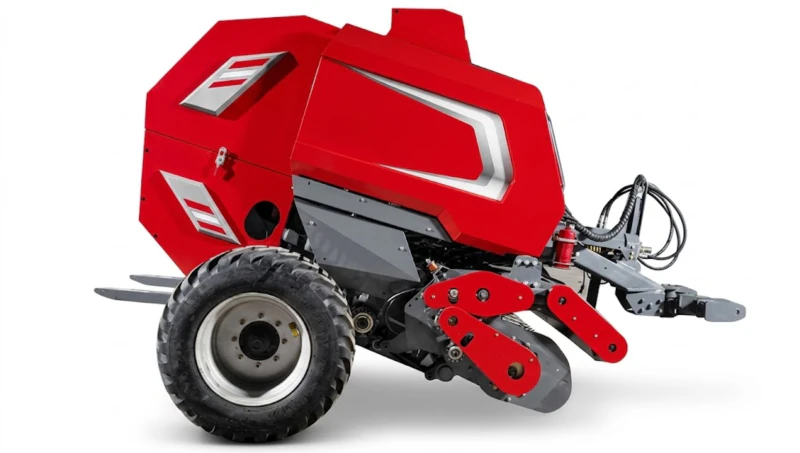
Mechanism: A round bale’s nucleus forms correctly only when material enters the chamber evenly across the full pickup width and is distributed uniformly across the chamber’s lateral dimension. When material is fed predominantly to one side — because the baler is not centred on the windrow, because a damaged pickup tine section creates a gap in the feed across part of the pickup width, or because the feed rotor’s lateral distribution mechanism is worn or damaged — the nucleus forms as an off-centre roll that is denser on one side than the other. As the off-centre nucleus grows, the compression forces from the drum ring are not evenly distributed around its circumference, and the less-dense zone of the nucleus cannot resist the inward pressure from the denser side. The result is a core that is loose specifically in the zone that received insufficient initial material, often visible as an off-centre void when the bale is opened laterally.
Prevention: Drive consistently with the windrow centred in the pickup — use a windrow guide stripe or consistent visual landmark on the tractor bonnet as a centering reference rather than steering by feel. Replace any missing or bent pickup tines across the full pickup width, paying particular attention to whether tine damage is concentrated on one side, which would confirm asymmetric feed as the cause. Inspect the feed rotor’s lateral distribution auger (if fitted) for wear or asymmetric damage that would reduce material distribution on one side of the chamber.
Identification: Cut the bale laterally through its centre axis with a bread knife or hay probe. An off-centre void that is consistently positioned on the same side of every bale confirms asymmetric feed rather than start-of-cycle or moisture causes.
Pressure Setting That Starts Too Low and Ramps Too Slowly
Mechanism: Manual pressure systems that use a ramp function — starting at low compression at the beginning of the cycle and increasing to the target pressure as the bale grows — are designed to prevent the tractor from stalling under the engagement load of a full-pressure chamber start. If the initial low-pressure phase is too long or the ramp rate is too slow, the nucleus forms under below-target compression and remains loose even after target pressure is reached, because the compression applied later in the cycle compresses the outer layers against the already-formed loose nucleus rather than retroactively compressing the nucleus itself. The nucleus density is set at the moment of formation and cannot be meaningfully increased by higher compression applied later to the outer layers.
Prevention: On manual-pressure balers with adjustable ramp functions, shorten the low-pressure phase to the minimum needed to prevent tractor stall on engagement — typically 5–8 seconds rather than the 15–20 seconds that some operators set to ensure a smooth engagement. On sensor-controlled density balers, confirm the density setpoint is active from the first material entry into the chamber rather than being delayed by a timer or a minimum-diameter trigger that allows the nucleus to form below target density before the sensor system activates. Consult the baler’s operator manual for the specific control logic governing the early-cycle pressure behaviour.
Sensor baler note: Some sensor systems have a “soft start” mode that applies reduced pressure for the first N seconds of each bale cycle to protect the compression system during cold-morning engagement. If this mode is active, verify that N is set to the minimum required for the equipment protection purpose — not a default that was never adjusted for the specific application.
3. Diagnosing Core Loosening: Which Cause Is Active in Your Operation
When core loosening appears in a baling operation, the first diagnostic step is characterising its distribution — which bales are affected and which are not — before attempting any equipment adjustment. The distribution pattern directly identifies the cause.
| Distribution Pattern | Most Likely Cause | First Action |
|---|---|---|
| Every bale — consistent | PTO speed drop or pressure ramp too slow | Monitor PTO speed during cycle start; check ramp setting |
| First bale after ejection only | Thin windrow at restart or excessive start speed | Slow start speed; advance to dense windrow before engaging |
| Afternoon bales only | Material too dry for nucleus cohesion | Take moisture readings; slow speed on afternoon dry crop |
| Off-centre void on same side | Asymmetric material feed — damaged tines or misalignment | Inspect pickup tines by section; check windrow centering |
| Correlated with windrow gaps | Sparse windrow at cycle start | Avoid bale ejection on thin sections; improve raking |
4. The Storage and Handling Consequences of Core Loosening
Structural Failure Under Stacking Load
A round bale’s structural integrity under axial stacking load depends on the core’s ability to resist the inward compression applied by the weight of bales stacked above it. In a correctly formed bale, the dense core and dense outer shell form a structurally continuous cylinder that distributes stacking load evenly across its cross-section. In a core-loosened bale, the inward collapse mechanism that formed the loose core continues under stacking load: the outer shell acts as a thick-walled tube with a loose filling that cannot resist the radial inward pressure the stack load generates. The outer shell gradually deforms under sustained load, the net wrap that depended on the outer shell’s geometry for its tension loses its grip, and the bale collapses — often laterally rather than vertically, creating an unstable row that requires the entire stack to be rebuilt.
Feed Value Loss at the Core
The loose core of a core-loosened bale is not just a structural problem — it is a quality problem. The air pocket or loosely packed zone at the bale centre allows aerobic microbial activity to continue long after the bale’s outer surface has been sealed by net wrap and the moisture has equilibrated. Aerobic fermentation at the core consumes soluble carbohydrates and digestible protein — the same degradation pathway as outdoor storage surface loss, but occurring from the inside of a bale that appears externally intact. Bales fed to dairy cattle that consistently underperform their expected ration contribution — despite adequate crude protein analysis on the outer material — may have significant core-zone quality degradation that the standard hay probe sampling (typically taken from the bale’s outer ring) does not capture.
Commercial Consequences
For export operations, core loosening is rarely detectable at loading — the bales appear correctly formed and dense from the outside. The failure appears at the destination when bales that were compressed for container loading do not re-expand correctly (the loose core collapses under the compression load rather than springing back to shape) or when the buyer opens bales for feeding and discovers the internal void. Buyers who receive core-loosened bales from an otherwise reliable supplier do not always communicate the specific defect — they adjust their next purchase price or redirect volume to a competitor without explanation. Understanding core loosening as a commercial risk, not just a mechanical defect, motivates the operational discipline needed to prevent it consistently.
Experiencing Core Loosening in Your Baling Operation?
Our technical team can help you identify the specific cause from your bale distribution pattern and operational data, and advise on the equipment setting or maintenance action that resolves it. We can also recommend the sensor-controlled density balers that eliminate the manual pressure ramp issues that cause Cause 6 at the design level.