
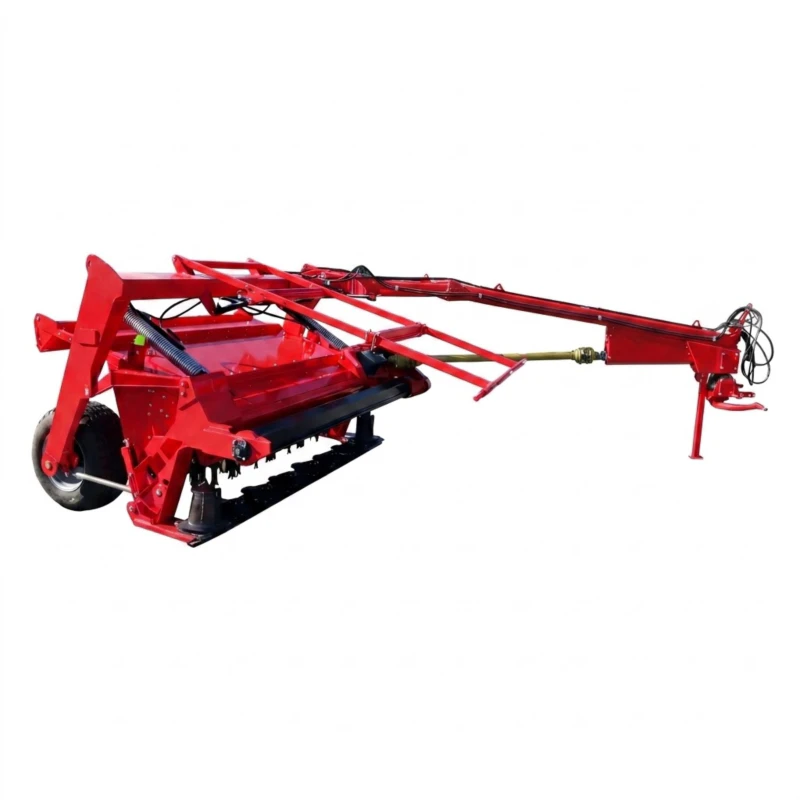
9GQY-3.2 Mower Conditioner
9GQY-3.2 Mower Conditioner — 3.2m rotary cutterbar, 8 discs, flail/tine conditioner, 0.8–2.2m swath. Cuts dry-down by 50%. Side-pull, 1 operator. ≥110HP, 540–1000rpm.
9GQY-3.2 Mower Conditioner: Wide-Cut Side-Pull Disc Mowing with Integrated Flail Conditioning for Premium Hay Quality
An 8-disc rotary cutterbar across a 3.2m cutting width, flail/tine conditioner with 0.8–2.2m adjustable swath width, 540–1000 r/min PTO compatibility, and single-operator side-pull trailed design — delivering accelerated dry-down and consistent swath placement at 6–15 km/h from tractors of ≥80.88 kW (110 HP).
1. Introduction: Why Cutting and Conditioning in One Pass Defines Modern Hay Quality
The gap between first-cut hay and premium hay is almost entirely a drying speed problem. Undamaged cut stems retain their waxy cuticle layer, which slows moisture evaporation from the plant interior by as much as 60–70% compared to conditioned material. In climates where the weather window between cutting and baling is measured in hours rather than days, this moisture retention difference translates directly into either premium-grade nutritional hay or weather-damaged low-value product that costs the same to produce. The only reliable way to close this gap is mechanical conditioning at the point of cutting — breaking or abrading the stem surface immediately after severance to accelerate moisture release before the first swath turn.
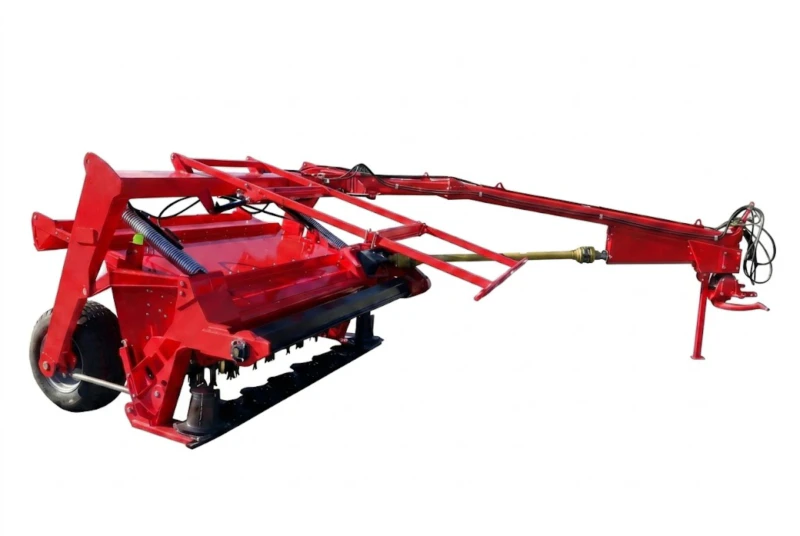
The 9GQY-3.2 Mower Conditioner integrates both functions into a single side-pull trailed implement: an 8-disc rotary cutterbar across a full 3.2m cutting width severs standing crop cleanly and continuously, while an integrated flail/tine conditioning system breaks the stem cuticle and partially crushes the stem wall as the cut material passes through. The result is a conditioned swath placed at an operator-adjustable width of 0.8–2.2m that can reach baling moisture in significantly less field time than unconditioned cut material — reducing weather exposure risk, preserving leaf fraction (the primary carrier of protein and energy in forage crops), and enabling one operator to complete large acreage efficiently at 6–15 km/h working speed. See our full range of forage harvesting equipment to pair the 9GQY-3.2 with the appropriate round baler for your operation.
The side-pull trailed configuration places the cutterbar offset to the right of the tractor, allowing the tractor wheels to travel in previously cut areas on passes after the first — protecting standing crop from wheel damage and enabling cleaner cutting geometry on headland turns. The single-operator design requires no additional field personnel; the complete cut-condition-swath cycle from field entry to swath placement operates from the tractor cab throughout the working day.
2. Working Principle: Three-Stage Cut-Condition-Swath Cycle
Stage 1 — 8-Disc Rotary Cutting
As the tractor pulls the 9GQY-3.2 forward at 6–15 km/h, the 8 cutting discs of the rotary cutterbar spin at high speed, each disc carrying two free-swinging blades — 16 blades total — that sever standing crop stems cleanly at the set stubble height of ≥50mm. The rotary disc design provides several advantages over reciprocating sickle bar systems: disc speed generates sufficient inertia to cut cleanly through lodged, tangled, or wet crop without the blade-to-blade impact failures that cause sickle bar blockages in difficult conditions. The horizontal disc plane also allows each pair of blades to process a broader cut arc per disc, enabling the 3.2m total cutterbar width to be serviced by only 8 discs rather than the larger number of smaller elements that would be required in a sickle bar configuration. Free-swinging blade mounting allows individual blades to deflect on contact with rocks, hardened soil mounds, or hidden debris — protecting both the blade and the cutterbar drive shaft from the rigid-mount impact failures that damage fixed-blade systems.
Stage 2 — Flail/Tine Conditioning
Cut material from the disc cutterbar passes immediately into the conditioning rotor, where flails and tines work the stem material as it moves rearward through the conditioner housing. The flail/tine combination delivers the two distinct conditioning actions that accelerate dry-down most effectively: the flail elements impact and partially crush the stem wall, fracturing the waxy cuticle along the stem length and opening the plant interior to direct air and solar exposure; the tine elements simultaneously rake and break the leaf sheath junctions that otherwise slow moisture movement from leaf to air. Together, these actions can reduce field dry-down time by 30–50% compared to unconditioned mowed material under equivalent weather conditions — enabling single-day cut-and-bale cycles in good weather and protecting crop quality when weather windows are narrow.
The conditioning intensity is not fixed: the clearance between the conditioning rotor and the rear shield plate is adjustable, allowing operators to increase conditioning aggressiveness for thick-stemmed, waxy crops like established alfalfa or brome, or reduce it for fine-stemmed grasses where over-conditioning causes excessive leaf shatter and dry matter loss. This adjustability makes the 9GQY-3.2 effective across the full range of forage crops in a diversified operation without reconfiguration beyond a clearance adjustment.
Stage 3 — Adjustable Swath Placement
Conditioned material exits the rear of the conditioner housing and is directed into a swath by the adjustable swath forming plates. The swath width is continuously adjustable between 0.8m and 2.2m, giving the operator full control over the trade-off between maximum solar exposure (wide swath) and optimal pickup width for the baler that will follow. A wide 2.2m swath maximises drying speed by spreading material thinly across the field surface — valuable when weather windows are tight and fastest possible dry-down is the priority. A narrower swath at 0.8m concentrates material into a tighter row that matches the pickup width of smaller round balers and reduces the number of windrow passes the baler requires. Most operators set swath width to approximately match their baler’s pickup width, balancing dry-down efficiency against baling throughput.
Conditioning effectiveness is highest when applied immediately after cutting, before the cut stem surface begins to seal through oxidation and surface drying. A mower conditioner that conditions material in the same pass as cutting applies mechanical treatment to still-fresh stem surfaces that respond maximally to flail and tine action. Separate tedding or conditioning operations conducted hours after cutting work on material that has already begun to seal, requiring more aggressive mechanical treatment that increases leaf shatter and dry matter loss. The 9GQY-3.2’s integrated one-pass design consistently outperforms two-machine approaches in dry-down speed for a given level of leaf loss — the key quality-versus-speed trade-off in premium hay production. For the round baler that will follow, explore our complete forage baler lineup.
3. Complete Technical Specifications
The following table contains the verified engineering specification sheet for the 9GQY-3.2 Mower Conditioner, derived from factory test documentation under standard operating conditions at rated power input.
| No. | Item / Parameter | Unit | Specification / Value |
|---|---|---|---|
| 1 | Model Name | / | Model 9GQY-3.2 Mower Conditioner |
| 2 | Hitch / Towing Type | / | Side-Pull / Side-Trailed |
| 3 | Cutting Width | m | 3.2 |
| 4 | Cutterbar Structure Type | / | Rotary Type |
| 5 | Number of Discs | pcs | 8 |
| 6 | Conditioner Type | / | Flail / Tine Conditioner |
| 7 | Swath Width | m | 0.8–2.2 (Adjustable) |
| 8 | Required Power Range | kW / HP | ≥80.88 / 110 |
| 9 | Working Speed Range | km/h | 6–15 |
| 10 | PTO Speed | r/min | 540–1000 |
| 11 | Number of Blades | pcs | 16 |
| 12 | Overall Dimensions (L×W×H) | mm | 6750 × 3500 × 2000 |
| 13 | Average Stubble Height | mm | ≥50 |
| 14 | Operator(s) | person | 1 |
| 15 | Structural Weight | kg | 2185 |
At 3.2m cutting width with 8 discs and 16 blades, the 9GQY-3.2 covers approximately 1.92–4.8 hectares per hour (at 6–15 km/h working speed), representing substantial daily mowing capacity from a single-operator implement. The dual PTO speed compatibility across 540–1000 r/min extends the range of tractors that can operate this machine without speed adapters, while the 2185 kg structural weight ensures stability during high-speed operation on varied terrain.
4. Five Core Advantages
Advantage 1: 3.2m Wide-Cut Coverage for High Daily Hectarage
The 3.2m cutting width is one of the widest available in trailed side-pull mower conditioner configurations. At the mid-range working speed of 10 km/h, the machine covers 3.2 hectares per hour — completing a 100-hectare hay field in under two 16-hour days with a single operator and tractor. This coverage rate is the primary commercial justification for the implement: large forage operations cut to weather deadlines, and the capacity to cut large acreage quickly directly reduces the probability that the first cut is still in swath when adverse weather arrives. The wider the cutting pass, the fewer field passes required, and the shorter the time between first and last windrow — compressing the weather exposure window for the entire field.
Advantage 2: 8-Disc Rotary Cutterbar for Clean, Reliable Cutting in All Conditions
The rotary disc cutterbar outperforms reciprocating sickle bar systems in three critical commercial conditions: lodged or tangled crop, where disc inertia maintains cutting speed through bent and interlocked stems that stall sickle bar blades; wet conditions, where water-lubricated stem surfaces cause sickle bar slippage but have minimal effect on high-speed disc cutting; and high-yield dense stands, where the continuous cutting arc of each disc pair processes heavier material volumes than the reciprocating sickle can handle without stalling. Free-swinging blade mounting on each disc eliminates the rigid-blade impact fractures that cause expensive cutterbar housing damage when rocks or other hard objects are encountered. The 16 blades across 8 discs provide the cutting density needed to sever all standing stems cleanly across the 3.2m width at working speeds up to 15 km/h without leaving uncut strips between disc positions.
Advantage 3: Flail/Tine Conditioning for Accelerated Dry-Down and Premium Hay Quality
The integrated flail and tine conditioning system processes cut material between severance and swath placement, delivering the dual conditioning action that achieves the greatest dry-down acceleration for a given level of leaf loss. Flail elements impact and crush the stem wall, breaking the waxy cuticle that retards moisture evaporation from the plant interior. Tine elements simultaneously abrade and fracture the leaf sheath junctions and internode cuticle, opening additional moisture pathways. The combination can reduce field drying time by 30–50% versus unconditioned mowing under equivalent weather conditions — a difference that in marginal weather conditions separates successfully baled premium hay from rained-on low-value product. Adjustable conditioning intensity accommodates different crop species from fine grasses (minimum conditioning to prevent leaf shatter) to established alfalfa (maximum conditioning for fastest stem dry-down).
Advantage 4: Adjustable Swath Width for Flexible Baling Integration
The 0.8–2.2m swath width adjustment range covers the full spectrum of practical operational requirements. At 2.2m, the wide swath spreads material as thinly as possible across the field surface, maximising solar exposure and wind contact for fastest possible dry-down — optimal in good weather when drying speed is the priority and tedder passes can be avoided. At 0.8m, the narrow swath concentrates material into a windrow that matches pickup width for compact round balers in the 9YG-1.0 class, minimising baler passes and improving pick-up efficiency when working with smaller-capacity equipment. The adjustment is made without special tools and can be changed between fields when different baler configurations are used across the operation. This flexibility makes the 9GQY-3.2 a versatile mowing asset across diverse farm equipment configurations rather than a machine that is optimised for only one baler size.
Advantage 5: Side-Pull Single-Operator Design for Efficient Field Coverage
The side-pull trailed configuration offsets the cutterbar to the right of the tractor, so the tractor wheels travel in already-mowed areas on all passes after the first — preserving standing crop from wheel damage and enabling the maximum working width to be productive on every pass, not just alternating passes as would be required by a centrally mounted implement on a narrow-track tractor. Single-operator design means the complete cut-condition-swath sequence from field entry to swath placement requires no additional field personnel, reducing labor cost per hectare and simplifying harvest logistics in operations where skilled operator availability is a constraint. All operational adjustments including swath width, stubble height, and conditioning intensity are accessible without leaving the tractor cab during routine operation.
5. Field Application Scenarios
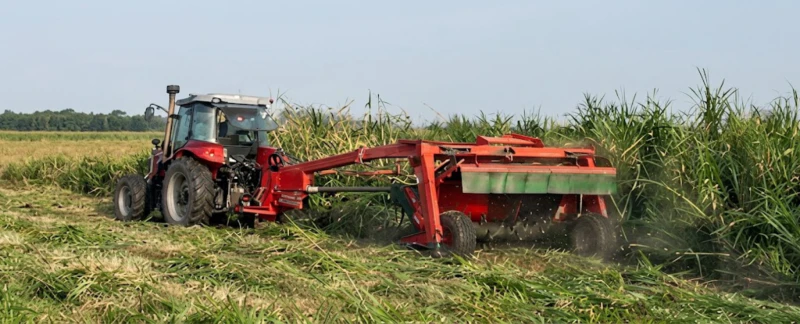
Large-Scale Commercial Alfalfa Production
Alfalfa is cut four to six times per season in high-production regions, with each cut needing to reach baling moisture (typically 18% or below for net-wrapped round bales) as quickly as possible to preserve the leaf fraction that carries 70–80% of the crop’s crude protein value. The 9GQY-3.2’s aggressive flail/tine conditioning is particularly effective on alfalfa stems, which have a thick, waxy cuticle that resists simple crushing but responds well to the combined impact-and-abrasion action of flail elements followed by tine raking. Wide swath width maximises solar exposure on the first cut of the day when solar intensity is highest. The 3.2m cutting width completes large alfalfa acreages within the one-to-two-day cutting window that most multi-cut alfalfa management systems target.
Dairy Farm and Livestock Operation Forage Supply
Dairy and livestock operations managing their own forage land need to cut and bale high-quality hay within narrow weather windows while simultaneously managing other farm activities. The 9GQY-3.2’s single-operator, high-coverage design allows forage cutting to be completed quickly by one skilled tractor operator, leaving the rest of the farm workforce available for other operations during the same period. Faster dry-down from conditioning reduces the dependence on extended good-weather periods that unconditioned mowing requires, lowering the risk that a weather change between cutting and baling degrades the hay quality that determines animal performance and milk yield. Swath width set to match the operation’s round baler pickup width eliminates the need for a separate tedding or windrowing pass before baling.
Commercial Hay Contractor Services
Custom hay cutting contractors billing per hectare need maximum daily coverage to maintain profitability. The 9GQY-3.2’s 3.2m cutting width at 10–15 km/h operating speed represents competitive daily hectarage from a single tractor-implement combination. The integrated conditioning eliminates the need to charge separately for a conditioning pass or tedding pass, simplifying the service offering and reducing the number of separate machine operations clients need to coordinate before baling. The broad 540–1000 r/min PTO compatibility allows the machine to be matched to the range of tractor models that contractors typically operate without speed adapter complications.
Grassland Management and Multi-Cut Systems
Permanent grassland and mixed sward operations benefit from the 9GQY-3.2’s ≥50mm stubble height preservation, which maintains the grass sward’s ability to regrow quickly after cutting — a critical factor in multi-cut management systems where the interval between cuts determines annual yield. Stubble too low damages the growing point and delays regrowth; too high leaves material that shades regrowth and reduces the next cut’s yield potential. The ≥50mm minimum stubble specification is appropriate for most grass and legume-grass mixed sward management recommendations and supports rapid canopy recovery for maximum annual dry matter production.
6. Related Product: PTO Drive Shaft for Mower Conditioner Operation
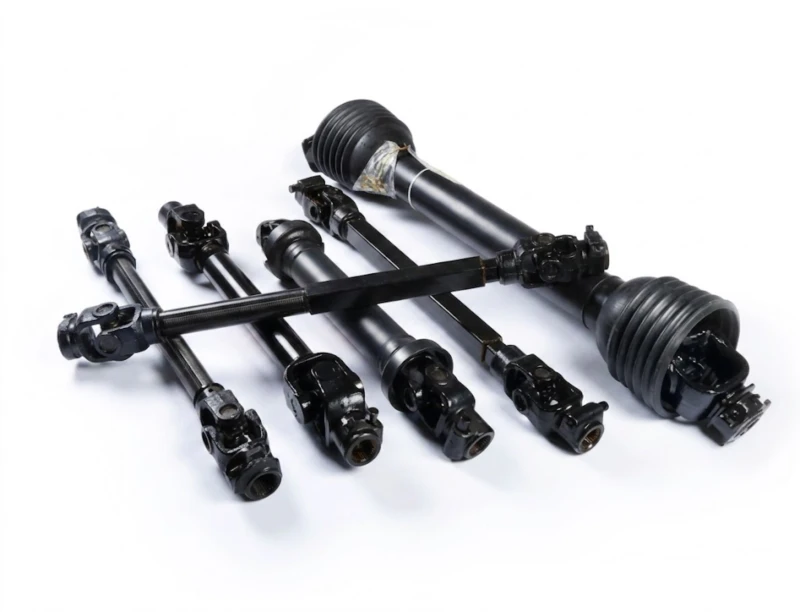
The 9GQY-3.2 draws all mechanical power for its disc cutterbar and conditioning rotor through the PTO driveshaft — at ≥80.88 kW (110 HP) input demand across a 540–1000 r/min range. Mower conditioner operation generates high peak torque events when the cutterbar contacts dense stem clumps, lodged crop, or occasional field debris embedded in the standing material. A correctly rated, dynamically balanced pto shaft matched to both the operating speed range and the power demand is essential for protecting the cutterbar gearbox, the conditioning rotor drive, and the tractor PTO from the damage that undertorqued or imbalanced driveshafts produce at high operating speeds.
Why Shaft Specification Is Critical at 540–1000 r/min and 110 HP
Dual-speed operation requirements: The 9GQY-3.2’s 540–1000 r/min PTO compatibility means the driveshaft must be rated for safe and balanced operation across this full range. A shaft dynamically balanced to ≥2500 r/min test speed ensures smooth transmission at both 540 and 1000 r/min settings, eliminating the vibration at 1000 r/min that an inadequately balanced shaft produces — vibration that accelerates bearing wear at both the tractor PTO output and the mower conditioner input gearbox at a rate that compounds through a season of high-speed operation.
Overload protection for disc cutterbar operation: Disc mower cutterbars encounter rocks, soil heave mounds, and hidden metallic debris in forage fields that generate instantaneous peak torque spikes orders of magnitude above steady-state cutting loads. The shear-bolt or friction clutch overload protection device in the driveshaft must disconnect the drive within milliseconds of impact to prevent gearbox fracture and disc assembly damage. Confirm the overload device is rated and calibrated for the torque range at the operating PTO speed before field use — a device calibrated for 540 r/min may not provide adequate protection at 1000 r/min where kinetic energy is substantially higher.
High-speed guard integrity is non-negotiable: At 1000 r/min, the rotating driveshaft represents a severe contact hazard. The full-length plastic guard must be in perfect condition — no cracks, deformation, or missing sections — before each operating shift. At mower conditioner speeds, clothing contact with an unguarded rotating shaft causes entanglement injuries in milliseconds, far faster than human reaction time allows any protective response. Inspect the guard as the first step of every pre-operation check and replace immediately if any defect is found.
7. Manufacturing Quality and Structural Durability
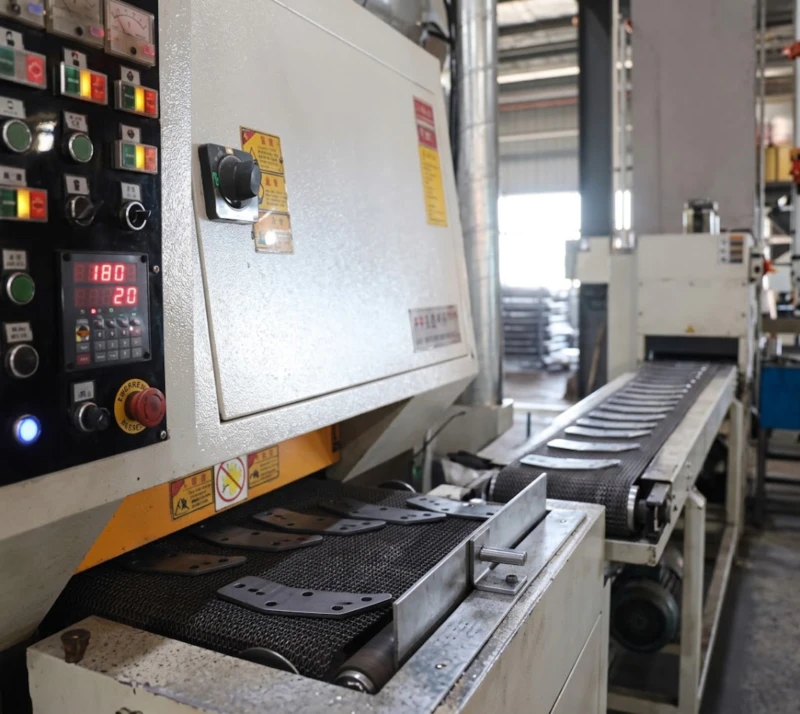
The 9GQY-3.2 operates at consistently high mechanical loads — disc blades rotating at cutting speed, conditioning rotors processing dense stem volumes, and the entire 2185 kg structure absorbing the vibration of high-speed disc cutterbar operation across varied terrain. The structural frame, cutterbar housing, and conditioning rotor are fabricated to dimensional tolerances that maintain alignment through seasons of commercial-intensity use, preventing the progressive misalignment that causes premature disc gearbox wear and conditioning rotor imbalance in less precisely manufactured implements.
8. Frequently Asked Questions (FAQ)
A minimum of 80.88 kW (110 HP) is required for rated-condition operation. For fields with above-average standing crop density, high-moisture conditions, or continuous 1000 r/min PTO operation, a tractor in the 90–110 kW (120–150 HP) range provides additional power reserve that prevents tractor engine lugging during peak load events and maintains working speed on dense crop headland entries. The tractor must also provide at least 540 r/min PTO output with a spline interface matching the driveshaft specification, and have at least one hydraulic remote valve for implement lift control.
Roller conditioners crush stems between two driven rubber or steel rollers, which is effective on large-diameter, hollow-stemmed crops like corn and heavy grasses but less effective on the fine-stemmed, waxy species like alfalfa where cuticle disruption along the full stem length is needed. Flail and tine conditioners deliver impact-plus-abrasion treatment that disrupts the cuticle more thoroughly on fine-stemmed legumes and grasses, generally producing faster dry-down on these crops at the cost of slightly higher leaf loss on very leafy species. The 9GQY-3.2’s flail/tine design is the preferred choice for alfalfa, mixed-grass swards, and fine-stemmed hay crops where cuticle disruption is the primary dry-down constraint.
As a starting point, set swath width approximately equal to your baler’s pickup width. For balers in the 9YG-1.0 class with 1900mm pickup, a 1.8–2.0m swath provides a slight spread that improves dry-down without the baler pickup missing material at the swath edges. For larger balers with 2150–2240mm pickup, a 2.0–2.2m swath maximises dry-down while still fitting cleanly within pickup width. In hot, dry conditions where drying is fast, a wider swath reduces field dry-down time further; in cool, humid conditions where drying is slow, a wider swath becomes even more important for achieving target moisture before weather deteriorates. Adjust the setting between fields as weather conditions and baler type change across your operation.
For most forage crops and standard field conditions, 540 r/min provides adequate disc blade speed and conditioning rotor velocity with better fuel economy and lower tractor drivetrain wear. Increase to 1000 r/min for high-yield dense stands, tough-stemmed mature crops, or when operating at the upper end of the 6–15 km/h working speed range where higher blade speed is needed to maintain clean cutting at faster forward speed. If the tractor has a 1000 r/min PTO setting and adequate power reserve, 1000 r/min typically improves cutting quality in difficult conditions and reduces the risk of disc blade contact with uncut stems at the disc margins during high-speed passes.
Conditioning intensity is adjusted by changing the clearance between the conditioning rotor and the rear shield plate. A smaller clearance increases rotor-to-material contact pressure, increasing conditioning aggressiveness — appropriate for thick-stemmed, waxy crops like established alfalfa or mature brome grass where maximum cuticle disruption is needed. A larger clearance reduces contact pressure, providing gentler conditioning — appropriate for fine-stemmed grasses and young legumes where over-conditioning causes excessive leaf shatter that reduces hay quality and dry matter yield. Refer to the operator manual for the specific clearance settings recommended for common crop types; adjust from the recommended starting point based on the amount of leaf loss observed in the conditioned swath.
Disengage PTO, shut down the tractor, and confirm all rotating components are completely stationary before approaching the cutterbar for any inspection or blade work. Lower the cutterbar fully to the ground. Access each disc blade through the cutterbar’s service access points. Remove the blade bolt, extract the worn blade, and install the replacement blade in the same orientation. Torque the bolt to the specification in the operator manual — under-torqued blades can be ejected at high speed during operation, creating a severe safety hazard. After replacing all blades, check that the blade pivot swings freely and the blade does not contact the disc body at any swing position. Run the machine at low speed in a clear area before returning to field operation.
Daily: inspect all 16 blades for wear, bending, and secure mounting; check PTO shaft guard integrity; clear debris from conditioner housing and swath forming plates. Every 50 hours: lubricate all grease points on disc gearboxes, conditioning rotor bearings, and PTO shaft joints; check cutterbar oil level (most disc cutterbars use an oil bath lubrication system that requires periodic top-up). Every 200 hours: inspect disc gearbox oil for contamination indicating bearing wear; check conditioning flail and tine wear and replace any that are worn below minimum dimension; inspect swath forming plate adjustment mechanism. At season end: drain and refill disc gearbox oil; apply corrosion protection to all exposed metal surfaces; store in a covered, dry location.
The side-pull trailed configuration has three advantages over front-mounted disc mowers for large commercial operations: the implement travels behind the tractor in straight, continuous passes without the tractor chassis obscuring the operator’s view of the cutterbar-to-standing-crop junction; the side offset allows the tractor wheels to travel in previously cut areas on all passes after the first, preventing wheel damage to standing crop; and the larger structural weight (2185 kg versus typical front-mounted machine weights of 1000–1500 kg) provides greater stability at high working speeds and handles the gyroscopic forces of the disc cutterbar more safely than lighter front-mounted alternatives. For operations, contact our technical team for site-specific configuration recommendations.
Cut, Condition, and Swath in One Pass — The Foundation of Premium Hay Quality
The 9GQY-3.2 Mower Conditioner delivers 3.2m wide-cut coverage, integrated flail/tine conditioning, and 0.8–2.2m adjustable swath width from a single-operator side-pull implement — reducing field dry-down time by up to 50% and enabling premium hay quality across diverse forage crops. Request your quote today.