Forage Quality Guide
Raking losses of 8–15% on alfalfa are not an equipment problem or a weather problem. They are a timing problem, a speed problem, and a setup problem — all of which are correctable with the right knowledge applied before the rake starts moving.
The raking operation takes less than two hours per hectare. The leaf loss it causes — or prevents — determines the crude protein content of every bale produced that season. No other two-hour operation in the hay production calendar has a larger impact on the final product’s market value.
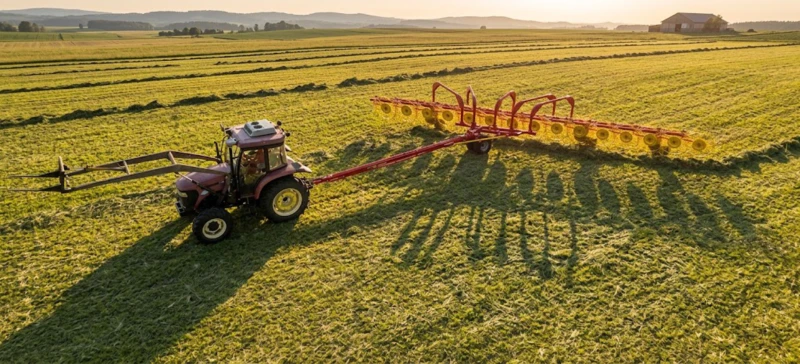
Most hay producers know that raking causes some leaf loss. Far fewer know how much raking causes, because the leaves that shatter during raking are scattered in the field as fine particles that are invisible from the tractor cab — they do not accumulate in a visible pile that reveals the scale of the loss. The standard commercial measurement protocol — cutting and weighing test plots before and after raking — is too labour-intensive for most farms, and so the actual leaf loss during raking goes unmeasured and therefore unmanaged. The 8–12% total leaf loss that is common on commercial alfalfa raked at sub-optimal conditions is not recognised as a problem because the farmers who experience it do not have a reference point showing what 2–3% leaf loss looks like and what the price difference between those two outcomes represents.
The reference point is significant. At USD 200 per tonne premium alfalfa and 14 tonnes dry matter per hectare yield, a 10 percentage point reduction in raking leaf loss (from 12% to 2%) represents USD 280 per hectare of retained product value — USD 140,000 per season on a 500 ha alfalfa operation — from a management change that costs nothing except the discipline to check moisture before raking begins. That number, applied to real operations, explains why the largest and most commercially successful alfalfa producers in Inner Mongolia, Australia, and Central Asia are uniformly disciplined about raking moisture timing while smaller operations treat raking as an equipment operation rather than a quality management operation.
This guide covers the five controllable causes of raking leaf loss on alfalfa and legume crops, the correct moisture window, speed settings, rake type selection, and equipment setup that reduce losses below 3% — and the downstream effect that lower raking loss has on bale density consistency and pickup performance. For the forage harvesting equipment referenced throughout, see our complete range of raking and hay harvesting equipment.
1. Why Alfalfa Leaves Shatter During Raking — The Mechanism Behind the Loss
The Petiole Joint: Where Loss Originates
An alfalfa leaf is attached to its stem by a petiole — a narrow stalk approximately 3–8mm long that connects the trifoliate leaf to the main stem at a node. This petiole joint has dramatically different mechanical properties at different moisture levels. At 45% moisture, the petiole is highly flexible — it can bend through 90° and return without fracturing, absorbing the impact of a rake tine with no leaf detachment. At 30% moisture, the petiole retains most of its flexibility but begins to show stress fracture under repeated high-speed tine contact. At 20% moisture, the petiole becomes brittle enough that virtually any mechanical contact — a tine tip, the leading edge of an adjacent stem, the force of air displaced by a tine moving at 3+ m/s — can cause fracture and immediate leaf detachment. Below 15% moisture, even the gentle disturbance of swath movement by wind after raking causes additional leaf shatter from the already-fractured petioles.
Once the petiole fractures, the detached leaf immediately becomes a flight-risk particle. Alfalfa leaves are aerodynamically light — a single trifoliate leaf weighs less than 0.5g — and are carried by air currents generated by the rake’s tine movement at any speed above idle walking pace. The detached leaves scatter across the field surface in a zone 0.5–2.0m wide on both sides of the rake’s path, invisible at normal viewing distance but collectively representing 3–12 percentage points of the swath’s total dry matter depending on the severity of the loss.
The Moisture-Loss Relationship Quantified
Research measurements on alfalfa raking leaf loss at different moisture levels — using replicated plot comparisons between raked and unraked material at identical moisture levels — consistently show the following relationship. Above 45% moisture, raking loss is below 1% — the petiole is too flexible to fracture under any normal tine speed. At 35–45% moisture (the optimal raking window), loss is 1.5–3% — petioles absorb most tine impact without fracturing, and the small proportion that do fracture are in a zone of the swath that has already dried faster than the interior. At 25–35% moisture, loss rises to 4–7% — petioles are beginning to lose flexibility and a significant fraction fracture on first tine contact. Below 25% moisture, loss rises to 8–15% or higher, with each percentage point of moisture reduction below 25% generating an additional 0.3–0.8% of leaf loss. At 12% moisture — optimal baling moisture but far below optimal raking moisture — raking produces 15–25% leaf loss, making raking at this moisture level commercially indefensible on premium alfalfa.
2. The Five Controllable Causes of Raking Loss — and How to Address Each
Raking Below the Optimal Moisture Window
Why it happens: Most raking schedules are set by clock rather than by moisture meter. Operators rake at a fixed time after mowing — typically 18–24 hours after cutting on a standard drying schedule — without checking whether the crop has actually reached the optimal raking moisture window or has dried through it into the brittle zone below 25%. In warm, dry conditions, alfalfa can drop from 45% to 20% moisture in 12–14 hours rather than the 18–24 hours that drying schedule assumptions are built around. On these days, raking at 18 hours is raking at 18% moisture — well below the optimal window.
Solution: Replace calendar-based raking schedules with moisture-measurement-triggered raking. Use a forage moisture meter — a handheld electronic meter or the more accessible squeeze/press test on a handful of swath material — to confirm moisture is in the 35–45% range before beginning the raking pass. In dry, hot conditions, check at 12 hours after cutting as well as at 18 hours, and begin raking as soon as the meter reads 40% or below — do not wait for a scheduled time that may allow the crop to dry through the optimal window.
Field test without a meter: Grab a handful of material from the swath interior (not the surface, which dries faster). Roll a stem between thumb and forefinger — at 35–45% moisture, it bends without snapping and feels cool and slightly moist. At 25%, it bends but cracks if bent sharply. Below 20%, it snaps cleanly. If stems are snapping, raking has been delayed past the optimal window.
Raking Speed Above 8 km/h on Legume Crops
Why it happens: Raking speed directly determines tine tip speed on finger-wheel rakes (which are ground-driven) and material throughput rate on rotary rakes. On finger-wheel rakes at 10 km/h, tine tip speed reaches 4–5 m/s — above the threshold where even correctly moistened alfalfa petioles experience significant fracture rates from the kinetic impact energy of tine contact. Operators who run at maximum speed to minimise raking time are accepting a 40–60% increase in leaf loss rate relative to the same rake at optimal speed, typically without realising this trade-off exists.
Solution: Limit raking speed to 6–8 km/h on alfalfa and mixed legume swards, regardless of the rake’s rated maximum working speed. The 2–3 km/h speed reduction from the maximum rate increases raking time per hectare by 20–35 minutes — a modest time investment that typically reduces leaf loss by 2–4 percentage points on crops raked at the correct moisture. Calculate the value of the additional leaf retention (protein content improvement × tonnes per hectare × market price) against the cost of the additional raking time — at commercial hay values, the retained leaf value almost always exceeds the cost of the slower raking time.
Exception: Natural grassland hay with a low legume proportion is less sensitive to raking speed — grass leaves are more flexible than alfalfa petioles at equivalent moisture. Speed limitation is most important for pure alfalfa, alfalfa-dominant mixes (above 40% legume), and red or white clover-dominant swards.
Using a Rotary Rake Instead of a Finger-Wheel Rake on Alfalfa
Why it happens: Rotary rakes are more common in natural grassland operations and are sometimes adopted for alfalfa without recognising the leaf loss penalty their higher tine energy imposes on fine-stemmed legume crops. A rotary rake at standard PTO speed produces tine tip speeds of 8–12 m/s — two to three times the tine tip speed of a finger-wheel rake at optimal working speed. The kinetic energy at contact is proportional to the square of tip speed, meaning the rotary rake delivers 4–9 times the impact energy per tine contact that a finger-wheel rake at 6–8 km/h produces. On alfalfa at 35–45% moisture, this additional impact energy increases leaf loss from 2–3% (finger-wheel) to 5–8% (rotary), even when all other raking variables are correctly controlled.
Solution: Use a finger-wheel rake for alfalfa and legume-dominant swards. Reduce rotary rake PTO speed by 30–40% if a rotary is the only available implement — reducing from 540 r/min to 380–400 r/min input speed decreases tine tip speed proportionally and brings leaf loss rates closer to finger-wheel performance, at the cost of reduced throughput. For operations where the rotary rake is used primarily for natural grassland hay and alfalfa is a smaller secondary crop, the reduced-speed rotary is a practical compromise. For operations where alfalfa generates the majority of revenue, purpose-specifying a finger-wheel rake for alfalfa raking is the commercially justified choice.
Leaf loss comparison by rake type on alfalfa at 38% moisture: Finger-wheel at 7 km/h: 1.8–2.5% loss. Rotary at reduced PTO (380 r/min): 3.5–5% loss. Rotary at full PTO (540 r/min): 5.5–8% loss. These ranges are representative of field measurements across multiple seasons — actual values depend on alfalfa variety, maturity at raking, and field conditions.
Raking Tines Set Too Close to the Soil Surface
Why it happens: Operators attempting to maximise collection rate set rake tines as close to the ground as possible to pick up any material that has settled below the normal swath height. Below a certain tine height, however, tines begin to contact the soil surface, picking up soil particles, small stones, and root crowns that contaminate the windrow and damage the tines. More importantly for leaf loss: when tines contact the soil surface, they disturb the bottom layer of the swath with high impact — flicking material upward aggressively rather than lifting it gently. This high-impact disturbance of the bottom layer — which is typically the driest, most brittle layer in the swath because it has dried from below as well as above — shatters leaves from the lower swath fractions that would have been collected without contact at a slightly higher tine height.
Solution: Set tine height so that tine tips clear the soil surface by 10–20mm in normal field conditions. On soft, post-irrigation fields, increase this clearance to 20–30mm to avoid soil disturbance that introduces contamination alongside the increased leaf loss risk. The material left below the tine clearance height — stems that have lodged flat against the soil surface — is typically a small fraction (1–2% of total dry matter) that does not justify the additional leaf loss from aggressive tine contact. Adjust tine height from the centre outward across the rake’s width to account for any frame twist or crown in the field surface.
Soil contamination signal: If raked windrows show grey-brown discolouration at the windrow base when the windrow is opened, tines are contacting or very close to the soil surface. Soil ash content above 2% of bale dry matter will cause rejection by most export buyers with ash content specifications. Check tine height setting immediately if soil discolouration appears in windrows.
Multiple Raking Passes on the Same Material
Why it happens: Operations that rake twice — once to turn and aerate the swath for faster drying, and a second time to consolidate it into a baler-ready windrow — subject the material to twice the mechanical contact, and the second pass occurs when the material has dried further than during the first pass, often into the more brittle moisture range where leaf fracture rates are higher. Each raking pass generates its own leaf loss fraction, and the combined loss from two passes is not simply additive — the second pass on drier material generates disproportionately higher loss than the first pass at higher moisture, because the petioles that survived the first pass at 45% moisture may fracture at 30% moisture on the second pass.
Solution: Design the mowing and raking system to eliminate the need for a second raking pass. A mower conditioner set to a wide swath (1.8–2.2m) combined with effective conditioning that accelerates drying eliminates the aeration-raking pass that wide swaths achieve through natural exposure. A rake with sufficient working width to consolidate the mower’s full swath width in a single pass eliminates the width-reduction pass that insufficient rake width requires. The 9LZY-9.0 at 9m working width and the 9LH-12 at 12m both provide the coverage needed to consolidate typical commercial mowing systems in a single raking pass, eliminating the double-pass leaf loss compounding that narrower or less capable rakes require.
Double-pass leaf loss estimate: A correctly executed first raking pass at 40% moisture with a finger-wheel rake at 7 km/h produces 2–3% leaf loss. A second pass on the same material at 25% moisture produces an additional 5–8% leaf loss — for a combined loss of 7–11% from the two-pass approach versus 2–3% from a well-designed single-pass system.
3. The Downstream Effect: How Raking Loss Reduction Improves Bale Quality
Leaf Fraction and Crude Protein Content
The alfalfa leaf fraction — what is retained or lost during raking — constitutes 40–50% of the plant’s total dry matter but 60–70% of its crude protein content. A bale that has retained its leaf fraction contains proportionally more digestible protein per kilogram of dry matter than a bale of equivalent stem material from the same crop. Reducing raking leaf loss from 10% to 2% on alfalfa at 20% crude protein as-cut does not simply retain 8% more dry matter — it retains a disproportionately protein-rich 8%, improving the finished bale’s crude protein content by approximately 2–4 percentage points above what the stem-dominant material remaining after high-loss raking would produce.
In market terms, the difference between 18% crude protein and 21% crude protein alfalfa hay in most Asian export markets is USD 30–60 per tonne in price premium — a difference that is substantially generated in the raking operation rather than in the agronomy. Farms that invest in precision variety selection, irrigation management, and cutting timing to maximise crude protein at cutting, then lose 3–4 percentage points of that protein through poor raking practice, are experiencing a quality loss in the field operation that agronomic investment cannot compensate for.
Windrow Quality and Bale Density Consistency
Lower raking loss produces a better windrow for the baler — for reasons that extend beyond the obvious dry matter retention benefit. A windrow with high leaf retention is physically more cohesive: the interlocking leaf material between stems provides the binding structure that makes the windrow hold its cross-section during baler pickup and feed more uniformly into the compression chamber. A windrow depleted of its leaf fraction is more stem-dominant, which means more parallel, less interlocking material that tends to slide through the pickup tines rather than feeding as a cohesive mat. This stem-dominant windrow creates variable feed density to the compression chamber — denser zones where stems align and more dense sections alternate with lighter zones where the parallel stems have created gaps — producing exactly the kind of variable density input that makes bale density inconsistency inevitable regardless of the baler’s density control system.
The connection is therefore direct: raking loss reduction → improved windrow cohesion → more consistent feed to baler pickup → less density variation requiring compensation by the density control system → tighter bale-to-bale density distribution → lower proportion of below-specification bales. The baler’s sensor density control system performs measurably better on windrows with good leaf retention than on leaf-depleted windrows from high-loss raking, because the cohesive windrow presents a more uniform feed rate to the compression chamber and the sensor system’s adjustments are smaller and less frequent.
4. The Raking Loss Reduction Checklist: Operational Protocol for Below-3% Loss
The following protocol, applied consistently, has been demonstrated to achieve raking leaf loss below 3% on alfalfa raked at the correct moisture window. It requires no additional equipment investment beyond a forage moisture meter — the only tool that enables the moisture-triggered raking approach that is the single most impactful loss-reduction measure available.
| Control Point | Target / Action | If Out of Range |
|---|---|---|
| Crop moisture | 35–45% — measured at swath interior, not surface | Above 45%: wait 2–4 hours and recheck. Below 25%: accept elevated loss or skip this cutting’s raking for direct baling on single swaths |
| Raking speed | 6–8 km/h for alfalfa and legume-dominant swards | Reduce to 5–6 km/h if material shows visible leaf scatter behind the rake at 7 km/h |
| Rake type | Finger-wheel preferred on alfalfa. Rotary at 30–40% reduced PTO speed if no alternative | If using rotary, reduce PTO speed to 380 r/min and accept 1–3% additional loss vs finger-wheel |
| Tine height | 10–20mm clearance above soil surface on firm ground | Raise 5mm if windrow base shows soil discolouration. Lower maximum 5mm if 5–10% of stems remain unraked after pass |
| Number of passes | Single raking pass only — system designed for single pass | If second pass unavoidable, complete within 30 minutes of first pass while moisture is still in acceptable range |
| Time of day | Early morning preferred (5am–9am) when dew has rehydrated leaf surface | Avoid midday raking in hot dry conditions — leaf moisture drops fastest between 11am and 2pm. Resume after 4pm when humidity rises |
5. Quantifying Your Raking Loss: A Practical Field Measurement Method
The most common barrier to raking loss management is not knowing how much loss is actually occurring. The following method requires 2 hours of initial setup work and provides a representative measurement of actual raking leaf loss under your conditions — giving you the financial baseline from which to calculate the value of the loss-reduction protocol.
The Sheet Collection Method
Before raking begins, lay four 1m × 1m collection sheets on the field surface at equal intervals across a 100m section of a representative windrow. After the rake completes its pass across these collection points, collect and weigh all material from each sheet — including both the material that would have been collected normally (stem and leaf in the windrow) and the detached leaves that scattered outside the collection sheet area (which requires a 1.5m × 1.5m sheet to capture the 0.25m scatter zone on each side). Weigh both the windrow material collected from the sheet and the scattered leaf material separately.
Raking leaf loss percentage = (weight of scattered leaf material) ÷ (weight of windrow material + weight of scattered material) × 100.
Repeat this measurement at three different locations in the field — headland zone, mid-field zone, and a zone where wind displacement was strongest — to get a representative average. A raking loss below 3% confirms that the protocol is working. A raking loss above 5% identifies that one or more of the five controllable causes is active and should trigger a review of the raking conditions against the checklist in Section 4.
Once you have the baseline measurement, calculate the annual financial value of the loss at your crop production volume and market price. For most commercial alfalfa operations, this calculation produces a number that immediately justifies both the forage moisture meter investment and the time discipline of moisture-triggered raking — the most impactful single change available for raking loss reduction.
Reducing Raking Loss Starts with the Right Equipment System
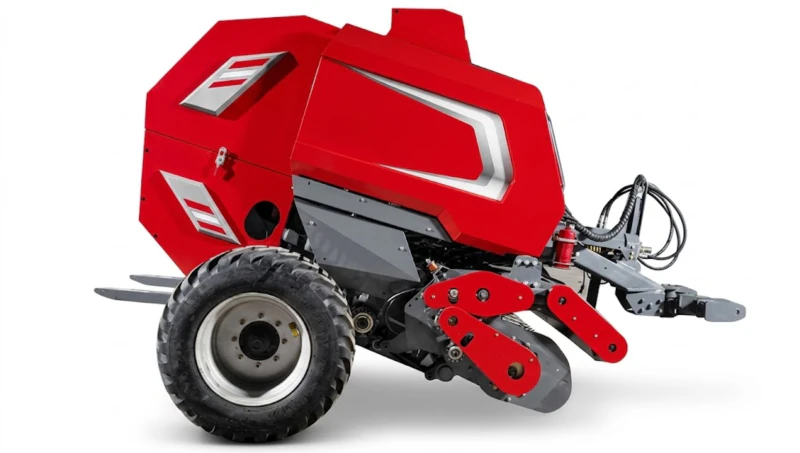
The 9LZY-9.0 finger-wheel rake at 9m working width, combined with the 9YG-1.25 or S9000 round baler at 2240mm pickup, is the system designed to convert low-loss raking into low-field-loss baling. Our team can help you configure the complete harvest chain that delivers below-3% total raking and baling loss on premium alfalfa.