
Equipment Specification Guide
Pickup width is the single specification most commonly mismatched in commercial hay operations — chosen to fit the budget rather than the windrow — and the one whose consequences are least visible because the field loss it causes is scattered rather than concentrated.
Every tonne of crop that a baler’s pickup misses at the windrow edge is a tonne that the farmer paid to grow, mow, condition, and rake — but never collected. Pickup width is where that investment is either recovered or permanently lost.
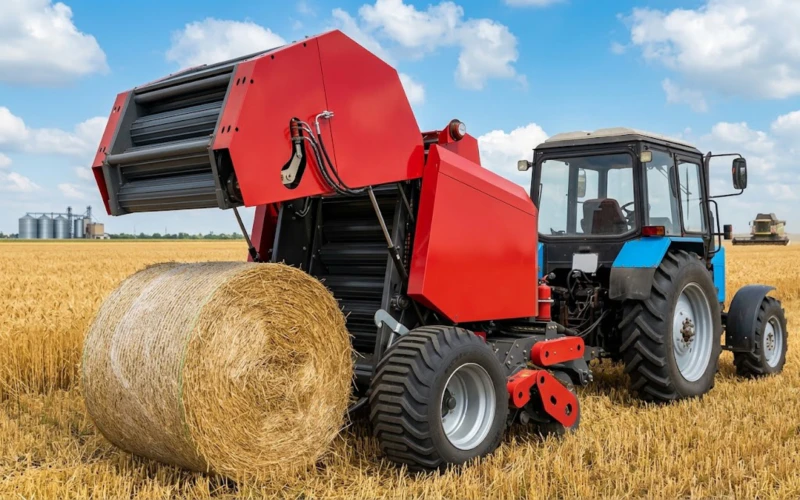
Of all the specifications listed in a round baler’s product description, pickup width generates the least discussion and the most overlooked field losses. Buyers compare density ranges, throughput ratings, and sensor system features — and then accept whatever pickup width comes standard on the model they selected without asking whether it matches the windrow width their raking system produces. The mismatch is usually modest — 200–300mm of pickup shortfall relative to the windrow width — but it occurs on every single pass, across every windrow, across every baling day of every season. Across a commercial operation producing 500 ha of alfalfa per year, a consistent 200mm pickup shortfall that leaves material at both windrow edges can represent 3–5% of total dry matter production permanently lost to the field — not collected, not baled, not sold.
The loss is most severe on alfalfa and legume crops because the material that migrates to the windrow edge during raking is disproportionately leaf-rich — the light leaf fraction has lower aerodynamic resistance than stems and travels further during the rake’s lateral throw. The edge material is therefore the highest crude-protein fraction of the windrow, and the pickup that fails to collect it is discarding the most commercially valuable fraction of the crop. On natural grassland hay and straw, where leaf fraction is lower and edge migration is less pronounced, the pickup width matching error is proportionally less severe — but field loss is still real and still cumulative.
This guide explains what pickup width means as a baler specification, how windrow width is determined and why it varies within and between fields, the correct method for matching pickup width to your raking and mowing system, and the cost consequences of both undershoot (pickup too narrow) and overshoot (pickup too wide for the windrow) across different crop and market contexts. For the round balers referenced in this guide, see our full range of commercial round balers with 1900mm and 2240mm pickup options.
1. What Pickup Width Means — and What It Does Not Mean
The Specification Defined
Pickup width is the lateral distance across which the baler’s pickup mechanism can collect and feed material from the ground into the compression chamber. It is measured as the distance between the outermost active tine positions on the pickup rotor — the tines at the extreme left and right edges of the pickup assembly. Material lying within this width is collected; material lying outside it is not.
What pickup width does not mean: it is not the same as the pickup rotor’s physical width (which may be slightly wider or narrower than the effective tine coverage zone), it is not the same as the recommended windrow width (which should be slightly narrower than the pickup to provide edge margins), and it is not a guarantee that all material within the specified width will be collected at any working speed. At the edges of the pickup’s active zone, tine engagement density is lower than at the centre — the spacing between adjacent tine paths is larger at the rotor’s extremities because the tines fan outward from their mounting positions. This edge zone effect means that very light material (fine leaf fractions, short chaff) at the extreme pickup margins may not be fully collected even within the stated width, making the 85–90% windrow-to-pickup width ratio important as an operational guideline rather than a precise cutoff.
The Two Standard Commercial Pickup Widths
Commercial round balers are available in two primary pickup width configurations for most models: 1900mm and 2240mm. The 1900mm pickup is the standard configuration for smaller balers and suits windrows produced by narrower mower conditioners or by rake systems set to produce 1.5–1.7m windrows. The 2240mm pickup is the commercial standard for balers matched to 3.2m disc mower conditioners producing 1.8–2.0m swath widths — the most common commercial configuration in irrigated alfalfa and grass hay production. A third option, the 2400mm hammer-claw pickup on the 9YG-1.0C, is designed specifically for corn stover collection where standing material width exceeds the standard swath dimensions of windrow-dependent crops.
The practical rule: Your windrow width should be 85–90% of your baler’s pickup width. For a 2240mm pickup, the correct windrow target is 1900–2000mm. For a 1900mm pickup, the correct windrow target is 1615–1710mm. If your windrow exceeds your pickup width, you are losing material at the edges. If your windrow is below 75% of your pickup width, you are underfeeding the chamber and producing inconsistent, light bales.
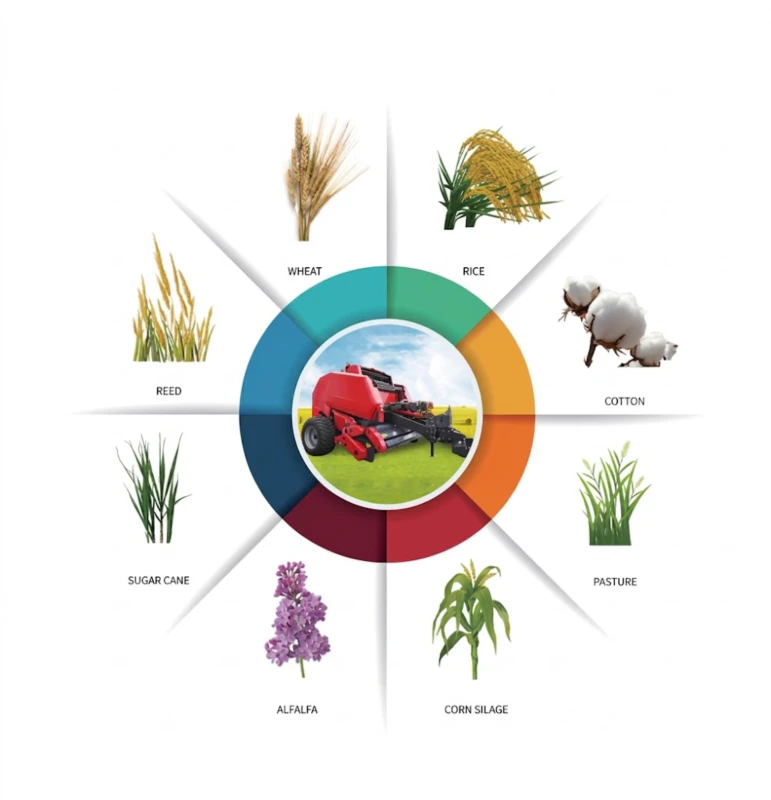
2. How Windrow Width Is Determined — and Why It Varies
The Mower Conditioner’s Swath Width Setting
The starting point for windrow width is the mower conditioner’s swath width setting — the width at which cut material is deposited after passing through the conditioning rolls or flails. A 3.2m mower conditioner can typically be set to deposit its swath at anywhere from 0.8m (narrow, slow-drying swath for humid conditions) to the full 3.2m cutterbar width (wide, fast-drying swath for dry conditions). The typical commercial setting for irrigated alfalfa production is 1.8–2.2m — wide enough to encourage fast field drying while narrow enough to be collected in a single rake pass without the rake covering so wide an area that it drives soil contamination into the edge material.
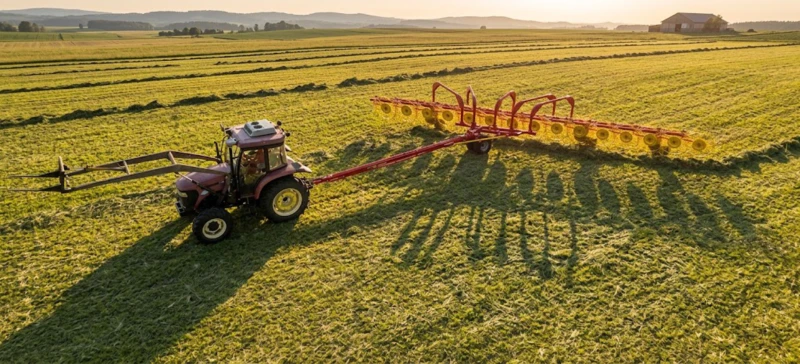
This mower swath width becomes the starting point for the rake, which then either consolidates multiple swaths into a single windrow (if the rake works on multiple swaths per pass) or simply tidies and densifies the individual swath into a windrow-ready form. The final windrow width presented to the baler is a product of both the mower setting and the rake’s consolidation geometry. On operations where the mower is set to wide swaths and the rake operates on a single swath per pass, the windrow width can be 1.8–2.2m. On operations where the rake consolidates two or three swaths per pass, the windrow width is wider — potentially 2.5–3.0m if two 1.4m swaths are combined — and the baler’s pickup must be specified accordingly or two passes will be needed.
Why Windrow Width Varies Across a Field
Even with consistent mower settings and rake operation, windrow width varies across a field for three reasons that the baler’s pickup must accommodate. First, wind — a consistent prevailing wind during and after mowing displaces the lighter material fraction (leaves, fine stems) laterally, widening the swath on the downwind side by 100–300mm. Second, rake turning at headlands — the rake’s deceleration, turn, and re-engagement sequence deposits material less uniformly in headland zones, producing windrows that are 20–30% wider or narrower than mid-field windrows. Third, crop yield variation — sections of the field with higher yield produce denser, wider swaths from the same mower setting; sections with lower yield produce narrower ones. The pickup width margin of 10–15% above the target windrow width accounts for this natural variation without requiring the operator to track windrow width continuously through the baling pass.
How to Measure Your Actual Windrow Width
Do not rely on the mower setting or the rake adjustment indicator to determine your actual windrow width — measure it directly with a tape measure in the field. Take three measurements at different locations in the field: mid-field in a representative crop density zone, at a headland end, and in a zone where wind displacement was observed during mowing or raking. Record the widest measurement as your design width for pickup selection purposes. A windrow that is 1.95m at its widest during a typical production day requires a 2240mm pickup (87% ratio — within the 85–90% target), not a 1900mm pickup (97% ratio — above the maximum and generating consistent edge loss).
3. The Cost of Pickup Width Mismatch: Undershoot and Overshoot
Undershoot: Pickup Too Narrow for the Windrow
A pickup that is narrower than the windrow leaves a strip of uncollected material along both windrow edges with every pass. The width of this uncollected strip is half the difference between windrow width and pickup width on each side — a 2.0m windrow with a 1900mm pickup leaves approximately 50mm of uncollected material on each side. This 50mm strip contains the edge material that is disproportionately leaf-rich on alfalfa crops, and it is lost permanently unless the operator makes a second narrower-windrow pass to collect it — an additional field operation that adds tractor hours and fuel cost to the collection cycle.
The financial consequence of undershoot depends on the proportion of field loss and the value of the material being lost. On alfalfa at USD 200 per tonne, a 4% total dry matter field loss from consistent pickup undershoot on 500 ha producing 14 tonnes per hectare dry matter represents 280 tonnes of lost product worth USD 56,000 per season. This is not a theoretical estimate — it is the consequence of consistently running a 1900mm pickup on 2.0m windrows across a full commercial alfalfa season. The cost of upgrading to a 2240mm pickup, expressed as additional depreciation per season, is a fraction of this figure.
| Scenario | Windrow Width | Pickup Width | Field Loss Estimate |
|---|---|---|---|
| Correct match | 1900mm | 2240mm | ≤2% ✓ |
| Slight undershoot | 2000mm | 1900mm | 3–5% edge loss |
| Significant undershoot | 2200mm | 1900mm | 6–10% edge loss |
| Overshoot (windrow too narrow) | 1400mm | 2240mm | Underfeed — light bales |
Overshoot: Pickup Too Wide for the Windrow
The opposite mismatch — a pickup that is significantly wider than the windrow — generates a different set of problems. When the windrow is substantially narrower than the pickup width (below 70% of pickup width), material enters the compression chamber concentrated in the central section of the pickup width. The outer sections of the pickup sweep clean ground rather than crop, contributing nothing to bale formation while still requiring tractor power and PTO energy to drive the pickup rotor. The bale that forms is not uniformly packed across its axial length — it is denser in the centre zone that receives material and less dense or void in the axial zones that correspond to the pickup’s empty outer sections. This axial density non-uniformity produces bales with a characteristic “dumbbell” cross-section when cut — dense at the ends and soft in the middle — that collapses under stacking pressure from the ends inward.
The correction for overshoot is simple: widen the windrow by adjusting the rake’s consolidation setting or mower swath width to produce a windrow at 85–90% of the baler’s pickup width. Overshoot is a less commercially significant problem than undershoot because it does not generate field loss — no crop is left on the ground — but it does generate bale quality issues that have downstream consequences for storage integrity and buyer acceptance.
4. Pickup Width, Tine Design, and Crop Compatibility
Standard Spring-Tine Pickup: The Right Design for Hay Crops
Standard spring-tine pickup mechanisms — the cam-driven or cam-less ground-following designs used in the 9YG-1.0 and 9YG-1.25 series — are optimised for collecting windrow hay at consistent moisture and height from the ground. The tines are flexible, smooth-surfaced, and move in a path that is calculated to lift material from the ground surface with the minimum possible impact force. On alfalfa and legume crops where leaf retention is critical, the spring-tine’s gentle action at the correct moisture window (12–18% for final baling) produces the lowest possible leaf loss rate. At 1900mm or 2240mm width, the spring-tine pickup covers the full windrow in a single pass with consistent engagement across the full pickup width when the windrow width is correctly set.
Spring-tine pickups require the windrow to be in a consistent, loose, aerated condition to perform correctly — which is why windrow quality from the raking system is so directly connected to pickup performance. A tightly matted windrow from aggressive over-raking, or a windrow with heavy dew from morning condensation, resists the gentle lifting action of spring tines and can cause blockages at the pickup entrance that interrupt the feed to the compression chamber. Correct raking moisture timing and windrow aeration are therefore prerequisites for optimal spring-tine pickup performance, regardless of width.
Heavy-Duty and Hammer-Claw Pickup: The Right Design for Residue
Corn stover and heavy straw residue require a pickup mechanism with substantially more impact energy per tine contact than spring-tine designs can deliver. The 9YG-1.0C’s hammer-claw pickup at 2400mm width uses 20 rigid hammer elements that rotate at high speed and engage standing or lodged stalks through impact rather than lifting — bending or snapping stalks downward and forward into the feed system rather than scooping them upward from a ground-level windrow. The 2400mm width is not chosen arbitrarily — it corresponds to the full residue strip width from two rows of corn at standard 750mm row spacing, allowing complete single-pass collection of the combine’s full residue footprint without a preliminary windrowing operation.
Operating a spring-tine pickup on corn stover produces the blockages and field losses described in the A04 article — losses of 20–35% of available dry matter per pass from material that the spring tines cannot engage. The hammer-claw design at 2400mm is not interchangeable with a spring-tine pickup at the same width for this application — the mechanism difference, not just the width difference, is what makes the 9YG-1.0C viable for stover collection where the 9YG-1.25 is not. Both operate in the same baler chassis with the same compression chamber; it is the pickup assembly design that determines which crop type can be commercially collected.
5. Working Speed, PTO Drive, and Pickup Performance
How Working Speed Affects Pickup Collection Efficiency
A pickup’s collection efficiency — the proportion of material lying within its width that is actually collected and fed to the compression chamber — is not constant across working speeds. At very low speeds (below 4 km/h), the tines have more time to engage each section of the windrow but the reduced inertia of the pickup rotor means tines are moving more slowly and may not lift heavier material (wet hay, densely matted swath) cleanly. At optimal speeds (6–8 km/h for hay, 4–6 km/h for residue), the tine path geometry achieves its designed collection efficiency of 95–98% of material within the pickup width. At high speeds (above 10 km/h on heavy material), tines move faster than the material’s inertia allows it to follow the tine path, causing material to be knocked forward rather than lifted upward — a “flinging” action that deposits material ahead of the baler rather than into the pickup funnel.
The practical implication for pickup width is that at the correct working speed, the stated pickup width delivers its rated collection efficiency and field loss stays within the design specification. Operators who increase working speed beyond the optimal range to improve daily bale count are therefore accepting a reduction in pickup collection efficiency — the effective pickup width narrows as material is flung past the pickup entrance rather than collected. Maintaining the correct working speed for the crop and windrow condition is as important as selecting the correct physical pickup width for achieving low field loss.
PTO Speed Stability and Pickup Drive Performance
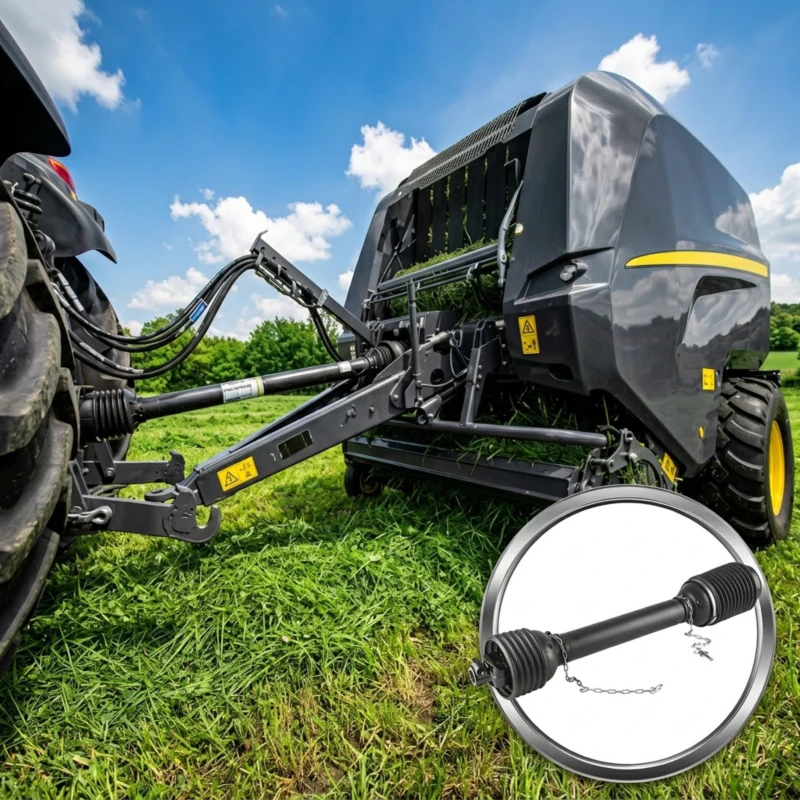
The pickup rotor is PTO-driven at a speed that determines the tine tip velocity and therefore the pickup’s lifting and feeding action. PTO speed variation — from tractor engine load fluctuation, from a worn or imbalanced pto shaft, or from tractor power that is insufficient for the combined PTO and drawbar load of baling — causes the pickup rotor to cycle between above-design and below-design speed. At below-design speed, the tines do not generate sufficient lifting force to collect material against windrow gravity and inertia, and edge material that a correct-speed pickup would collect is left on the ground. At above-design speed (engine over-RPM on descending slopes), material is flung past the pickup entrance rather than fed into the compression chamber.
This PTO speed stability dependency means that pickup width matching is not just a geometry problem — it is a power system problem as well. A 2240mm pickup that is physically correct for the windrow width will still produce edge loss if the PTO speed drops during dense windrow sections, because the reduced tine velocity at the pickup’s outer edges — where tine engagement is least forceful even at correct speed — becomes insufficient to collect edge material when speed drops further. Maintaining a stable PTO speed through a correctly matched tractor and a well-maintained driveshaft is therefore a pickup performance requirement, not just a density control requirement.
6. The Pickup Width Selection Decision: A Practical Guide
The correct pickup width for any commercial operation can be determined by answering four questions in sequence. These questions apply regardless of crop type, baler brand, or market destination — they are the universal decision logic for this specification.
What is your maximum windrow width — measured in the field, not estimated from mower settings?
Measure three windrow cross-sections at different field positions and record the maximum. This is your design width. Any pickup width below 111% of this measurement will generate edge loss on at least some windrows. For confident edge-margin coverage, target 120–125% of your maximum measured windrow width — the pickup width that covers the maximum plus a 10–12% margin.
What is your primary crop — and how sensitive is it to edge loss?
Alfalfa and clover: high sensitivity — 50mm of uncollected edge material on each side of a windrow represents 2–4% additional leaf loss above the pickup’s baseline collection efficiency. Grass hay and mixed sward: moderate sensitivity — edge loss is measurable but less concentrated in high-value fractions. Straw and biomass: low sensitivity — field loss from edge material costs less per tonne than the upgrade to a wider pickup in most biomass market contexts.
Can you adjust your raking system to produce the windrow width your pickup requires?
If your existing rake can be adjusted to produce a consistent windrow width within 85–90% of a 1900mm pickup, a 1900mm pickup may be adequate. If your mower conditioner produces swaths that cannot be consolidated below 1.8m without a second raking pass, the 2240mm pickup is required. The rake adjustment flexibility determines whether the pickup width must match the current windrow or whether the windrow can be adjusted to match a cost-optimised pickup width.
What is the annual field loss cost of the narrower pickup versus the cost difference of the wider one?
At premium alfalfa prices, a 3% additional field loss from a 1900mm pickup on 2.0m windrows at 500 ha/season is worth USD 20,000–40,000 per year in lost production. At grass hay prices, the same loss is worth USD 5,000–12,000 per year. Calculate this against the additional capital cost of the 2240mm pickup, annualised over the baler’s expected service life. In virtually every commercial alfalfa context, the wider pickup is the correct economic decision. In grass hay and straw contexts, the arithmetic is less one-sided and the answer depends on specific market prices and annual production volumes.
Not Sure Whether 1900mm or 2240mm Is Right for Your Operation?
Measure your windrow width and tell us your crop type and annual volume — our technical team can confirm the correct pickup specification for your system and calculate the field loss cost difference between the two options for your specific operation.