
Equipment Investment Analysis
A hydraulic bale transporter is not a convenience purchase. It is a system performance investment that eliminates the field congestion bottleneck that limits your baler’s afternoon productivity — and its payback period is often measured in seasons, not years.
The cost of leaving 200 bales on the field while your baler idles behind them is not the cost of the bale transporter you did not buy. It is the cost of the hay you did not bale during the window when baling conditions were perfect and field access was blocked.
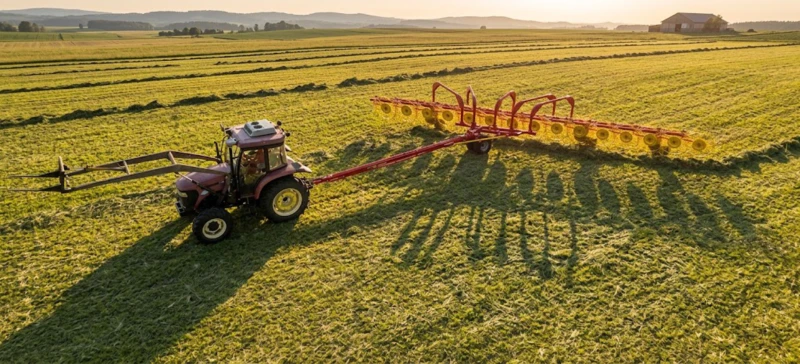
The case for a hydraulic bale transporter is often made in terms of labour saving — one less person needed to follow the baler with a tractor and trailer, fewer trips to move bales from field to storage. This framing is accurate but incomplete. The more significant financial argument for the hydraulic bale transporter is not about labour cost per trip — it is about what happens to baler productivity when there is no transporter keeping up with it. A baler that produces 60 bales per hour for the first four hours of a baling day, then slows to 20–30 effective bales per hour for the remaining six hours because the field is filling with ejected bales that block windrow access, is not a 60-bale-per-hour machine — it is an average of 36–40 bales per hour, and the gap between 60 and 36 represents the return that a correctly sized transporter would have generated.
This field congestion effect — invisible in any analysis that looks only at the transporter’s own operating economics — is the primary financial driver for the hydraulic bale transporter investment in commercial hay operations. It is also the reason that ROI calculations for bale transporters that consider only labour saving consistently underestimate the return, while operations that have used both systems (with and without a dedicated transporter) consistently report that the baler’s daily output increased by 15–25% after the transporter was introduced — not because the baler became faster, but because it stopped spending 30–40% of the afternoon waiting for field clearance.
This guide covers the complete financial case for the hydraulic bale transporter, the calculation framework for your specific operation, and the operational factors that determine whether the transporter investment generates a 2-season or a 5-season payback. For the 9JYY-4.5 hydraulic bale transporter referenced throughout this guide, see our complete range of forage harvesting and bale handling equipment.
1. The Field Congestion Problem: Why Baler Productivity Falls in the Afternoon
How Field Congestion Develops During a Baling Day
A commercial round baler at 60 bales per hour ejects a bale every 60 seconds. In a 10-hour baling day, that is 600 ejected bales lying in the field. If a single tractor with a front-end loader spike and flat-bed trailer is responsible for clearing the field — a typical configuration for operations without a dedicated transporter — it can move 6–10 bales per trip at 15–20 minutes per round-trip cycle to storage. At 8 bales per trip and 18 minutes per cycle, the single-tractor collection system clears approximately 26 bales per hour. Against a baler producing 60 bales per hour, the field accumulates 34 uncollected bales per hour — after 4 hours of baling, there are 136 uncollected bales in the field ahead of the baler.
These accumulated bales sit in the field at positions where they were ejected — which means they sit on the windrow paths that the baler needs to travel to continue collecting. As the afternoon progresses, the baler must increasingly steer around ejected bales to follow the windrow, creating S-shaped travel paths that reduce working speed, cause the baler to leave material at windrow curves uncollected, and require the baler to occasionally stop and reverse to align with the next windrow section. By mid-afternoon on a high-output baling day without dedicated field clearance, an experienced operator estimates they lose 20–35% of potential baling time to bale-navigation delays alone — time that a dedicated transporter would have converted into additional bale production.
The Afternoon Productivity Collapse in Numbers
The following illustrates a typical 10-hour baling day on a 200 ha alfalfa operation, comparing operations with and without a dedicated hydraulic bale transporter:
| Time Period | Without Transporter | With 9JYY-4.5 Transporter |
|---|---|---|
| Morning (hours 1–4) | 55–60 bales/h (field clear) | 55–60 bales/h ✓ (field clear) |
| Midday (hours 5–7) | 35–45 bales/h (congestion building) | 55–60 bales/h ✓ (cleared continuously) |
| Afternoon (hours 8–10) | 20–30 bales/h (severe congestion) | 55–60 bales/h ✓ (field clear) |
| 10-hour daily total | ~380–420 bales | 550–600 bales ✓ |
The difference — 150–200 additional bales per day from the same baler and operator — is the primary financial return on the transporter investment. At 300 kg per bale and USD 150 per tonne hay value, 175 additional bales represent USD 7,875 per baling day in additional revenue. An operation with 25 productive baling days per season generates USD 196,875 in additional seasonal revenue from the field congestion elimination alone — a figure that dwarfs any reasonable transporter purchase cost.
2. The 9JYY-4.5 Hydraulic Bale Transporter: How It Solves the Congestion Problem
The Mechanism: Hydraulic Pickup, Tandem Axle, One Operator
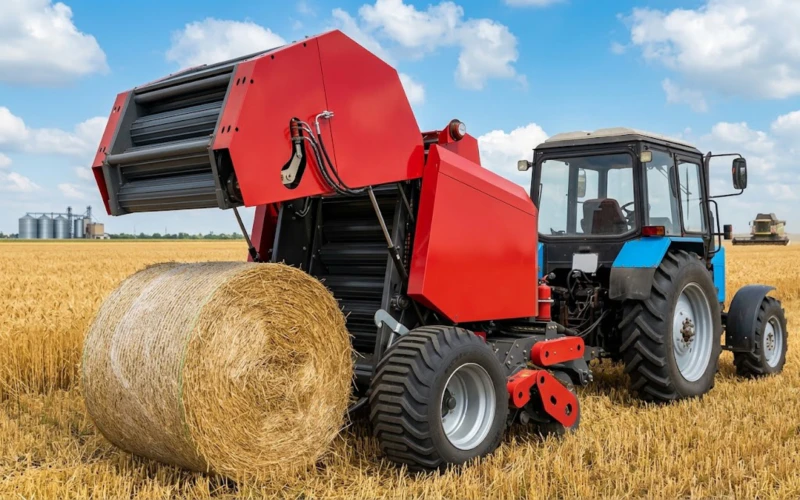
The 9JYY-4.5 is a trailed hydraulic bale transporter with a 4,500 kg payload capacity — approximately 13–15 standard round bales at 300–350 kg per bale. A hydraulic picking arm extends from the rear of the transport frame, reaches behind the bale on the field, and lifts it onto the transport bed in one continuous hydraulic sequence controlled from the tractor cab. No manual intervention is required — the operator aligns the tractor to position the picking arm beside the bale, activates the hydraulic circuit, and the bale is loaded while the tractor remains stationary. Each pickup cycle takes 20–40 seconds depending on the bale’s position relative to the arm, after which the tractor advances to the next bale.
The tandem axle configuration distributes the 4,500 kg maximum load across two axle positions — reducing peak ground pressure on each axle compared to a single-axle trailer of equivalent capacity. This is operationally important on irrigated alfalfa fields where field passes after irrigation can create soft soil conditions that a heavily loaded single-axle trailer would rut but the tandem axle distributes across a wider contact area. The permitted transport speed of up to 40 km/h allows the transporter to complete multiple field-to-storage round trips per hour at typical field-to-storage distances of 500–1500m, generating the clearance rate needed to stay ahead of a 60-bale-per-hour commercial baler.
The Clearance Rate Calculation
The transporter’s bale clearance rate must match or exceed the baler’s production rate to keep the field clear. At 14 bales per load and a round-trip cycle of 15 minutes (5 minutes picking 14 bales at 20 seconds each + 5 minutes transit each way at 1.5 km round trip at 18 km/h average speed), the 9JYY-4.5 clears 56 bales per hour — approximately matching a baler producing 55–60 bales per hour under good conditions. For balers operating at the upper end of their throughput range on ideal windrows, or for longer field-to-storage distances that extend the transport time per trip, two transporters operating alternately provide the clearance capacity to stay ahead of peak baler output.
The clearance rate calculation for any operation requires three inputs: the baler’s realistic daily bale count (not the rated throughput, but the actual count from recent baling days), the number of hours when bale accumulation would otherwise cause field congestion (typically the afternoon hours of a full baling day), and the field-to-storage distance. These three inputs determine whether one transporter is sufficient or whether two are needed, and whether the investment generates its return through baler productivity improvement, labour saving, or both.
3. The Complete ROI Calculation Framework
The hydraulic bale transporter ROI has three distinct revenue streams that should be calculated separately and then summed. Most operations that calculate only one of these streams underestimate the total return and conclude the investment period is longer than it actually is. All three are real and quantifiable from your own operation’s data.
Revenue Stream 1: Additional Bales from Eliminated Field Congestion
Calculate the difference between your baler’s morning throughput rate (when the field is clear) and your afternoon throughput rate (when bales are accumulating). For most operations, this difference is 25–40% of the morning rate — meaning the baler operates at 60–75% efficiency in the afternoon due to field congestion. The additional bales that a dedicated transporter would have enabled — by maintaining field clearance throughout the afternoon — are calculated as: (morning throughput rate − afternoon actual rate) × afternoon operating hours × annual baling days × revenue per bale.
For a representative commercial operation: morning rate 60 bales/h, afternoon actual rate 38 bales/h (37% reduction), 6 afternoon hours per day, 25 baling days per season. Additional bales per season = (60 − 38) × 6 × 25 = 3,300 bales. At 300 kg and USD 150/tonne, each bale is worth USD 45. Additional seasonal revenue = 3,300 × USD 45 = USD 148,500 per season.
Revenue Stream 2: Labour Cost Saving
A dedicated hydraulic bale transporter operated by a single person replaces the two-person system of baler operator plus separate tractor-and-trailer operator that most operations use for field clearance without a specialised transporter. The labour saving is one operator-day per baling day. At a daily labour rate of USD 120–200 including on-costs, across 25 baling days per season, this represents USD 3,000–5,000 per season in direct labour cost saving. This is a smaller figure than the field congestion productivity gain but adds directly to the total ROI. On operations where labour availability is a genuine constraint rather than just a cost line item, the labour saving has additional strategic value: it allows the second person to be deployed on other harvest chain tasks (mowing, raking) during the baling day rather than being committed to the field clearance role.
Revenue Stream 3: Reduced Bale Damage from Improved Handling
Bales moved with a front-end loader spike are subjected to puncture loading at the spike entry point — a force that deforms the bale’s internal structure at the contact zone and can tear the net wrap at the spike penetration point, creating a pathway for moisture entry during outdoor storage. The hydraulic bale transporter’s arm picks bales from the side without spike penetration, maintaining the bale’s structural integrity and net wrap coverage. On operations selling premium alfalfa at export prices where individual bale integrity affects container loading performance and destination inspection grade, the reduced bale damage from transporter handling versus spike handling has a measurable per-bale quality value that can be estimated from the rate of net wrap punctures per handling event and the price consequence of a punctured bale versus an intact one over a 90-day outdoor storage period.
Total ROI summary for the representative operation:
- Field congestion productivity gain: USD 148,500 per season
- Labour cost saving: USD 4,000 per season
- Reduced bale damage (conservative estimate): USD 2,500 per season
- Total annual return: USD 155,000 per season
- Investment cost (9JYY-4.5): approximately USD 45,000–65,000
- Payback period: 0.3–0.4 seasons
4. When the ROI Is Lower — and When a Transporter May Not Be Justified
The USD 155,000 annual return calculated above applies to a large commercial operation with 25 baling days per season, a baler producing 60 bales per hour, and a 37% afternoon throughput reduction from field congestion. Each of these assumptions scales the return up or down proportionally. Understanding when the calculation produces a shorter payback and when it extends beyond what the investment justifies prevents both over-investment (buying a transporter that generates minimal return) and under-investment (rejecting a transporter because the analysis used only the labour saving rather than the productivity gain).
Factors That Reduce the Transporter’s ROI
Low annual baling day count (below 10 days per season)
At 10 baling days instead of 25, the field congestion productivity gain from the example drops from USD 148,500 to USD 59,400. The payback period extends from 0.4 to 1.0 seasons. Still financially justified at reasonable bale prices, but the arithmetic is less compelling.
Low hay value (below USD 80 per tonne)
At USD 80 per tonne grass hay instead of USD 150 per tonne premium alfalfa, the additional bale value drops to USD 24 per bale versus USD 45. The total productivity gain drops proportionally. At very low hay prices (biomass straw at USD 50 per tonne), the productivity gain alone may not justify the transporter investment and the labour saving becomes the primary financial argument.
Field-to-storage distance above 3 km
At 3 km round-trip distance, the 9JYY-4.5’s cycle time increases to 20–25 minutes per trip, reducing clearance rate to 34–42 bales per hour — below the production rate of a full-output commercial baler. At this distance, two transporters operating alternately are needed to maintain field clearance, doubling the transporter capital cost while the productivity gain from each unit is halved. At distances above 5 km round trip, intermediate staging points are more cost-effective than increasing the transporter fleet size.
Low baler throughput (below 30 bales per hour)
At 30 bales per hour baler production, the field accumulation rate is low enough that a standard tractor-and-trailer collection system can keep up without congestion developing for most of a 10-hour day. The field congestion effect that makes the transporter ROI compelling at 60 bales per hour is much smaller at 30 bales per hour, and the investment may only be justified on the labour saving alone. Below 20 bales per hour, the transporter ROI from productivity gain is minimal.
5. The Hydraulic System: Tractor Requirements and PTO Considerations
What the 9JYY-4.5 Needs from the Transport Tractor
The 9JYY-4.5 hydraulic bale transporter requires a tractor with two double-acting remote hydraulic valves — one for the picking arm extension and lift sequence, and one for the unloading mechanism that tilts the transport bed to roll bales off at the storage site. System pressure of minimum 16 MPa at both circuits is required for the arm to generate the lift force needed to pick bales at maximum payload weight. No PTO drive is required — the transporter’s hydraulic functions are powered entirely through the tractor’s remote valve circuits, drawing hydraulic flow from the tractor’s system without a PTO shaft connection. This eliminates the PTO shaft specification, maintenance, and safety considerations that apply to PTO-driven implements, making the transporter simpler to integrate into an existing tractor fleet that may already be committed on PTO drive requirements for the baler and mower conditioner.
The tractor’s minimum hydraulic flow requirement at the remote valves with the engine at working RPM is 25–30 litres per minute at 16 MPa — a specification met by most tractors in the 40–80 kW range that would typically be used for this transport role. Confirm the available hydraulic flow from your transport tractor’s remote valve circuit before specifying the transporter — a tractor with marginal hydraulic flow will experience slow arm cycles that increase the per-bale pickup time and reduce the hourly clearance rate below the theoretical maximum.
Integrating the Transporter with Your PTO-Driven Equipment
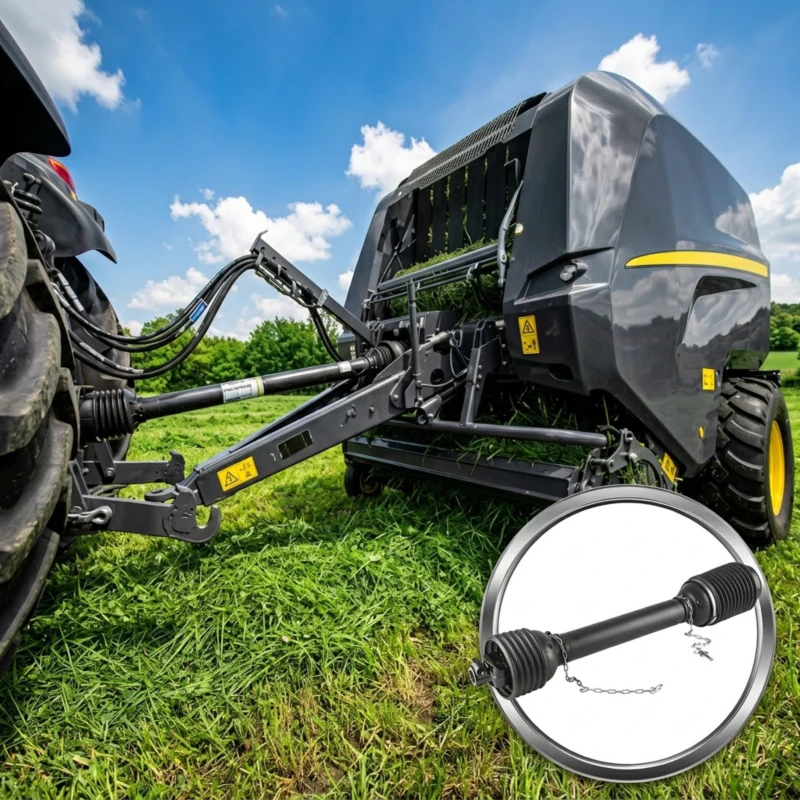
Because the transporter requires no PTO drive, the transport tractor can be a smaller, lower-power unit than the baling tractor — releasing the farm’s highest-power tractor for exclusive use on the baler while the transporter operates on an available smaller tractor. This equipment allocation strategy — large tractor on baler, smaller tractor on transporter — is the most efficient use of the existing tractor fleet and eliminates the need to purchase an additional high-power tractor to support the transporter role. The baling tractor’s PTO shaft, which must be rated for the baler’s full torque range and correctly maintained for sensor density system performance, is not relevant to the transporter operation. For PTO shaft selection and maintenance guidance for the baling tractor, refer to our B03 article on PTO shaft specification — the pto shaft connecting the baling tractor to the round baler remains the critical mechanical reliability point in the baling system even when the transporter is a separate, non-PTO unit.
6. Calculating the ROI for Your Operation: A Step-by-Step Template
Use the following template to calculate your specific operation’s expected return from the hydraulic bale transporter investment. The template requires data that most operations can supply from records of recent baling seasons.
Step 1: Establish your baler’s morning and afternoon throughput rates
Count bales produced in each hour of your last three full baling days, noting the time of each count. Average the first-four-hour rate (morning) and the last-four-hour rate (afternoon) separately. Record: Morning rate = _______ bales/h. Afternoon rate = _______ bales/h.
Step 2: Calculate the afternoon productivity deficit
Deficit per hour = Morning rate − Afternoon rate = _______ bales/h. Afternoon hours per day (typically 4–6 hours) = _______. Daily productivity deficit = Deficit/h × Afternoon hours = _______ bales/day.
Step 3: Calculate the annual productivity gain value
Annual additional bales = Daily productivity deficit × Annual baling days = _______ bales. Annual revenue gain = Annual additional bales × Bale weight (kg) ÷ 1000 × Hay price (USD/t) = USD _______.
Step 4: Add labour saving
Labour saving = Daily operator cost × Annual baling days (if transporter eliminates one daily operator role) = USD _______.
Step 5: Calculate payback period
Total annual return = Revenue gain + Labour saving = USD _______. Payback period = Transporter purchase price ÷ Total annual return = _______ seasons. If payback period is below 3 seasons, the investment is financially sound at typical commercial hay values. Below 1 season is exceptional and indicates significant field congestion was limiting your baler’s actual daily output.
Ready to Eliminate Field Congestion and Recover Your Baler’s Afternoon Productivity?
Our technical team can help you run the ROI calculation for your specific operation — morning and afternoon throughput rates, field-to-storage distance, annual baling days, and hay value — and confirm whether one or two 9JYY-4.5 transporters are needed to match your baler’s output rate.