Forage Equipment Guide
From pickup width and chamber design to sensor-controlled density and PTO shaft matching — the five decisions that determine whether your alfalfa bales meet export grade or fall short.
The wrong baler does not just reduce output — it quietly destroys the crop’s protein value, bale by bale, across every season you run it.
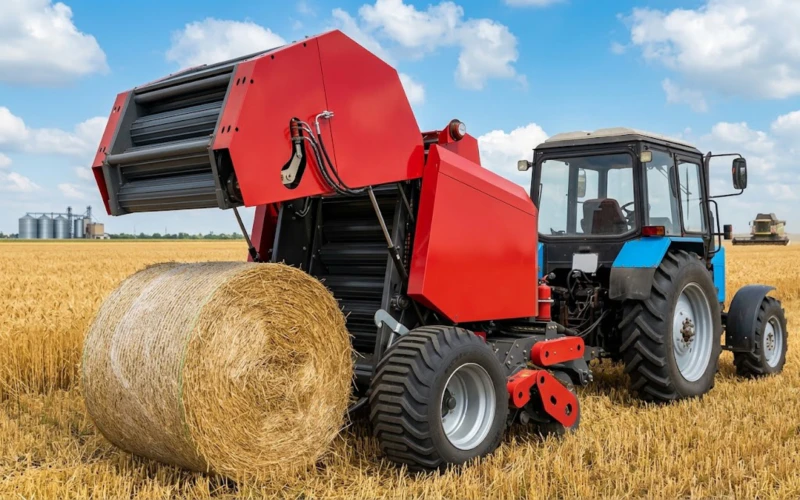
Alfalfa is the highest-value forage crop in commercial hay markets. Buyers in dairy and equine sectors pay premiums measured in dollars per tonne for every percentage point of crude protein above the baseline — and that protein is concentrated almost entirely in the leaf fraction, which accounts for 60–70% of the plant’s digestible nutrients. The problem is that alfalfa leaves are mechanically fragile. They shatter on contact with aggressive equipment, strip from stems under excessive tine force, and crumble when handled at below-optimal moisture. Every leaf lost during the cutting, raking, and baling sequence is protein that never reaches the feedbunk and revenue that never reaches the balance sheet.
For dairy farms producing alfalfa for their own herds, leaf loss compounds further: a reduction in crude protein content forces nutritionists to compensate with more expensive supplemental protein in the ration — adding cost at the feeding stage that began with the wrong equipment choice at the baling stage. For commercial hay operations selling into export markets, the consequence is more direct: export contracts specify minimum crude protein levels, and bales that fall below specification are rejected or deeply discounted.
This guide covers the five specifications that determine whether a round baler protects or destroys alfalfa quality, how to match those specifications to your operation’s scale, and why the power transmission chain — including the pto shaft connecting your tractor to the baler — matters more than most buyers realise.
1. Why Alfalfa Is Fundamentally Different from Other Forage Crops
The Leaf-Loss Problem
Grass hay — ryegrass, oat hay, prairie hay — is relatively forgiving of mechanical handling. Its leaf structures are long and flexible; they bend rather than shatter under tine contact and retain much of their nutritional value even when moderately bruised. Alfalfa is not like this. Its trifoliate leaves attach to stems at a single narrow petiole joint that breaks cleanly under minimal mechanical stress. Once detached, the leaf becomes airborne dust at any working speed above 5 km/h, and it is gone.
Field measurements consistently show that aggressive raking and baling equipment causes 8–15% total leaf loss on alfalfa, compared to 1–3% with equipment specifically designed for the crop. That difference in leaf retention equates to a 3–8 percentage point difference in the crude protein content of the finished bale — the difference between commodity-grade and premium-grade hay in most export markets.
The Narrow Baling Window
Optimal baling moisture for net-wrapped round bales is 12–18%. Above 22%, bales generate internal heat during storage through microbial respiration — darkening hay and destroying carotene and digestible protein over weeks. Below 10%, the leaves are so desiccated that even gentle pickup action causes shattering above 10% of leaf dry matter. The practical baling window is often just a 4–8 hour period on a given afternoon, demanding equipment that operates at high throughput without sacrificing gentle handling.
2. Five Key Specifications to Evaluate
Specification 1 — Pickup Width
The pickup width determines how much of the windrow the baler collects in a single pass. A narrow pickup forces more precise steering and leaves material at windrow edges that requires a second pass or is lost as field loss. A 2150–2240mm wide pickup collects the full windrow including lateral margins, and tolerates slightly off-centre tracking without crop loss.
For alfalfa, tine design matters as much as width. Cam-less ground-following pickup mechanisms lift material with minimum aggressive contact that causes leaf shatter. Cam-driven systems develop wear at contact points over time, causing tine trajectory variation that increases leaf-stripping action as the machine ages. For multi-season alfalfa operation, a cam-less pickup delivers consistent gentle handling across the full service life.
Specification 2 — Compression Chamber Type
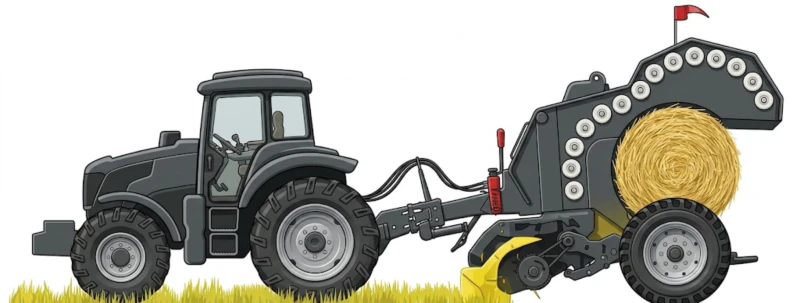
For alfalfa specifically, the roller or drum-type fixed chamber has a significant advantage over belt-type variable chambers. The continuous contact surface of multiple drums arranged around the chamber perimeter applies even compression force across the full bale face from the first layer to the last — producing a bale as dense at the geometric core as at the outer edge. Belt-type chambers tend to produce a harder outer layer and a softer inner core, because tension changes as the belt wraps more tightly around the growing bale. The 18-roller drum chamber in the S9000 and 9YG-1.25 series produces the core-to-surface density uniformity that prevents bale collapse under stacking weight and maintains geometry during long-distance transport.
Specification 3 — Bale Density Control
This is the specification most buyers underestimate, and the one that most directly determines whether a commercial alfalfa operation meets export specifications or falls short. Manual pressure adjustment systems are inherently reactive: when windrow density increases, chamber pressure rises before the system responds, and several bale layers are compressed at above-target density before equilibrium is re-established. The result is a bale with density variation across its layers.
Sensor-controlled density systems use pressure transducers that monitor chamber load in real time and adjust compression force before each new layer is added. The system maintains the operator-set target — adjustable across 100–200 kg/m³ — regardless of windrow density variation, crop type, or working speed changes. Third-party testing on alfalfa documented bale-to-bale density variation below 5% across full working days, compared to 15–25% variation for manual-adjustment systems under equivalent conditions.
Why this matters for export: Buyers specify minimum density, not average density. A bale with average 175 kg/m³ but ±25% variation may contain individual bales at 131 kg/m³ that fail the specification — even though the average complied. Sensor control eliminates this tail risk entirely.
Specification 4 — Binding Method
Alfalfa stored outdoors in twine-bound bales loses significantly more dry matter from the outer layer than net-wrapped equivalents. Twine wraps hold the bale in shape but leave the outer 50–80mm of material exposed to weather. Rain infiltrates from the top and sides, rewetting material that then ferments aerobically as it re-dries. Net wrap applies 2–3 overlapping spiral passes across the full bale face, sealing the outer surface against rain and UV exposure, and reducing outdoor storage dry matter loss by up to 65% compared to twine-bound equivalents at the same storage duration. For operations that cannot move bales under cover immediately after ejection, net wrap is not optional for alfalfa — it is the difference between premium-grade and commodity-grade product after 60 days of outdoor storage.
Specification 5 — Tractor Power and PTO Shaft Matching
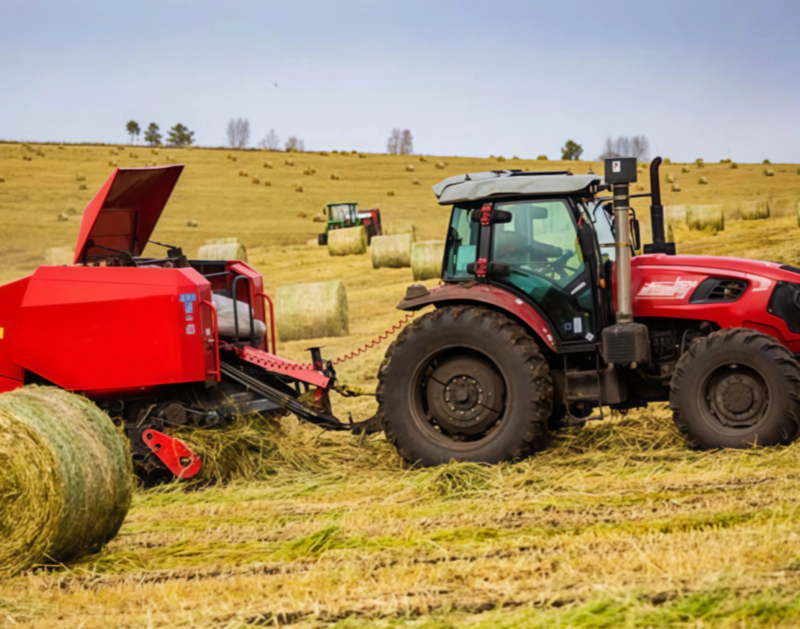
The final specification that directly affects alfalfa bale quality is the power transmission chain. Sensor-controlled density systems calibrate their pressure targets against a stable PTO input speed — typically 720 r/min for large commercial balers. When PTO speed fluctuates because the tractor is underpowered for the workload, or because a worn or imbalanced driveshaft introduces rotational variation, the sensor system reads chamber pressure against an unstable input baseline. The result is density variation that the sensor cannot fully compensate for, defeating the purpose of sensor control.
This is why the specification of the pto shaft connecting your tractor to the baler is not a secondary detail. A shaft that is dynamically balanced to the operating speed, correctly rated for the torque range of alfalfa baling, and equipped with a friction-clutch or shear-bolt overload device protects both the baler gearbox and the sensor system’s accuracy. An undersized or worn shaft is the most common cause of unexplained bale density inconsistency in commercial alfalfa operations that have otherwise invested in sensor-controlled equipment.
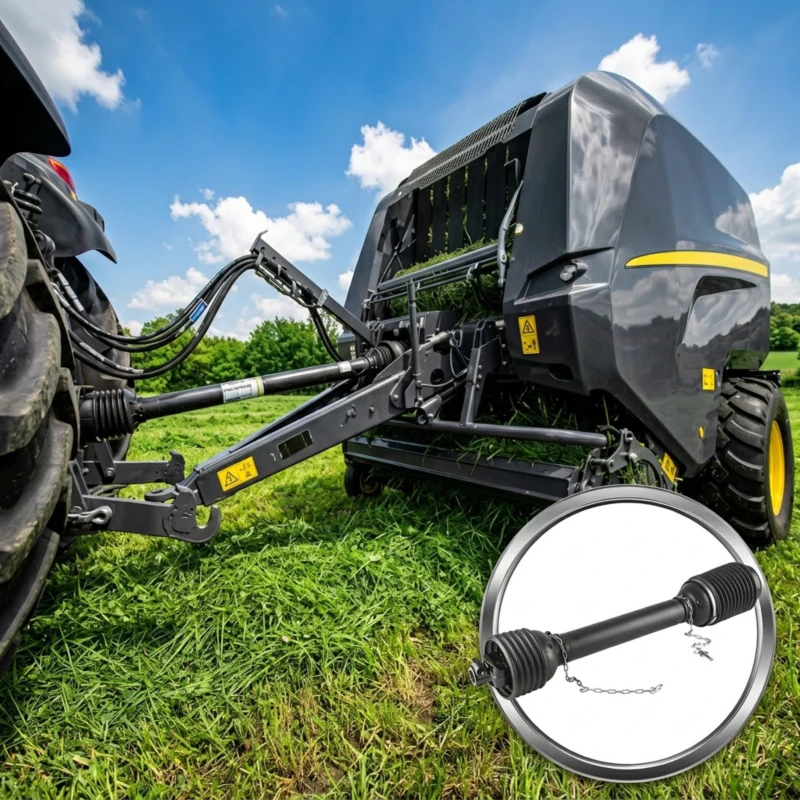
PTO shaft selection checklist for alfalfa balers:
- Rated for full input torque at 720 r/min
- Dynamically balanced at operating speed
- Spline interface matches tractor PTO output (6-spline or 21-spline)
- Friction clutch or shear-bolt overload protection rated for alfalfa peak loads
- Full-length guard in serviceable condition — inspect before every shift
3. Matching Baler to Operation Scale
Small to Mid-Scale Holdings (Under 500 ha/season)
Operations producing under 500 ha of alfalfa per season typically have tractors in the 75–100 HP range and need a baler that maximises per-pass coverage while remaining within the tractor’s power envelope. The 9YG-1.25 series with 2240mm pickup, 18-roller drum chamber, sensor density control, and automatic net wrap covers this requirement precisely. At ≥75 kW tractor power and 720 r/min PTO input, it produces 40–100 bales per hour at 100–200 kg/m³ with bale-to-bale consistency appropriate for domestic market sale and direct farm use.
Commercial and Export Operations (500–5000 ha/season)
At this production scale, the sensor-density consistency advantage of the S9000 Classic or S9000 Beyond translates into measurable annual revenue difference from export specification compliance. A documented case from a large dairy ranch in Inner Mongolia running two S9000 Classic units shows average bale density of 180 kg/m³ with less than 6% bale-to-bale variation across a full harvest season — well within the ±10% tolerance that export contract penalties begin at. The same operation’s previous manually-adjusted equipment produced 24% bale-to-bale variation, with 18% of bales falling below the contract minimum.
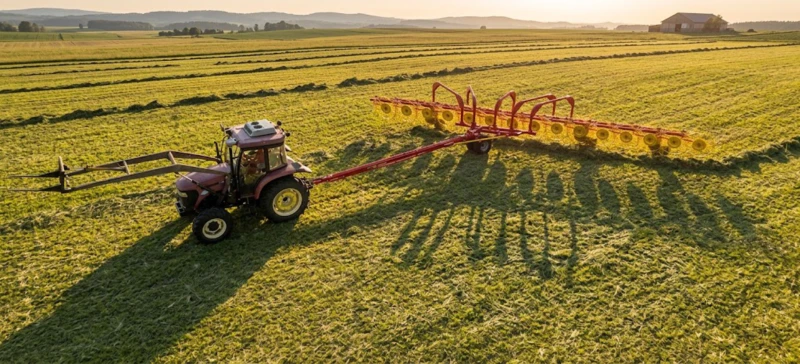
At the higher end of this scale, running two S9000 series units simultaneously alongside the appropriate harvest chain — mower conditioner, rake, and hydraulic bale transporter — creates a commercial hay production system that can realistically clear 50+ hectares of alfalfa from cutting to bale-on-ground in a single production day. Browse our complete range of forage harvesting equipment to design the right system for your operation.
4. Four Common Buying Mistakes
Choosing twine binding to reduce per-bale consumable cost
The saving is USD 0.30–0.80 per bale on consumables. The additional outdoor storage loss from uncovered twine-bound bales is 8–15% of dry matter on bales stored more than 60 days. At USD 200 per tonne hay value, a 10% storage loss on a 350 kg bale costs USD 7 per bale — ten times the consumable saving before accounting for the protein content downgrade.
Selecting a pickup width narrower than the windrow
A pickup that does not fully span the windrow leaves material at the margins — material that is disproportionately leaf-rich, because the light leaf fraction migrates to windrow edges during raking. This material either becomes field loss or requires a second pickup pass, doubling tractor hours for the baling phase on the most nutritionally critical crop fraction.
Accepting manual density control to save on purchase price
Manual pressure systems rely on experienced operators to judge density through indirect indicators — bale shape, hydraulic pressure gauges, feel. On a 12-hour harvest day, operator attention to these indicators degrades. The density variation that results means some bales meet export specifications and others do not — and there is no way to identify which bales failed until they are tested at the destination, by which point the financial penalty is already incurred.
Mismatching the PTO shaft to the baler’s torque demand
Using a pto shaft rated for lighter-duty applications on a large commercial alfalfa baler introduces speed fluctuations at the baler input that the sensor density system cannot fully compensate for. The visible result is unexplained density inconsistency from an otherwise well-specified machine. A correctly rated shaft matched to the baler’s torque specification typically costs less than one rejected export bale.
5. Conclusion: Three Questions That Simplify the Decision
Alfalfa buyers evaluating round balers can simplify the specification analysis to three diagnostic questions:
- Does the pickup width fully cover my windrow at my working speed? If not, you are leaving leaf-rich material on the field with every pass.
- Does the density control system maintain consistency across a full working day without operator monitoring? If not, you are accepting export specification risk that cannot be managed after the fact.
- Is the entire power transmission chain — tractor, PTO shaft, baler input — matched to sustained alfalfa baling loads? If not, the sensor system you invested in cannot deliver its specified performance.
If the answer to all three is yes, the baler will protect the value of the crop you have invested months of management to produce. If any answer is no, the equipment is the limiting factor on the operation’s commercial performance — regardless of how well every other aspect of the program is managed.
Ready to Select the Right Alfalfa Round Baler?
Our technical team can match baler model, tractor power, and PTO shaft specification to your specific acreage, yield, and market requirements.