
Hay Production Knowledge
Most hay producers measure bale density in kilograms per bale. The buyers who set market prices measure it in kilograms per cubic metre — and the gap between those two ways of thinking is where significant annual revenue is lost without most producers ever noticing.
Bale density is the single specification that connects the field operation to the logistics cost to the buyer’s price — understanding it as a system variable, not just a machine setting, changes how you manage the entire production chain.
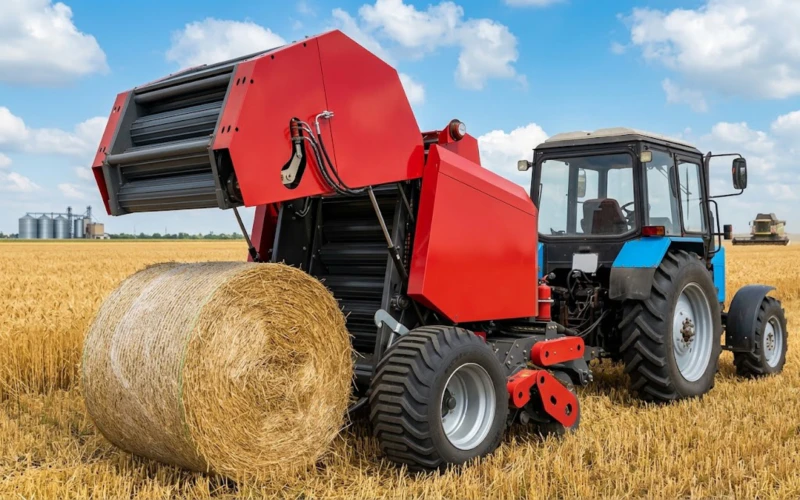
Ask ten hay producers what bale density means and most will describe it in terms of bale weight — a heavy bale is a dense bale, a light bale is a loose one. This is a workable shorthand for field management but an incomplete framework for commercial decision-making, because bale weight and bale density are not the same thing unless every bale in a production run has the same dimensions. When bale diameter varies — as it does across a day of baling in variable windrow conditions — two bales of identical weight can have density values that differ by 20% or more. The buyer paying by the tonne is indifferent to this difference. The buyer paying by the container load is not.
Bale density — properly understood as mass per unit volume, measured in kilograms per cubic metre — determines how much dry matter is packed into a given physical space. It affects the number of bales that fit on a truck, the number of bales that fit in a shipping container, the number of bales that can be stored in a barn of fixed floor area, and the energy content per delivery trip in a biomass supply chain. Every one of these downstream logistics variables scales with density — and the cost consequences compound across the large volumes of a commercial hay operation in ways that are not visible if density is only tracked as average bale weight.
This article explains what bale density actually means as a measurement, how it is produced and controlled in a round baler, why it varies across a production day, what the transport and storage cost consequences of different density levels are, and how to use this understanding to make better equipment and operational decisions. For the round balers with sensor-controlled density systems that produce the consistent density values this article discusses, see our range of hay balers for commercial production.
1. What Bale Density Actually Means: The Measurement Behind the Number
The Definition: Mass per Unit Volume
Bale density is defined as the mass of dry matter contained in one cubic metre of bale volume — expressed in kilograms per cubic metre (kg/m³). For a cylindrical round bale, volume is calculated from the bale’s diameter and length using the formula for a cylinder: π × (diameter/2)² × length. A standard round bale at φ1200mm diameter and 1200mm length has a volume of approximately 1.357 m³. If that bale weighs 220 kg, its density is 220 ÷ 1.357 = 162 kg/m³. If an adjacent bale of the same dimensions weighs 185 kg, its density is 136 kg/m³ — 16% lower, which translates to 16% less dry matter per container or truck load at equivalent transport cost.
The practical reason this distinction matters is that the dimensions of bales are not perfectly consistent across a production run. Bale diameter is nominally fixed by the baler’s chamber size but varies in practice by ±30–50mm depending on how full the chamber is at the wrap-and-eject cycle trigger point. A bale ejected at 1180mm diameter has a volume 4% smaller than a bale ejected at 1220mm diameter. If both bales weigh the same, the 1180mm bale is actually 4% denser — it contains 4% more dry matter in the same apparent volume. Buyers who weigh bales individually cannot see this difference. Buyers who measure density directly — or who work from known bale dimensions and weights — can.
What Density Ranges Mean in Practice
Commercial round balers produce bale densities across a wide range depending on crop type, moisture content, and compression system settings. The following reference ranges cover the most common commercial hay and residue applications:
| Density Range | Typical Application | Commercial Implication |
|---|---|---|
| Below 100 kg/m³ | Light straw, poor settings | Transport-inefficient; rejected by most buyers |
| 100–130 kg/m³ | Grass hay, low compression | Domestic sale only; high transport cost per tonne |
| 130–160 kg/m³ | Grass hay, standard settings | Acceptable for most domestic buyers |
| 160–180 kg/m³ | Alfalfa, high compression | Meets most export minimum specifications |
| 180–200 kg/m³ | Premium alfalfa, sensor control | ✓ Premium export grade; highest transport efficiency |
2. How Bale Density Is Produced in a Round Baler
The Compression Mechanism
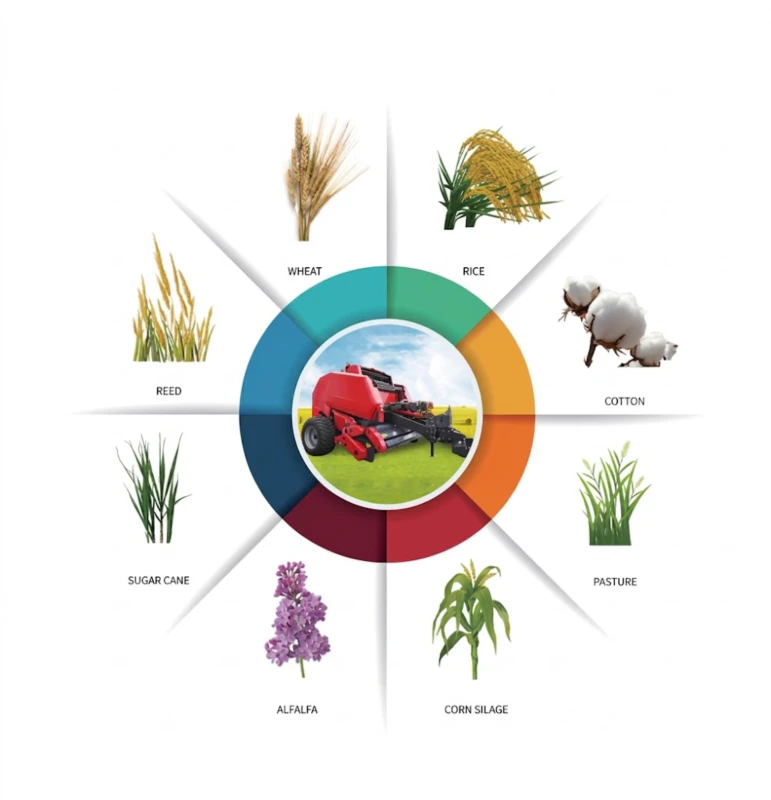
In a fixed-chamber round baler — the configuration used in the 9YG and S9000 series drum-roller balers — the compression chamber is a ring of rollers or drums whose diameter and spacing are fixed. Material fed from the pickup enters the chamber and is caught between adjacent drum surfaces, which rotate to pull material inward and roll it into a growing cylindrical bale. As the bale grows in diameter, it contacts more drum surfaces simultaneously, and the pressure required to compress each new layer of material into the existing bale core increases. The baler’s hydraulic system controls the force applied through the drum array to resist this expansion — higher hydraulic pressure means higher resistance means higher compression of each incoming material layer, which means higher density in the finished bale.
The density set point — the target density the baler is trying to achieve — is therefore a hydraulic pressure setting in a manual system, or a pressure feedback loop target in a sensor-controlled system. In both cases, the actual density achieved depends on the interaction between the set point and the volume and resistance of material arriving from the pickup. When more material arrives per unit of forward travel (denser windrow), the chamber fills faster and the hydraulic system must work harder to maintain the set density — potentially failing to keep up if the windrow density spike is sudden and large. When less material arrives (sparse windrow gap), the chamber fills slowly and the set pressure is maintained with less load, potentially producing a softer-core section in the developing bale.
Why Material Moisture Changes Everything
The same compression force applied to the same volume of material at different moisture contents produces dramatically different density outcomes, because moisture changes the material’s compressibility. Hay at 25% moisture contains significant free water in the cell structure that provides hydraulic resistance to compression — the material behaves almost like a wet sponge, returning some of its compressed volume when pressure is released. The finished bale is denser than the uncompressed material but significantly less dense than the same material baled at 15% moisture, where the reduced cell water content allows the dry structural fibres to pack more tightly under the same compression force. The practical consequence is that bales produced from morning windrows at 20% moisture will be less dense than bales produced from afternoon windrows at 14% moisture — even at the same baler pressure setting and the same apparent windrow density — because afternoon hay is drier and compresses more efficiently.
The moisture-density relationship in numbers: Alfalfa baled at 20% moisture under the same compression pressure typically achieves 130–145 kg/m³. The same crop baled at 14% moisture achieves 165–185 kg/m³ — a 25–30% density improvement from moisture reduction alone, with no change in baler settings. This is why the fastest path to higher bale density in most operations is not a pressure setting increase — it is allowing the crop to reach optimal baling moisture before starting the baler.
3. The Transport Cost Calculation: What Density Is Worth Per Tonne
The commercial value of higher bale density flows through three distinct logistics cost channels: truck transport, container shipping, and on-farm storage. Each of these channels has a fixed-cost component that is paid regardless of how much dry matter is carried, and a variable-cost component that scales with the number of trips. Higher density bales reduce the number of trips required for the same dry matter volume — reducing the variable cost component while the fixed cost is unchanged. The density-to-cost relationship is therefore not linear but accelerating: each percentage point of density increase generates slightly more cost saving than the last, because fixed costs are spread over increasing load size.
Flat-Bed Truck Transport: The Domestic Market Calculation
A standard agricultural flat-bed truck carries bales to its legal payload limit or its dimensional stacking limit — whichever is reached first. For round bales in the φ1200mm × 1200mm size range, the dimensional limit is typically reached before the payload limit, meaning the truck is carrying as many bales as fit the truck’s deck area, and any additional weight those bales represent goes directly to reduced cost per tonne transported. A truck carrying 16 bales at 220 kg each (3.52 tonnes) versus 16 bales at 175 kg each (2.80 tonnes) pays the same transport cost but delivers 26% more hay per trip. At a transport cost of USD 200 per trip, this is a difference of USD 56.82 versus USD 71.43 per tonne transported — a 26% transport cost premium for the lower-density bales on the same route.
For operations transporting hay 200 km to a feedlot or domestic buyer, this USD 14.61 per tonne transport cost difference is significant relative to the typical domestic hay price margin. On 500 tonnes of annual production, the density-driven transport cost difference is USD 7,305 per season — a recurring annual cost differential that compounds year after year without any change in agronomic inputs, land cost, or labour cost.
Container Shipping: Where Density Has the Largest Financial Impact
For export hay operations shipping by container, the density-to-cost relationship is amplified by the fixed cost of ocean freight per container. A standard 40-foot container loaded with φ1200 × 1200mm round bales holds approximately 18–20 bales depending on how closely they are packed. At 180 kg/m³ average bale density, each bale weighs approximately 244 kg and 20 bales total 4,880 kg. At 130 kg/m³ average density, each bale weighs approximately 177 kg and the same 20 bales total 3,540 kg. On a USD 4,000 ocean freight cost per container, the higher-density load costs USD 0.82 per kg of hay delivered versus USD 1.13 per kg for the lower-density load — a 38% higher effective freight rate per kilogram of product at the destination.
Over a season producing 10 container loads, this density difference represents USD 13,400 in additional freight cost on the same physical volume of hay shipped — without any difference in the hay’s agronomic quality or market price at destination. This is why export alfalfa buyers enforce density specifications through pricing incentives and penalties: they are not managing bale aesthetics, they are managing their own logistics cost per kilogram of product received. Producers who deliver at the buyer’s specified density floor get the contract price. Producers who deliver below floor get a discount that compensates the buyer for the additional per-kilogram freight cost they incurred.
On-Farm Storage: The Often-Overlooked Density Dividend
Barn and shed storage capacity is measured in physical volume — cubic metres of covered space. Higher-density bales store more dry matter per cubic metre of shed floor, which means a given shed can store more total tonnes of hay before reaching capacity. For operations where covered storage capacity is a bottleneck — a common constraint in high-rainfall regions where outdoor storage quality loss is unacceptably high — increasing bale density effectively increases the shed’s storage capacity without any capital investment in additional structures. A 20% increase in average bale density from 140 kg/m³ to 168 kg/m³ increases the effective storage capacity of a 1,000 m² hay shed by 20% — the equivalent of building an additional 200 m² of shed without any construction cost.

4. Manual Pressure vs. Sensor Control: The Density Consistency Problem
Why Manual Settings Produce Density Distributions Rather Than Density Targets
A manual pressure setting on a round baler tells the hydraulic system to maintain a fixed resistance level in the compression chamber. This works as a density control mechanism only if the volume and compressibility of material entering the chamber remains constant — which it does not in normal commercial baling conditions. A windrow with 30% density variation from sparse to dense sections, combined with moisture that changes from 20% to 14% between morning and afternoon, produces a range of actual compression loads on the chamber that the manual setting cannot adapt to. The bales produced across this variation range span a density distribution that may be 40–50 kg/m³ wide — from 130 kg/m³ on the sparse, moist morning sections to 185 kg/m³ on the dense, dry afternoon sections — despite a single unchanging pressure setting throughout the day.
For domestic market sales where buyers purchase by the bale without density inspection, this variation is invisible at the point of sale but shows up in animal performance variation (higher-density bales provide more dry matter per feeding event) and in transport cost variability (lighter bales increase cost per tonne on the load where they appear). For export market sales where density is specified and inspected, the lower tail of this distribution — the 130–145 kg/m³ bales from the morning’s moist, sparse windrow sections — are the bales that fail specification and trigger price penalties on the entire shipment.
What Sensor Control Adds and How It Changes the Economics
Sensor-controlled density systems close the feedback loop that manual pressure systems leave open. Pressure transducers monitor chamber compression force in real time and adjust the compression element before each new material layer is added to the bale, maintaining the target density setpoint regardless of windrow density variation, moisture changes, or working speed fluctuations. The density distribution that a manual system produces as a wide band — 40–50 kg/m³ spread — compresses to a narrow band of ±8–12 kg/m³ under sensor control. Every bale in the production run is within a tight range of the setpoint: the 130 kg/m³ morning outliers disappear, and the 185 kg/m³ afternoon outliers are moderated as well — producing a consistent batch where every bale delivers approximately the same transport efficiency per unit volume.
The economic value of this consistency is not just in export specification compliance — it extends to every logistics stage downstream. Truck loaders can calculate exact payload per trip from bale count without individual weighing. Container stuffers know that each bale will compress predictably to the same dimensions under the loading equipment. Ration managers at the dairy farm know that each bale contains the same dry matter weight and can formulate rations accurately without bale-to-bale resampling. The density consistency that sensor control produces is a system efficiency improvement that generates value at every point after the bale leaves the field.
The role of the pto shaft in sensor density performance is worth noting here: the sensor system measures chamber pressure and adjusts compression assuming a stable PTO input speed. A worn or imbalanced driveshaft that introduces speed variation at the baler input adds noise to the pressure signal that the sensor cannot distinguish from material density variation. The result is residual density variation in a sensor-equipped baler that should theoretically be producing tight consistency — a symptom that is commonly misdiagnosed as sensor malfunction when the actual cause is power transmission instability. Inspecting and replacing the driveshaft before investigating the sensor system is the correct diagnostic sequence when a sensor baler produces unexpected density variation.

5. Practical Steps to Improve Bale Density in Your Current Operation
Whether you operate a manual-pressure or sensor-controlled baler, the following steps improve average bale density and reduce the density distribution spread — generating real financial returns through the transport and storage channels this article has described. They are listed in order of commercial impact, not complexity.
Bale at optimal moisture — not at the first available moisture
Moving from 20% to 14% average baling moisture increases achievable density by 25–30% on most hay crops without any change in baler settings or equipment. Use a forage moisture meter, not appearance or schedule, to determine baling start time. This single change has the largest impact on average density of any action on this list.
Increase manual pressure settings incrementally and monitor bale shape
On manual-pressure balers, increasing the hydraulic pressure setpoint by 5–10% increments until bale shape becomes visibly barrel-distorted indicates the maximum practical density for the current crop and moisture conditions. A slight barrel shape (wider in the middle) is acceptable; a strongly barrelled bale indicates excessive pressure that stresses the chamber components and can cause uneven bale winding that makes net wrap application less secure.
Improve windrow uniformity with better raking practice
Windrow density gaps — caused by raking speed variation, missed swath sections, or inconsistent rake arm angles — produce the sparse-windrow bale sections that drag down average density and widen the density distribution. Consistent raking speed, properly set rake arm angles, and overlap passes at field ends that ensure all swath sections are collected reduce the magnitude of density variation that the baler’s compression system must handle.
Inspect and maintain the compression chamber rollers or drums
Worn roller surfaces lose the grip on bale material that drives compression — a worn drum roller cannot apply the same compression force to the bale as a new one at the same hydraulic pressure setting. If average bale density has declined over successive seasons without any change in crop type or moisture management, worn compression chamber surfaces are a common cause that baler service can restore.
Upgrade to sensor-controlled density if density consistency is a market requirement
For operations selling into export markets or large domestic buyers with density specifications, all four operational improvements above are valuable but insufficient to eliminate the tail of below-specification bales that manual-pressure systems produce. Sensor-controlled density is the only mechanism that addresses variability at its source — adjusting compression before density variation occurs, rather than attempting to average it out through operational adjustments.
Ready to Improve Your Bale Density and Reduce Transport Cost?
Whether you are optimising an existing baler’s settings or evaluating sensor-controlled density equipment for the first time, our technical team can help you calculate the transport cost saving and export compliance improvement available from a density upgrade.