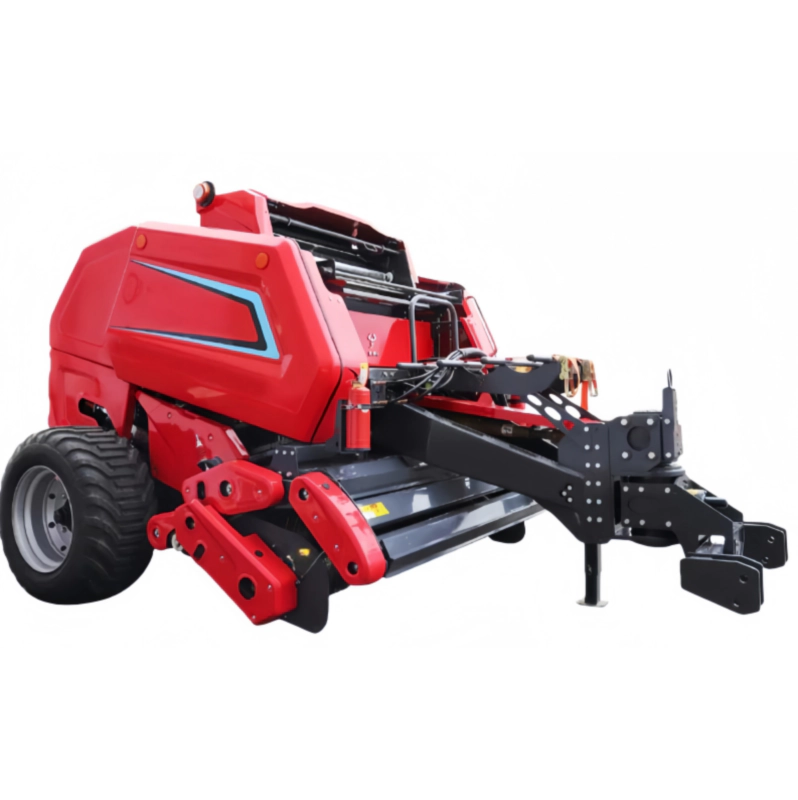
9YG-2.24D Round baler (S9000 Beyond)
The 9YG-2.24D Round Baler (S9000 Beyond) is our latest hay baler, designed specifically for large-scale agricultural production, hay storage, and baling operations. Utilizing advanced technology and innovative design, this machine significantly improves operational efficiency, reduces labor costs, and maintains excellent baling quality. Whether for small or large farms, the 9YG-2.24D Round Baler (S9000 Beyond) provides an efficient, stable, and reliable solution.
The Definitive Technical Guide to the 9YG-2.24D Round Baler (S9000 Beyond): Professional Large-Scale Baling with Electro-Hydraulic Precision
Command commercial hay and silage operations with a 2240mm wide pickup, 18-roller fixed compression chamber, sensor-controlled density system, and a peak output of 100 bales per hour — engineered for large-scale agricultural professionals.
1. Introduction: Professional-Grade Round Baling Architecture
Modern commercial forage production demands equipment that delivers absolute consistency — bale after bale, field after field, across seasons measured in thousands of operating hours rather than dozens. Livestock farms managing tens of thousands of head, dairy operations that supply national chains, and agricultural machinery cooperatives servicing entire townships face a shared challenge: how to maximize forage dry matter preservation while reducing per-bale transport and storage cost at industrial scale. The answer lies in high-density, sensor-controlled round baling technology.
The 9YG-2.24D Round Baler (S9000 Beyond) is the flagship model in the large round baler lineup from Hangzhou Watanabe Forage Balers Co., Ltd. It integrates an advanced electro-hydraulic control system with a proven heavy-duty mechanical structure, delivering bale densities of 100–200 kg/m³ with real-time sensor feedback that eliminates the variability inherent in manual-judgment machines. Where compact models like the 9YK-870 serve smallholdings and orchard rows, the S9000 Beyond is purpose-engineered for enterprises where throughput, density consistency, and continuous-cycle reliability are non-negotiable commercial requirements.
The economic logic is straightforward. Every additional kilogram of density packed into a φ1300 × 1400 mm bale reduces the number of handling events, transport trips, and storage positions required per tonne of dry matter. At scale — 50,000 bales per season at a large dairy ranch, or multiple machines running simultaneously on a commercial forage estate — a 15% reduction in transport cost per tonne translates directly into significant bottom-line improvement. This guide examines every mechanical, operational, and economic dimension of the S9000 Beyond to give buyers the technical grounding needed to evaluate it against their specific operational requirements.
2. What Is a Round Baler? Working Principle Explained
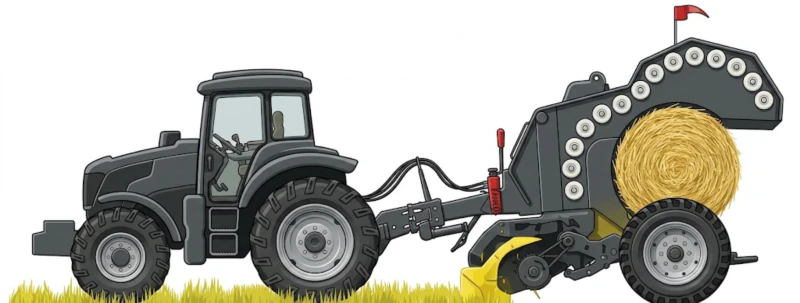
A round baler is an agricultural implement designed to pick up windrowed crop material from the field surface, compress it into a dense cylindrical bale, bind it with twine or net wrap, and eject it for storage or transport. Understanding the four-stage cycle reveals why specific design choices in the S9000 Beyond translate into operational advantages at commercial scale.
Stage 1 — Pickup
As the machine advances, the 2240mm spring-tooth pickup reel lifts windrowed material cleanly from the ground. The wide pickup span covers the full tractor wheel track width in a single pass, eliminating the double-pass approach required by narrower machines. Spring tines deflect safely when contacting ridge lines or embedded debris, maintaining clean intake without gouging the field surface.
Stage 2 — Feed and Compression
The pin-roller and roller-type feeder channels material into the fixed compression chamber, where 18 heavy-duty rollers — each 222mm in diameter — rotate continuously to build a tight cylindrical core from the inside outward. The electro-hydraulic sensor network monitors chamber pressure in real time, triggering micro-adjustments to maintain target density throughout the bale cycle regardless of windrow variation.
Stage 3 — Net Wrapping
Once the bale reaches the operator-set density target, the control system automatically initiates the net wrap cycle. A 2000 × 1.4m net sheet applies a complete edge-to-edge spiral envelope around the bale in two to three passes. This sealed surface protects the bale from rain infiltration and UV degradation during outdoor storage — a critical performance advantage for operations that cannot always move bales under cover immediately after ejection.
Stage 4 — Ejection and Reset
The hydraulic rear gate opens and the completed φ1300 × 1400mm bale rolls cleanly onto the field. The gate closes and the chamber resets within seconds, beginning the next cycle immediately. Experienced operators on open ground regularly achieve sub-60-second cycle times at 60–80 bales per hour sustained output — well within the rated 40–100 bales per hour range depending on tractor power and windrow density.
Transforming loose, bulk-volume crop residue into standardized high-density bales cuts storage footprint by up to 40% per tonne and reduces transport costs proportionally. For commercial forage baler operations, that density advantage is the central lever of profitability.
3. Verified Technical Parameters & Structural Metrics
The table below contains the complete engineering specification sheet for the 9YG-2.24D Round Baler (S9000 Beyond), transcribed directly from factory test data. All figures reflect standard operating conditions at rated power input.
| No. | Item Parameter | Unit | Specification |
|---|---|---|---|
| 1 | Model Name | / | 9YG-2.24D Round Baler (S9000 Beyond) |
| 2 | Connection Method | / | Towed Type |
| 3 | Pickup Width | mm | 2240 |
| 4 | Pickup Structure Type | / | Spring Tooth Type |
| 5 | Feeder Structure Type | / | Pin Roller + Roller Type |
| 6 | Baling Mechanism — Compression Chamber | / | Roller Type |
| 7 | Compression Chamber Width | mm | 1400 |
| 8 | Compression Chamber Diameter | mm | φ1200 |
| 9 | Number of Rollers | pcs | 18 |
| 10 | Roller Diameter | mm | φ222 |
| 11 | Binding Method | / | Net Wrapping |
| 12 | Supporting Power | kW | 55–100 |
| 13 | Structural Weight | kg | 4570 |
| 14 | PTO Shaft Speed | r/min | 720 |
| 15 | Overall Dimensions (L×W×H) — Working State | mm | 4600 × 3010 × 2370 |
| 16 | Bale Density Control | / | Sensor Control |
| 17 | Bale Size (Diameter × Width) | mm | φ1300 × 1400 |
| 18 | Bale Density | kg/m³ | 100–200 |
| 19 | Productivity | bales/h | 40–100 |
| 20 | Wheel Track | mm | 2600 |
| 21 | Working Speed | km/h | 5–35 |
| 22 | Net Specification (Length × Width) | / | 2000 × 1.4 m/bale |
With 18 rollers at φ222mm diameter, the S9000 Beyond maintains continuous contact pressure across the full bale perimeter at every stage of formation. This roller count — among the highest in the class — prevents the core loosening that shortens bale shelf life in machines with fewer contact points. Paired with sensor-controlled hydraulic feedback, it produces bales that hold their φ1300 × 1400mm geometry under outdoor storage conditions for months.
4. Five Core Advantages of the S9000 Beyond
Advantage 1: Extra-Wide Pickup and Maximum Field Coverage
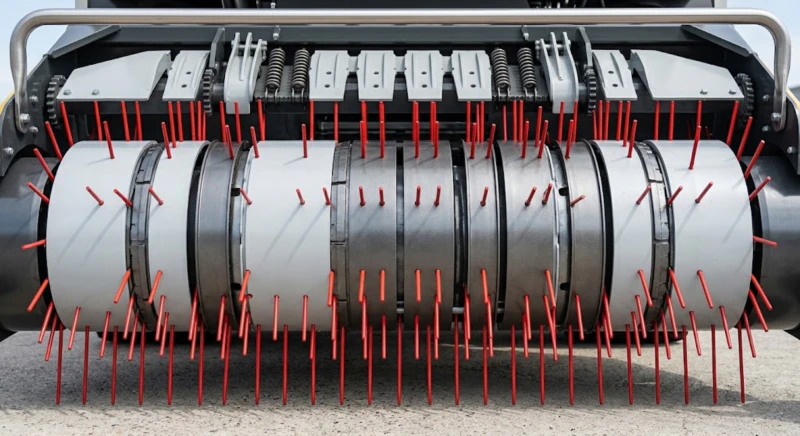
The 2240mm spring-tooth pickup is one of the widest available in this baler class. On open commercial hay fields, it eliminates the need for secondary windrow merging before baling — the pickup spans wide enough to capture twin windrows in a single pass on many crop types. Combined with a working speed range of 5–35 km/h, operators can push output to match the maximum throughput of even the most powerful tractors in the 55–100 kW range, sustaining peak production of 100 bales per hour under ideal conditions.
Advantage 2: Sensor-Controlled Density for Commercial-Grade Consistency
The integrated bale density sensor network is the technological differentiator that separates the S9000 Beyond from conventionally controlled balers. Pressure transducers monitor chamber load continuously and feed data back to the electro-hydraulic controller. The controller maintains the target density — adjustable across the 100–200 kg/m³ range — regardless of windrow weight variation, crop moisture fluctuation, or ground speed change. The result is a bale-to-bale consistency that commercial buyers require: uniform weight, predictable nutritional content, and standardized handling geometry across an entire season’s production.
Field data from a 10,000-head dairy ranch confirmed that sensor-stabilized alfalfa bale density at 180 kg/m³ reduced long-distance transport cost by approximately 15% per tonne compared to the variable-density bales produced by their previous equipment. At 50,000 bales per season, that cost saving compounds into a substantial return on equipment investment.
Advantage 3: Net Wrap Standard — Superior Outdoor Storage Protection
The 2000 × 1.4m net wrap standard on the S9000 Beyond covers the full bale face on every pass, delivering complete edge-to-edge protection. Compared to twine binding, net wrap reduces the baling cycle by approximately 32% due to faster application speed, and cuts outdoor storage dry matter loss by up to 65% by sealing the bale surface against rain and UV exposure. For operations that sell hay commercially — where buyers inspect bale condition on delivery — net wrap’s superior weather resistance directly supports premium pricing.
Advantage 4: Heavy-Duty Structure with Ultra-Low Failure Rate
Despite its 4570 kg operating weight, the S9000 Beyond’s structural frame uses high-tensile steel plate throughout the primary load path. Key connection points use replaceable wear inserts rather than welded structural members, enabling end-of-service-life component replacement without workshop cutting or reframing. Field reports from large-scale operations — including sustained runs of over 1500 operating hours in a single 90-day season — consistently record zero structural failures outside scheduled consumable replacement. This reliability is the machine’s most commercially significant attribute for contractors whose income depends on meeting seasonal completion deadlines.
Advantage 5: Cost-Effective Power Utilization and Long-Term ROI
The 55–100 kW power requirement places the S9000 Beyond within the operating range of mainstream mid-size tractors that most established operations already own, eliminating the need for a dedicated high-horsepower tractor purchase. At the recommended 85–110 kW operating range, the machine runs well within the tractor’s power band, improving engine thermal efficiency and reducing fuel consumption per bale compared to an undersized baler pushed to maximum load. Strong residual values on the used equipment market — typically 40–55% of original purchase price after five to seven seasons — further compress the total cost of ownership per bale across the equipment’s service life.
5. Commercial Application Scenarios
Large-Scale Dairy and Livestock Farm Forage Supply
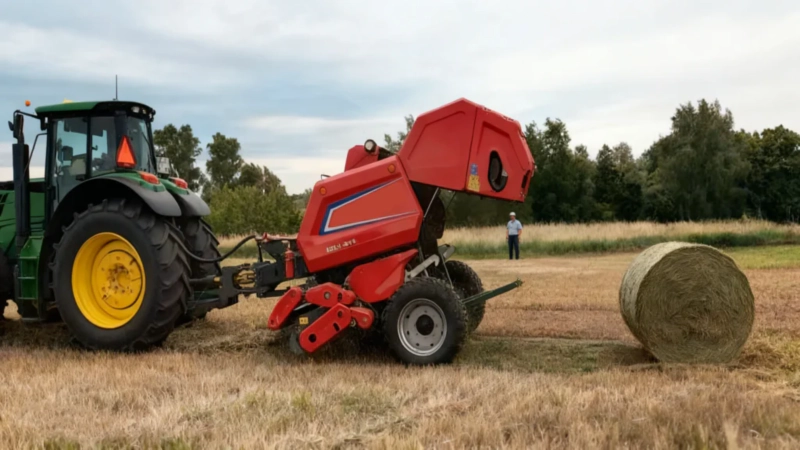
For dairy and livestock farms managing 500 to 50,000 head of cattle, consistent high-density alfalfa and grass hay bales are the foundation of a reliable feed chain. The S9000 Beyond’s sensor-controlled density system ensures that every bale delivered to the feedlot meets the same weight and nutritional profile, enabling accurate ration formulation without adjustment allowances for bale variability. Operations producing forage primarily for on-farm consumption benefit from reduced storage footprint and fewer handling cycles per tonne, both of which translate directly to labor cost savings at scale.
Commercial Hay Export Operations
Export hay buyers — particularly in Asian markets importing oat hay and alfalfa from Australia, North America, and Central Asia — specify strict minimum density and moisture standards. Achieving consistent 190 kg/m³ density across large production volumes requires sensor-controlled compression that manual systems cannot reliably deliver. The S9000 Beyond’s automated density management directly supports export contract compliance, reducing the risk of rejected loads and the associated financial penalties.
Agricultural Machinery Cooperative Services
Custom baling contractors and agricultural cooperatives operating per-bale service models benefit from the S9000 Beyond’s multi-crop versatility. The spring-tooth pickup combined with the roller compression chamber handles lodged corn stalks, tangled rice straw, soybean stover, and dense alfalfa without configuration changes. An average sustained output of 50–60 uniform bales per hour across diverse crop types maximizes daily revenue for cooperatives serving multiple farms during compressed seasonal windows.
Straw Recycling and Biomass Operations
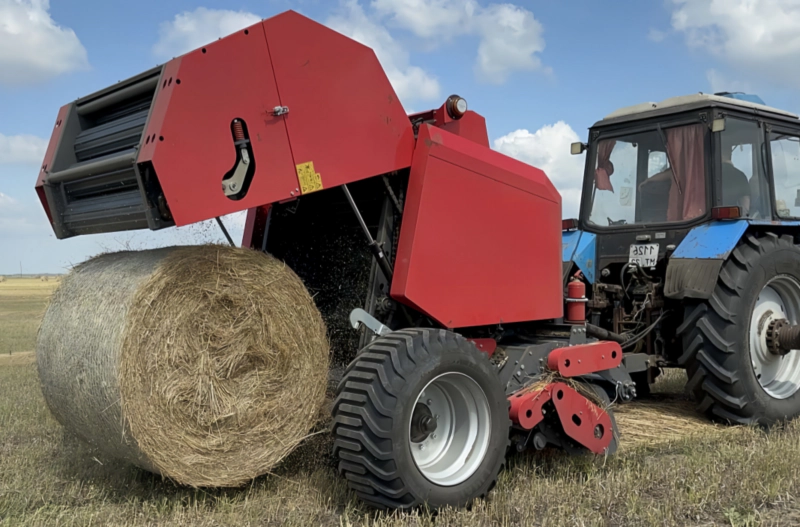
Straw recycling companies and biomass energy operations require high-volume, consistent bale specifications to maintain efficient processing line throughput. The S9000 Beyond’s wide pickup and high hourly output make it one of the most productive single-machine options available for wheat straw, rice straw, and corn stover collection at the field level. Government-sponsored ecological management projects — covering vegetation collection on reclaimed land or along riparian corridors — similarly benefit from the machine’s ability to clear large acreage rapidly without secondary field passes.
6. Compatible Tractors and Full Scope of Application
| Category | Item | Specification |
|---|---|---|
| Compatible Tractors | Power Requirement | 55–100 kW (75–135 HP) |
| Power Take-Off | Standard 720 r/min PTO shaft | |
| Hydraulic System | Minimum 2 sets of hydraulic output interfaces required | |
| Hitch Type | Three-point hitch, Category II | |
| Representative Brands | John Deere 6–7M Series, Case IH Maxxum, New Holland T6, Deutz-Fahr 6 Series, Fendt 200 Vario, CLAAS ARION 600, Kubota M6, Yanmar YT Series | |
| Application Scope | Crop Types | Forage: Alfalfa, Ryegrass, Oat Grass, Leymus chinensis Straw: Corn stover, Wheat straw, Rice straw, Soybean straw Other: Reed, Sugarcane leaves |
| Working Scenarios | Commercial production: Large-scale forage company operations Farm self-use: Forage reserves for large breeding farms Straw utilization: Collection for straw recycling companies Government projects: Ecological vegetation recycling |
|
| Suitable Regions | Plains: Continuous large-farm operation Hilly areas: Slopes up to 15° Arid areas: Semi-arid grassland regions Humid areas: Rainfall regions (moisture control required) |
|
| Operating Requirements | Material Moisture | Optimal: 12%–18% | Maximum: ≤25% (reduce speed above this) |
| Field Conditions | Recommended field area ≥2 hectares | Weed height ≤15 cm | |
| Ambient Temperature | −10°C to 45°C (special maintenance required outside this range) |
✔
✔
✔
✔
7. Power Transmission Mastery: The Critical Role of the PTO Shaft
The 9YG-2.24D is a tractor-trailed implement: every watt of mechanical energy powering its 18-roller compression chamber, the electro-hydraulic density control system, and the net wrap dispenser originates at the tractor engine. That energy travels through one critical link before it becomes useful work inside the baler — the power take-off driveshaft.
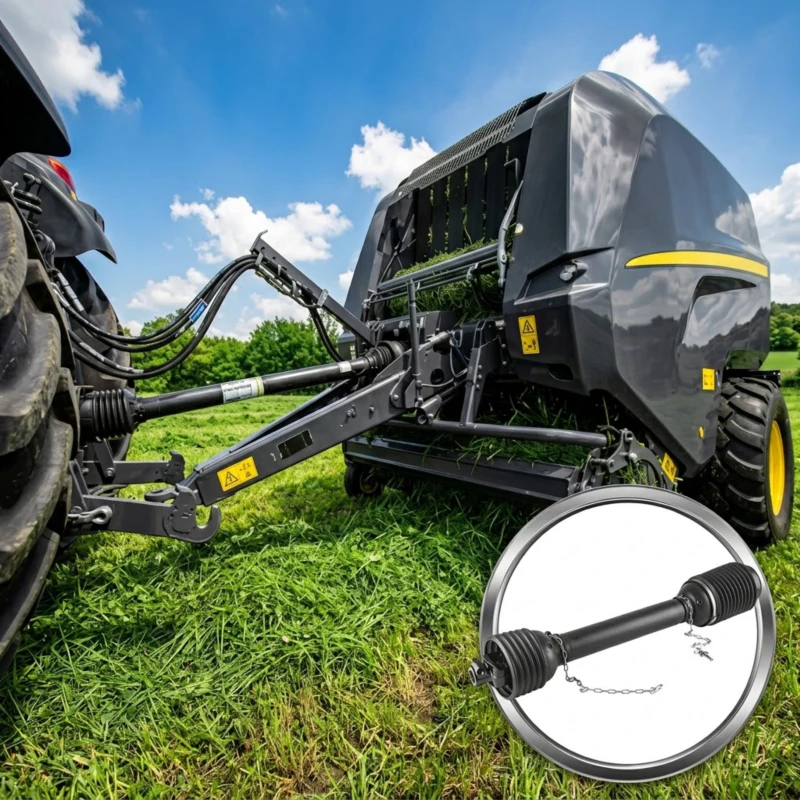
The S9000 Beyond operates at a standard input speed of 720 r/min. This PTO speed must be maintained precisely across the full working speed range of 5–35 km/h and across the wide variation in chamber resistance that occurs as bale density builds from empty chamber to full ejection-ready bale. Deploying a premium, correctly specified pto shaft matched to the tractor’s output specification and the baler’s input torque rating is not optional maintenance — it is a prerequisite for the sensor control system to function accurately and for the compression rollers to deliver consistent output.
Speed Synchronization
The electro-hydraulic density controller calibrates its pressure targets against a stable 720 r/min input. Speed fluctuation caused by a worn or mismatched driveshaft introduces measurement error that degrades density consistency — the primary commercial advantage of the S9000 Beyond over standard machines. A correctly specified PTO shaft maintains speed synchronization within tolerance across the full operating range.
Overload Protection
When the baler encounters a sudden hard obstruction — an embedded stone fragment, a metal stake tip, or a knotted wire ball — peak torque in the compression chamber spikes instantaneously. The friction clutch or shear-bolt overload protection device in a quality PTO shaft severs the torque path in milliseconds, protecting the gearbox, roller bearings, and chain drive from impact damage that would require workshop repair. On a machine rated to run 1500 hours per season, that protection device will activate multiple times per season in typical commercial field conditions.
Universal Joint Compensation and Safety
During field operation, the angular relationship between tractor and the towed baler changes continuously with terrain undulation and turning. A double universal joint assembly compensates for these angular changes automatically, delivering smooth, vibration-free torque transmission at all operating angles within the rated range. The full-length plastic safety guard enclosing the rotating assembly is a legal and operational necessity — inspect it before every shift and replace immediately if cracked, buckled, or missing. Never approach a rotating driveshaft from any direction.
✔
✔
✔
✔
8. Preventative Maintenance Protocol
The S9000 Beyond is designed for commercial-intensity use, but sustained reliability at 1000–2000 operating hours per season requires disciplined preventative maintenance. Neglecting routine intervals in high-dust, high-vibration harvesting conditions accelerates bearing wear, chain stretch, and roller surface degradation at rates that quickly erode the machine’s output consistency and uptime.
✔
✔
✔
✔
9. Real-Time Field Troubleshooting Guide
Issue 1: Bale Density Below Target
Check the sensor calibration setting against the operator manual specification. Verify that tractor hydraulic pressure to the density control circuit meets minimum specification. If the windrow is exceptionally light or dry, reduce working speed to allow adequate chamber fill time per bale cycle. Check all sensor connector seals for moisture infiltration that can produce false low-pressure readings.
Issue 2: Net Wrap Uneven or Skipping Edges
Inspect the net roll mounting tension — insufficient tension allows the net to spool unevenly during application. Check the guide rollers for accumulated crop fiber debris that deflects the net off the dispensing path. Verify the dispenser solenoid valve trigger signal from the controller activates at the correct bale-full setpoint. Replace damaged guide roller bearings promptly; uneven roller rotation is the most common cause of net edge misalignment.
Issue 3: Vibration or Unusual Noise During Operation
Stop the machine immediately, disengage PTO, and allow all moving parts to come to a complete stop before inspection. Check for foreign objects lodged between rollers or in the feeder channel. Inspect the PTO shaft for imbalance or coupler wear. Check chain tension — a slack chain bouncing on sprocket teeth produces a distinctive intermittent knocking. Do not resume operation until the source is identified and corrected; continued operation with unidentified vibration sources risks bearing failure and structural damage.
Issue 4: Hydraulic System Slow Response
Confirm hydraulic oil temperature is within normal operating range — cold oil at startup can cause sluggish response that self-resolves as the system warms. Check return line filter restriction indicator; a saturated filter significantly reduces flow. Verify tractor hydraulic flow rate at the baler’s external connections — insufficient tractor pump output from a worn pump or incorrectly set flow divider produces chronic slow hydraulic response.
10. Customer Feedback from the Field
Large-Scale Australian Farm — Efficiency in 45°C Conditions
“In 2023, we introduced three 9YG-2.24D round balers across our 20,000-hectare oat hay operation. The 2240mm pickup width perfectly suits our field scale. Operational efficiency increased by 35%, maintaining a stable bale density of 190 kg/m³ that fully meets our export contract specifications. The hydraulic system performed reliably under continuous 45°C conditions, completing 2000 operating hours in a single season without major repairs. Its reliability ensured we met every harvest window deadline, which is what secures our export orders.”
— Operations Manager, Southern Cross Farm, New South Wales, Australia
10,000-Head Dairy Ranch — Transport Cost Reduction
“For a ranch producing 50,000 alfalfa bales annually, equipment uptime is the lifeline. Two 9YG-2.24D balers increased our operational efficiency by about 30%. The sensor density control stabilized our alfalfa bales at 180 kg/m³, which reduced long-distance transport costs by approximately 15% per tonne. Over 90 working days, each machine logged over 1500 operating hours with no structural failures outside routine maintenance. Completing the harvest within the optimal nutritional window is essential for the feed quality we need at this scale.”
— Head of Machinery Department, 10,000-head Dairy Ranch, Hulunbuir, Inner Mongolia
Agricultural Machinery Cooperative — Multi-Crop Versatility and ROI
“The farmers we serve grow corn, rice, and soybeans — the baler must handle all of them without bias. The 9YG-2.24D’s roller compression chamber and spring-tooth pickup handle lodged corn stalks with very few blockages. Average operating speed of 8–10 km/h, producing 50–60 uniform bales per hour. After two full quarters, its robust construction and strong resale value have given our cooperative a stable cash flow and a considerable return on investment.”
— Chairman, Modern Agricultural Machinery Cooperative, Suihua City, Heilongjiang Province
11. Frequently Asked Questions (FAQ)
Q1: What crop types can the 9YG-2.24D process?
Forage crops including alfalfa, ryegrass, oat grass, and Leymus chinensis. Crop straw including corn stover, wheat straw, rice straw, and soybean straw. Other materials including reed and sugarcane leaves. Each material type requires corresponding adjustment of the density target and working speed for optimal bale quality and equipment longevity.
Q2: What is the optimal material moisture range?
Best results are achieved at 12%–18% moisture. The maximum permitted moisture is 25%. Operating above 25% requires a significant working speed reduction to maintain bale quality. For silage-purpose baling at higher moisture, bales should be film-wrapped within four hours of production to initiate anaerobic fermentation before oxygen penetration causes spoilage.
Q3: What tractor horsepower is required for optimal performance?
The machine operates on 55–100 kW (75–135 HP) tractors, with the 85–110 kW range delivering optimal output efficiency and fuel economy. Operating at the lower end of the range reduces peak productivity; operating at the upper end maximizes hourly bale count and suits large-acreage commercial operations requiring maximum throughput.
Q4: How does the sensor density control system work in practice?
Pressure transducers positioned at the compression chamber monitor chamber load in real time. This data feeds back to the electro-hydraulic controller, which adjusts compression roller force to maintain the operator-set density target. When the target is reached, the controller triggers the net wrap cycle automatically. The system maintains density consistency across windrow weight variation, moisture fluctuation, and working speed changes without requiring operator intervention.
Q5: What hydraulic interface does the tractor need to provide?
A minimum of two hydraulic output circuits is required — one for the rear gate operation and one for the density control and net wrap system. Both circuits must be capable of sustaining the flow rate and operating pressure specified in the machine manual. Verify your tractor’s hydraulic specifications against the requirements before connection.
Q6: How does the S9000 Beyond compare to the smaller 9YG-1.25 models?
The 9YG-2.24D’s 2240mm pickup width is approximately 79% wider than the 9YG-1.25’s 1250mm pickup, enabling proportionally higher field coverage per pass. The 18-roller compression chamber is also shared across the S9000 series, but the S9000 Beyond’s electro-hydraulic sensor control is the defining upgrade over basic manual-pressure models. For operations producing over 20,000 bales annually, the productivity premium justifies the investment difference.
Q7: Is the S9000 Beyond suitable for silage baling?
The S9000 Beyond can produce silage bales at material moisture up to 25% with speed adjustment. For dedicated high-moisture silage operations at 30–60% moisture, combining the round baler with a separate stretch-film wrapper, or using the 9YCM-850 baler-wrapper all-in-one model, eliminates the field exposure time between baling and wrapping that causes the most significant silage dry matter and nutrient loss.
Q8: What after-sales support and warranty does Hangzhou Watanabe provide?
Hangzhou Watanabe Forage Balers Co., Ltd. provides a standard manufacturer warranty on all major structural and mechanical components. Technical support responds to field queries on working days, and spare parts are held in inventory for rapid international dispatch. For full warranty terms, regional service coverage, and spare parts availability in your country, contact our team directly.
Command Your Commercial Harvest with the 9YG-2.24D S9000 Beyond
Equip your large-scale forage operation with sensor-controlled density technology, 18-roller compression, and the 2240mm pickup reach that eliminates double-pass inefficiency. Turn every windrow into a commercially standardized, high-density bale — at up to 100 bales per hour.