Forage Equipment Guide
The rake is the most underspecified implement in most forage harvest chains — chosen for price rather than for the leaf loss rate, windrow quality, and terrain performance that determine whether it supports or undermines everything the mower and baler are designed to achieve.
The cost of the wrong rake shows up in the bale — in higher leaf loss on alfalfa, in windrow density variation that produces inconsistent bales, and in field losses that are invisible until you compare what you baled against what the mower cut.
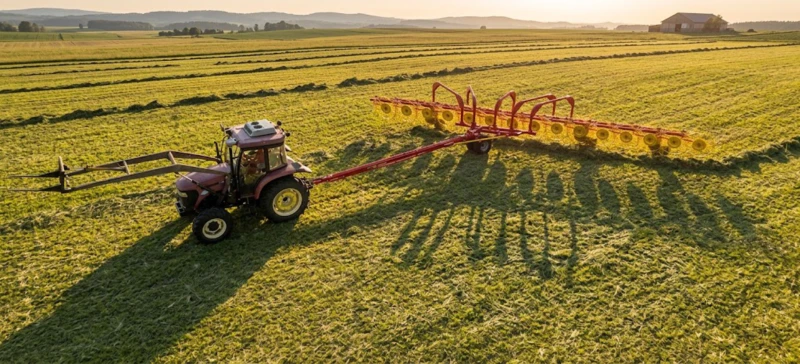
Every hay operation has a raking system — but most of them chose it by default rather than by design. The decision was made on the basis of what the dealer had in stock, what the neighbouring farm was using, or what cost the least at the time of the equipment purchase. The raking decision that should have been the fourth step in a systematic harvest chain design — after selecting the mower conditioner, the baler, and the bale transporter — was made first, or incidentally, or not made at all because the previous farm owner’s rake was included in the purchase.
The consequence is a raking system that may be technically capable of consolidating a windrow but is not matched to the specific performance requirements of the crop, the baler’s pickup width, or the scale of the operation. On alfalfa, a rake that is too aggressive causes leaf shatter that can reduce crude protein content by 3–5 percentage points — more than the difference between premium-grade and commodity-grade hay. On natural grassland at 10,000 ha scale, a rake that is too narrow creates the throughput bottleneck that forces cut material to spend an additional 6–12 hours in swath beyond its optimal drying window. On sloped terrain, a rake that is too wide and too heavy creates stability problems that a narrower, lighter implement would not.
This guide provides the systematic comparison between finger-wheel rakes and rotary rakes that most equipment decisions never receive — covering leaf loss performance, throughput capacity, terrain adaptability, windrow quality, power requirements, and total cost of ownership. For the raking implements and the complete forage harvest systems referenced in this guide, see our range of forage harvesting equipment.
1. How Each System Works — The Mechanics That Determine Performance
Finger-Wheel Rake: Ground-Driven, Passive Tine Action
A finger-wheel rake consists of a series of ground-driven wheel assemblies — each wheel carrying 60–90 spring-steel tines arranged radially around its hub — mounted on a lateral frame that spans the working width. The wheels are not powered: they are driven by ground contact as the implement is pulled forward, rotating at a speed proportional to forward travel speed. As each wheel rotates, its tines sweep through the swath material lying on the ground, lifting it and throwing it laterally toward the windrow forming zone between adjacent wheels or at the implement’s centre. The 9LZY-9.0 series at 9m working width carries 15 wheels with 900 total tines, forming a windrow through the combined lateral throw of 15 independently rotating wheel units.
The ground-driven mechanism has two consequences that define the finger-wheel rake’s performance profile. First, the tine tip speed is directly proportional to forward working speed — at 8 km/h, the tines move faster than at 6 km/h, generating more aggressive material engagement. Second, the tines are passive — they move through the material with the same force regardless of material density or resistance, without the powered drum’s ability to intensify engagement on a particularly dense swath section. This combination of proportional speed and passive action produces the gentlest possible engagement with cut material, which is why finger-wheel rakes are the preferred implement for alfalfa and other leaf-sensitive legume crops.
Rotary Rake: PTO-Driven, Active Tine Engagement
A rotary rake (also called a drum rake or rotor rake) uses one or more powered horizontal rotors — each carrying tine arms that extend outward from the rotor hub and sweep through the material at a speed determined by the PTO input speed rather than by forward travel speed. The rotor operates at a fixed tine tip speed regardless of how fast the tractor is moving: if the PTO drives the rotor at 120 r/min and the tine arms are 800mm long, the tine tips move at approximately 10 m/s regardless of whether the tractor is moving at 8 km/h or 12 km/h. This independent tine speed control is the rotary rake’s primary performance advantage — the tine engagement force can be maintained at the optimum level for the material by adjusting PTO speed rather than forward travel speed, allowing separation of the “how fast we cover ground” decision from the “how aggressively we engage the material” decision.
The rotary rake’s powered tine action generates higher throughput per unit of working width than a finger-wheel rake — it can move denser material at higher forward speeds without the engagement becoming insufficient. This throughput advantage makes rotary rakes the preferred implement for large-scale natural grassland operations where coverage rate is the primary constraint. The trade-off is higher tine tip speed and more aggressive material engagement, which generates more leaf shatter on fine-stemmed crops — making the rotary rake less suitable for alfalfa than for grass hay and straw.
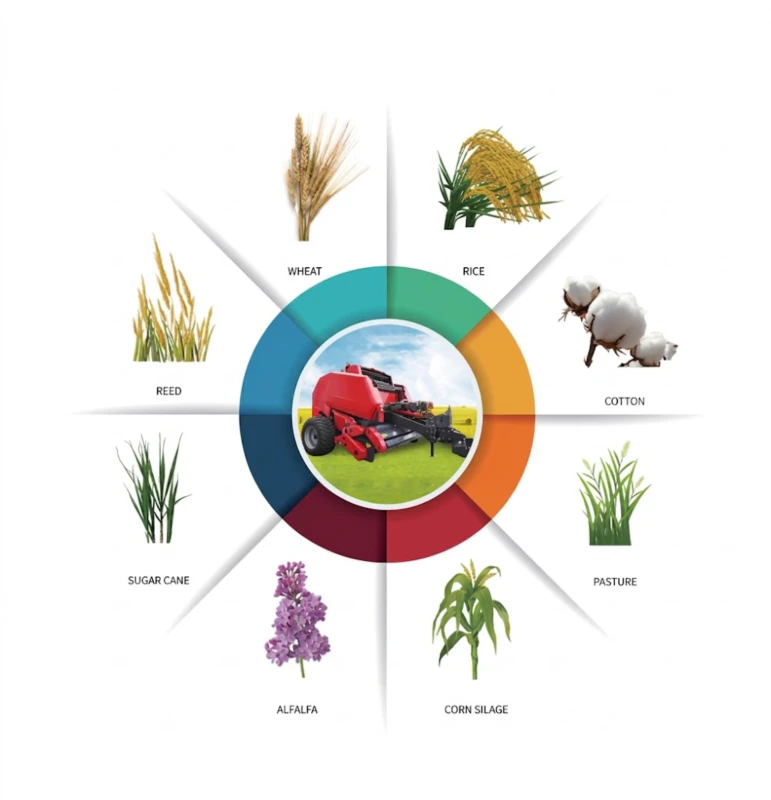
2. Leaf Loss: The Quality Dimension That Separates the Two Systems
Why Raking Causes Leaf Loss on Alfalfa
Alfalfa leaves attach to stems at a narrow petiole joint that fractures under minimal mechanical stress when the leaf is dry. At 30% moisture, the petiole retains enough flexibility to absorb the bending force of tine contact without fracturing. Below 25% moisture, the petiole becomes increasingly brittle and fractures under the impact of tines moving at speeds above approximately 3 m/s. Below 15% moisture, virtually any mechanical contact causes leaf detachment — raking at this moisture level produces significant shattering regardless of rake type, though gentler systems produce less than aggressive ones.
The practical leaf loss difference between finger-wheel and rotary raking on alfalfa raked at the optimal moisture window (35–45%) is typically 1–3 percentage points of total dry matter — 3–5% total leaf loss for finger-wheel versus 5–8% for rotary at equivalent forward speeds. At first appearance this seems modest, but on alfalfa at 20% crude protein (CP), a 3 percentage point dry matter leaf loss difference translates to approximately 1.2 percentage point reduction in bale CP content — a commercially significant quality difference that represents the gap between premium-grade and standard-grade pricing in most export markets. Across a season producing 500 tonnes of alfalfa, this CP difference is equivalent to approximately 6 tonnes of lost protein value — an amount that easily justifies the higher cost of a finger-wheel rake over a rotary alternative for alfalfa-specific operations.
When Rotary Rakes Are Acceptable on Legume Crops
Rotary rakes operating at reduced PTO speed — reducing tine tip speed from 10 m/s to 6–7 m/s — produce leaf loss rates on alfalfa that approach finger-wheel performance, at the cost of reduced throughput that may partially negate the rotary’s coverage rate advantage. For operations that already own a rotary rake and are baling alfalfa as a secondary crop alongside primary grass hay production, operating the rotary at reduced speed during alfalfa raking is a practical compromise. For operations where alfalfa is the primary value crop, the purpose-designed performance of a finger-wheel rake is the correct specification.
Raking moisture timing matters more than rake type: Both finger-wheel and rotary rakes produce significantly more leaf loss below 25% moisture than above 35%. The single most effective leaf loss reduction measure — for either rake type — is accurate moisture monitoring before raking begins and waiting for the optimal raking window rather than raking on a fixed time schedule. A rotary rake used at optimal moisture (35–45%) produces less leaf loss than a finger-wheel rake used at sub-optimal moisture (below 25%).
3. Throughput Capacity and Scale Matching
Finger-Wheel Rake Throughput
A 9m finger-wheel rake (the 9LZY-9.0 series) at 8–10 km/h working speed covers 7.2–9.0 effective hectares per hour — sufficient to stay ahead of a 2.4–2.8 ha/h mower conditioner by a comfortable margin, allowing the raking phase to be completed without creating a windrow accumulation backlog that holds the baler waiting. At 12m working width (the 9LH-12 horizontal hay rake configuration), effective throughput reaches 9.6–12.0 ha/h — sufficient for operations with two mower conditioners working simultaneously or for very large single-field operations where total raking area per day exceeds the capacity of a 9m system.
The horizontal hay rake design — a different geometry from the wheel-based finger-wheel — uses a bank of spring-steel tines arranged in a horizontal sweep pattern across the full working width, with tines rotating in a plane parallel to the ground rather than perpendicular to it. This design handles large volumes of material more uniformly across the rake’s width and is particularly effective for wide-area natural grassland operations where the material lies in a broad, even layer rather than in a concentrated swath. The 9LH-12’s 168 tines at 12m width provide 14 tines per metre of working width — sufficient density for consistent material engagement across the full grassland area without the concentrated zones of intense tine contact that can occur at the wheel centres of finger-wheel designs on very thin material.
Rotary Rake Throughput Advantage
A twin-rotor rotary rake in the commercial class covers 10–15 ha/h at 10–14 km/h working speed — 20–50% more area per hour than an equivalent-width finger-wheel rake. This throughput advantage is most valuable in large-scale grass hay operations where the raking phase is the system bottleneck — where the baler and mowing system both have more capacity than the rake can service, and where the time from cut to bale is constrained by the raking rate rather than anything else. For grassland operations above 2,000 ha per cut, the rotary rake’s throughput advantage can represent the difference between completing the raking phase within the optimal moisture window and leaving a proportion of the cut area over-dried before the baler arrives.
The throughput comparison must account for working width as well as speed. A 9m rotary rake at 14 km/h covers 12.6 ha/h — the same as a 12m finger-wheel rake at 10.5 km/h. At equivalent working width, the rotary’s speed advantage is real and meaningful for grass operations. At narrower working widths where both rake types are available, the comparison is less clear-cut and the leaf loss difference on fine-stemmed crops becomes the more decisive factor.
4. Windrow Quality: What the Baler Actually Receives
Windrow Consistency and Its Effect on Bale Density
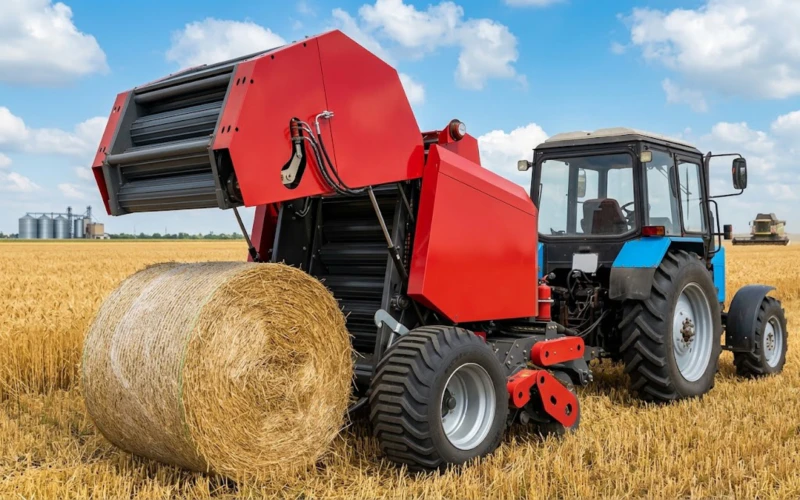
The quality of the windrow that the rake delivers to the baler — its width consistency, density uniformity, and height profile — directly determines the bale density consistency the baler can achieve. A uniformly formed windrow at 85–90% of the baler’s pickup width, with consistent material density per unit length and a rounded cross-section that feeds cleanly into the pickup, allows even a manual-pressure baler to approach the density consistency of a sensor-controlled system on a variable windrow. A poorly formed windrow — with width variations that cause the pickup to miss material at the margins, or density spikes where two swath passes have been merged unevenly — forces the baler’s compression system to compensate for raking variability in addition to the crop’s natural density variation.
Finger-wheel rakes produce windrows with a characteristic rounded-top cross-section — wider at the base where tines deposit material and slightly narrower at the crown where the windrow self-organises under its own weight. This rounded profile feeds smoothly into a round baler’s pickup because the material at the windrow edge is at the same height as the windrow centre, allowing the pickup to engage the full width simultaneously rather than lifting the edge material first and creating an uneven feed cascade to the chamber. Rotary rakes tend to produce a higher, narrower windrow that can develop a flat-topped or peaked profile at higher working speeds — a profile that feeds less uniformly into the pickup unless the baler’s feed channel is specifically designed for high-windrow material.
Windrow Width Setting: The Critical Interface Between Rake and Baler
Regardless of rake type, the windrow width must be set to 85–90% of the baler’s pickup width. For a baler with a 2240mm pickup, the windrow target is 1900–2000mm. Setting the windrow too narrow (below 70% of pickup width) wastes the baler’s full pickup capacity and produces lighter, less consistent bales because the chamber never receives the full material volume it was designed for. Setting the windrow too wide (above 100% of pickup width) causes the pickup to miss material at the windrow edges — the leaf-rich margin material that migrates to the windrow edge during raking — producing field loss concentrated in the most nutritionally valuable fraction of the crop.
Both finger-wheel and rotary rakes provide windrow width adjustment through the wheel spacing or rotor offset settings. The adjustment method differs between designs but the target is identical: the windrow that arrives at the baler must match the baler’s design intake width. Setting this width correctly at the start of each raking pass — and verifying it with a tape measurement of three windrows at different field positions — is a five-minute procedure that has a larger impact on bale density consistency than most mechanical adjustments.
5. Power Requirements, Terrain Adaptability, and Ownership Cost
Power: The Finger-Wheel’s Structural Advantage
Finger-wheel rakes require no PTO drive — they are ground-driven through wheel-ground contact and draw power from the tractor only through drawbar pull. The 9LZY-9.0 requires a minimum 18.4 kW (25 HP) tractor for working speeds up to 12 km/h — compatible with the smallest utility tractors in most agricultural fleets. The 9LH-12 horizontal rake requires a similar modest power input because its tines are also ground-driven through a mechanical linkage rather than a PTO shaft. This zero-PTO-power requirement means the rake never competes with the baler for tractor power resources — a significant advantage when one tractor is used for both raking and baling on smaller operations.
Rotary rakes require PTO input — typically 30–60 kW depending on working width and rotor count. This PTO demand must be available from the raking tractor simultaneously with the drawbar power needed for forward motion at working speed across the field’s terrain. For operations where the raking tractor is also used for baling in a sequential (not simultaneous) workflow, the tractor must be correctly specified for the higher-demand implement — the baler — with the rotary rake’s PTO demand being an additional consideration for tractor sizing. A tractor that is at its power limit for baling will be over-stressed if the same session includes rotary raking at full PTO demand.
Terrain Adaptability
Finger-wheel rakes are inherently terrain-following — each wheel assembly is independently ground-contacting, and the implement’s total weight is distributed across the full working width through the individual wheel contact points. On uneven natural grassland terrain, individual wheels can follow terrain changes independently without the lateral frame lifting away from the ground on one side. This terrain adaptability is the reason finger-wheel rakes are the standard choice for natural grassland operations with significant topographic variation — slopes, drainage channels, and undulations that would cause a rigid-frame implement to miss material on the high side while over-raking on the low side.
Rotary rakes are more sensitive to terrain variation because the rotor height above ground determines tine engagement depth — if terrain undulation raises or lowers the material relative to the rotor’s fixed operating height, tine engagement intensity changes. Most commercial rotary rakes have floating suspension systems that accommodate ±100–150mm of terrain variation, but beyond this range the material depth of engagement changes enough to affect windrow quality. For operations with terrain variation above ±200mm across the field, a finger-wheel rake’s individual-wheel ground-following capability provides more consistent windrow quality than a rotary rake’s fixed-rotor design.
Total Cost of Ownership
Finger-wheel rakes have a lower purchase price than equivalent-width rotary rakes in most markets, because the mechanical complexity of a ground-driven wheel assembly is substantially less than a PTO-driven rotor with bearing housing, drive shaft, and gearbox. Maintenance cost is also lower — wheel bearings are the primary wear item, replaceable without workshop tools at low unit cost, compared to rotor gearbox service and PTO shaft maintenance on rotary designs. The tine replacement cost is comparable between designs — both use replaceable spring-steel tines at similar per-tine cost and similar replacement frequency. For operations that are cost-sensitive on capital equipment investment and prioritise mechanical simplicity and low maintenance cost, the finger-wheel design’s lower total cost of ownership is a genuine and sustained advantage over the operating life of the implement.
6. The Decision Framework: Which Rake for Which Operation
The rake selection decision reduces to four questions whose answers, taken together, identify the correct implement for each specific operation:
| Decision Factor | Points to Finger-Wheel | Points to Rotary |
|---|---|---|
| Primary crop type | Alfalfa, clover, or mixed legume — leaf loss is commercially significant | Grass hay, natural grassland, straw — leaf quality less critical |
| Annual production scale | Under 500 ha/cut — 9m system adequate | Above 1,000 ha/cut — throughput is the bottleneck |
| Field terrain | Variable slopes, uneven natural grassland | Flat to gently undulating irrigated paddocks |
| Available tractor power | Small tractor (under 45 kW) — no PTO capacity to spare | Dedicated raking tractor with adequate PTO capacity |
| Capital and maintenance budget | Cost-sensitive; prefer lower purchase and maintenance cost | Throughput value justifies higher capital cost |
| Typical best match | Alfalfa / mixed legume / small-to-mid scale / variable terrain | Grass / large grassland scale / flat terrain / dedicated tractor |
The Role of the PTO Shaft in Rotary Rake Performance
For rotary rakes, the PTO driveshaft is a critical system component whose specification directly affects windrow quality. The rotor’s tine tip speed is determined by PTO input speed — variation in PTO speed produces variation in tine engagement force, which produces windrow density variation that downstream baling cannot fully compensate for. A correctly specified and maintained pto shaft delivering stable speed to the rotor gearbox produces consistent tine engagement across variable material density sections. A worn shaft with universal joint play introduces speed variation at the rotor that is indistinguishable from tractor throttle variation — the rotor runs unevenly, and the windrow reflects that unevenness as density variation that propagates all the way to the finished bale’s density distribution.
For finger-wheel rakes, no PTO shaft is required — the elimination of this component removes one maintenance item and one potential failure point from the harvest chain. This is a genuine operational advantage for remote-location operations or multi-machine fleets where PTO shaft inspection discipline is difficult to maintain consistently across all implements simultaneously.
Selecting a Rake for Your Forage Operation?
Our team can help you match the 9LZY-9.0 finger-wheel rake, 9LH-12 horizontal rake, or other raking configurations to your specific crop, scale, terrain, and baler pickup width — as part of a complete harvest system design or as a standalone implement recommendation.