
Export Hay Markets
Bale density is not a logistics specification — it is a quality proxy, a transport cost driver, and a supply chain reliability signal. Understanding what export buyers actually measure, and why, is the first step to producing hay that commands premium pricing consistently.
The difference between hay that sells at premium grade and hay that sells at commodity grade is rarely visible in the field. It shows up in the bale — in density, consistency, moisture, and colour — and all four of those variables are determined by what happens between the mower conditioner and the bale transporter.
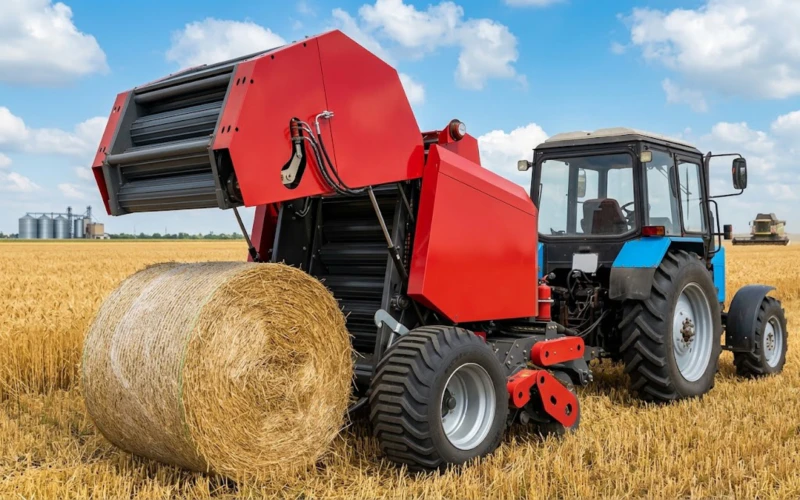
The specification sheets that export hay buyers in Japan, South Korea, China, and the Middle East send to their suppliers contain a list of requirements that can look, at first glance, like a logistics checklist: bale diameter, bale length, bale weight, moisture content, binding type. Experienced exporters understand that these are not logistics specifications — they are quality proxies. The buyer is not specifying bale weight because they need it to fit a particular container position. They are specifying bale weight because a bale at a consistent, known weight signals that the density control system was working correctly throughout the production run, that the operator was not compensating for wet windrows by reducing compression pressure, and that the bales in this shipment will perform predictably in the ration for the next three to six months. Bale weight consistency is a proxy for process control.
This distinction matters because it changes how producers should think about density specification compliance. A producer who treats the density specification as a logistics constraint — and attempts to meet it by weighing a sample of bales and adjusting the baler pressure setting until the average is within range — will produce bales that average the required weight but vary widely around that average. A producer who understands that the specification is a quality signal will instead invest in the sensor-controlled density system that eliminates variability from the root cause — ensuring that every bale across every working day of the season is within the target range, not just the average of measured samples.
This article examines what export alfalfa buyers actually specify and why, how bale density is produced and controlled at the equipment level, what the financial consequences of specification non-compliance look like in practice, and how producers can build the production system that reliably meets export standards season after season. For the baling equipment that makes consistent export-grade density achievable, see our range of commercial alfalfa round balers.
1. What Export Buyers Actually Specify and Why Each Item Is on the List
Bale Density: The Central Specification
The core export specification for round-baled alfalfa in most Asian dairy markets is a minimum net bale density in the range of 150–200 kg/m³, depending on grade category and buyer. Premium dairy-grade alfalfa destined for high-producing herds in Japan and South Korea typically requires 170–200 kg/m³. Standard dairy-grade product for Chinese dairy farms typically specifies 150–180 kg/m³. Lower-density product — below 140 kg/m³ — is categorised as utility-grade and commands significantly lower pricing, typically 15–25% below premium grade at equivalent crude protein content.
Why is density specified at all? Three reasons interact: transport economics, nutritional predictability, and storage performance. Transport economics: a higher-density bale carries more dry matter per volume unit, which directly reduces freight cost per tonne of hay delivered. At 170 kg/m³ versus 120 kg/m³, a bale of the same dimensions contains 42% more dry matter — meaning a container stuffed with 170 kg/m³ bales delivers 42% more product at the same freight cost as a container of 120 kg/m³ bales. At USD 4,000 per container, this difference is USD 1,680 in effective freight cost per container load of hay delivered — a difference that over a season’s shipments represents a very large absolute sum and the primary reason buyers enforce density specifications rather than treating them as aspirational.
Moisture Content: Quality Preservation in Transit
Most export contracts specify maximum moisture content at loading — typically 14–16% — because the 14–30 day ocean transit period in a sealed container creates conditions for microbial activity if moisture is above safe levels. A bale at 18% moisture that enters a container in acceptable condition can arrive at destination with surface mould, internal heating damage, and crude protein reduction from heat-damaged protein formation — all of which result in quality downgrades or rejection on arrival. The moisture specification is therefore not about the bale as it leaves the farm — it is about the bale as it arrives at the destination dairy after weeks in a sealed metal container in tropical ocean transit conditions.
Colour and Visual Grade: The First Impression That Sets the Price
Export alfalfa is graded visually before any chemical analysis is conducted. Green to light gold colour indicates rapid field drying and minimal UV exposure — the product of cutting at the right maturity stage, conditioning to accelerate drying, and baling within 24–36 hours in good conditions. Brown, bleached, or grey colour indicates either slow drying (long field exposure), rain damage after cutting, or above-optimal moisture at baling that caused internal heating discolouration in the bale core. Buyers’ agents and destination customs inspectors assess colour visually on arrival and adjust grade — and therefore price — accordingly. A shipment that analyses at 20% crude protein but arrives brown will be traded at a discount to equivalent-protein green product.
2. How Bale Density Is Produced and Why It Varies
The Three Variables That Determine Bale Density
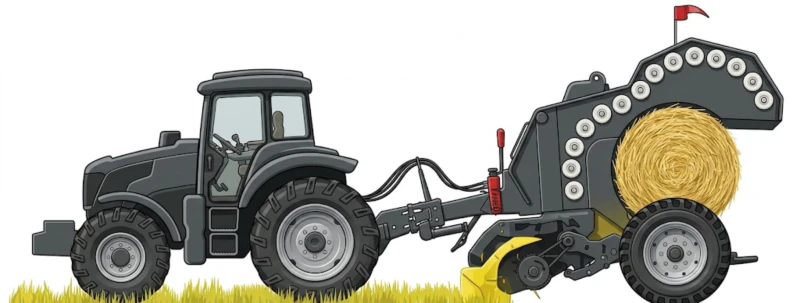
Bale density in a round baler is the product of three variables working simultaneously: the chamber pressure applied by the compression system, the volume of material entering the chamber per unit of forward travel, and the material’s resistance to compression — which varies with moisture content, crop species, and stem diameter. On a flat, uniform alfalfa field with consistent windrow density, all three variables remain relatively stable and a manual pressure setting can maintain acceptable density. On a real commercial field — where windrow density varies by 30–40% between sparse and thick sections, where tractor speed varies between headlands and mid-field, and where afternoon conditions differ from morning in terms of crop desiccation — the three variables change continuously and a static pressure setting cannot compensate.
The consequence is that manual-pressure balers produce density distributions rather than density targets. In a field test on mature alfalfa with representative windrow density variation, a manual-pressure baler set to produce a target of 175 kg/m³ average density produced a distribution ranging from 138 kg/m³ to 218 kg/m³ across the bale production run. The average was 174 kg/m³ — technically within spec. But 22% of individual bales were below the 150 kg/m³ floor that the buyer’s specification imposed. Those below-floor bales, if identified at loading or destination, would trigger price adjustment on the entire shipment under most contract terms — costing far more than any equipment investment could justify.
How Sensor-Controlled Density Eliminates the Distribution Problem
Sensor-controlled density systems address the variable-density problem at its source — the real-time mismatch between chamber pressure setting and material volume entering the compression zone. Pressure transducers monitor compression force across the chamber in real time, and the hydraulic control system adjusts the compression element (belt tension, roller pressure, or gate resistance depending on chamber design) before each new layer of material is added to the growing bale. The adjustment cycle is faster than the rate at which windrow density changes during normal forward travel, meaning the system maintains the target density continuously rather than responding to density deviations after they have already occurred in the bale.
In the same field test conditions described above, a sensor-controlled density baler set to 175 kg/m³ produced a distribution ranging from 168 kg/m³ to 183 kg/m³ — a ±4% variation band versus ±25% for the manual system. Zero bales fell below the 150 kg/m³ specification floor. The entire production run was within the premium-grade density band, and the consistency of individual bale weights — within ±5 kg of the target weight — simplified container loading logistics by eliminating the need for bale-by-bale weight assessment before stuffing.
The financial case in one number: If 22% of your manual-press bales fall below the export minimum density and trigger a 15% price discount on the entire container, the discount on a USD 40,000 container of premium alfalfa is USD 6,000. A sensor-controlled density upgrade that eliminates below-floor bales entirely pays back in fewer container-loads than most producers expect when they run the calculation.
3. The Production Chain That Determines Export Specification Compliance
Consistent export-grade bale density is not produced by a good baler alone — it is the outcome of a production chain where every step is managed to deliver the right material to the baler at the right moisture, density, and physical condition. A sensor-controlled baler receiving an inconsistently raked windrow with large gaps and dense sections cannot maintain the same density consistency as the same baler receiving a uniform windrow. The chain must be designed and managed as a system.
Mowing Timing and Conditioning Quality
Export-grade colour — the green to light gold standard — requires cutting alfalfa at the late bud to first flower stage and completing the drying cycle in 24–36 hours in good conditions. This fast drying requires effective conditioning at the point of cutting: a mower conditioner that achieves adequate stem cuticle disruption reduces field drying time to within the colour-preservation window. Conditioning effectiveness falls rapidly if the conditioning rotor is set too wide (insufficient contact pressure) or if the mower conditioner is operated at reduced speed in heavy crop conditions. Monitoring conditioning quality by breaking conditioned stems and checking for visible cuticle disruption along the stem length — not just at the cut end — is the field check that ensures the conditioning system is actually achieving the dry-down acceleration it is rated for.
Raking Timing and Windrow Uniformity
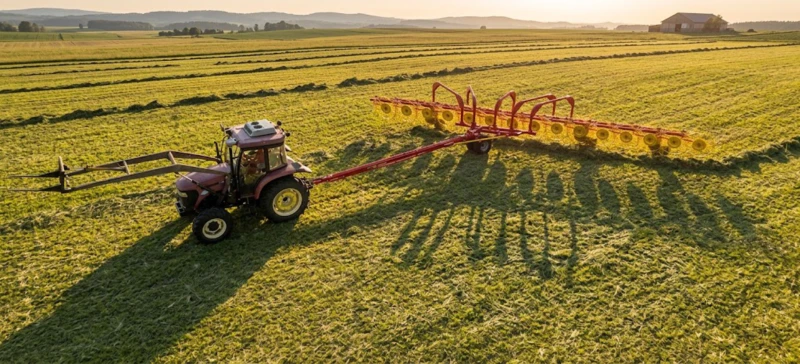
The windrow that the baler receives determines how well the density control system can maintain target density. A uniform windrow — consistent cross-section, consistent material density per metre, consistent width relative to pickup width — allows the sensor system to operate within its designed adjustment range and maintain tight density control. A non-uniform windrow — with gaps between adjacent swath passes, variable density from different cut sections raked together, or width inconsistency that leaves some sections outside the pickup’s collection zone — presents variable material loads to the baler that even sensor control cannot fully compensate for. Raking at the optimal moisture window (35–45% for alfalfa) with consistent tractor speed and rake arm angle settings is the operational discipline that produces the uniform windrow the baler needs for export-specification density consistency.
Baling Moisture: The Variable That Most Often Causes Compliance Failures
The majority of export specification failures — both at loading inspection and on arrival at destination — trace back to baling above the optimal moisture window. Producers baling at 20–22% moisture to capture the crop before a forecast weather change produce bales that appear compliant on density and colour when loaded, but develop internal heating discolouration during ocean transit that results in grade downgrade on arrival. The decision to bale in marginal moisture conditions — made under weather pressure at the farm level — creates quality consequences that are only visible weeks later at the destination, by which point the financial penalty is already incurred and irreversible.
The operational discipline that separates consistently export-compliant producers from occasionally export-compliant producers is the willingness to leave crop in the field — or delay baling — when moisture measurements are above the safe threshold, even when the weather forecast creates pressure to bale now. This requires accurate moisture monitoring (a calibrated forage moisture meter, not appearance or feel alone), a consistent protocol for sampling windrows before the baler starts, and a producer culture that treats moisture compliance as non-negotiable rather than as a judgement call under time pressure. The hay that gets baled at 20% moisture to beat a rain event and then fails destination inspection costs more than the hay that is left in the field for one more day and baled correctly the next morning.
4. The Role of the PTO Shaft in Export-Grade Density Consistency
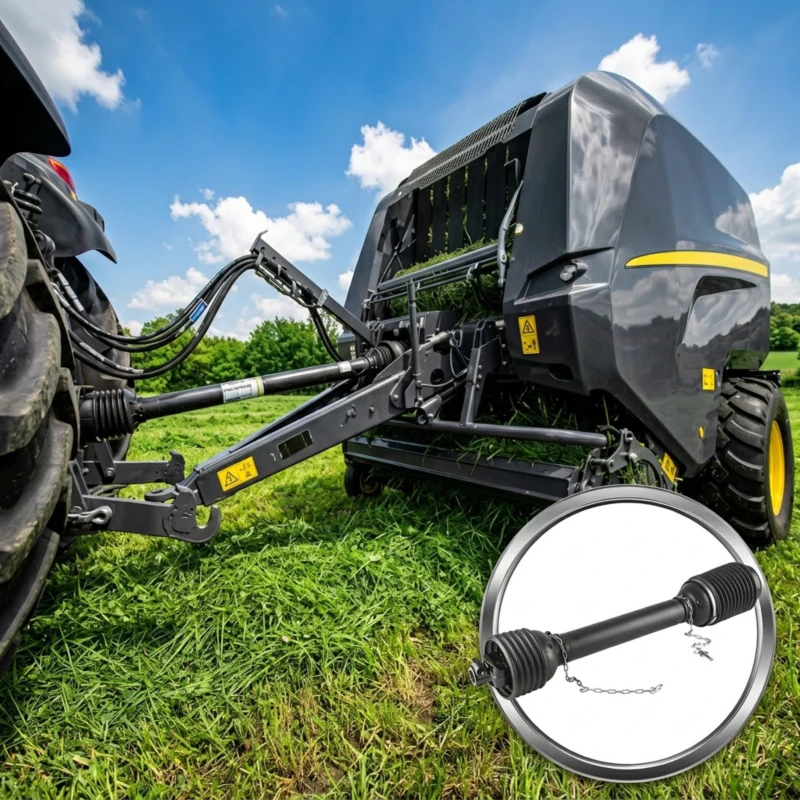
Sensor-controlled density systems rely on a stable, consistent PTO input speed to calibrate and maintain their pressure feedback loops accurately. The sensor measures chamber pressure — a force — and adjusts compression elements in response. The accuracy of this adjustment depends on the assumption that the power input driving the compression system is arriving at a consistent rotational speed. When PTO speed fluctuates — because the tractor is underpowered for the load, or because a worn or imbalanced driveshaft introduces rotational variation — the sensor system is compensating for a pressure reading that is partly a function of material density and partly a function of PTO speed variation. The two signals are indistinguishable from the sensor’s perspective, and the result is density variation that the sensor system cannot eliminate even though it is functioning correctly.
This is the mechanism by which an undersized or poorly maintained pto shaft degrades the performance of a sensor-controlled density system. The shaft introduces speed variation into the system that the sensor cannot distinguish from material density variation — and in attempting to compensate for both simultaneously, the sensor produces density variation rather than eliminating it. Export-grade producers who have invested in sensor-controlled density equipment and are still experiencing density inconsistency should check PTO shaft condition and balance before investigating the sensor system itself — the shaft is the more likely source of residual density variation in an otherwise correctly configured baling system.
For export alfalfa programs, the PTO shaft specification should be treated as part of the quality management system rather than as an equipment maintenance item. A dynamically balanced shaft rated for the baler’s full operating torque at 720 r/min, with a friction-clutch overload device calibrated for alfalfa peak loads, and an intact full-length guard inspected before every shift, is the shaft specification that allows a sensor density system to deliver its rated ±5% density variation rather than the ±15–20% that an unstable power input produces.
5. Building a Consistent Export-Grade Production System
Consistent export-grade production is the product of equipment, protocol, and measurement working together. The equipment provides the capability — sensor density control, wide pickup, effective conditioning, intact power transmission. The protocol converts that capability into consistent daily practice — moisture sampling before baling, conditioning intensity checks after each mowing start, windrow width verification relative to pickup setting. The measurement closes the loop — tracking bale-to-bale density across production days, identifying the conditions (time of day, windrow density zone, crop maturity) that produce density outliers, and using that information to adjust protocol before the next cut.
The Five-Point Export Compliance Checklist
Confirm moisture below 15% before starting the baler each day. Sample three windrow locations (near start, mid-field, far end) and do not proceed if any reading exceeds 16%. Record readings and time for season documentation.
Verify sensor density calibration against known bale weights at the start of each season. Weigh 10 consecutive bales on a calibrated scale and confirm average and spread are within specification before beginning export-grade production.
Inspect the PTO shaft guard and check for universal joint play before the first baling day of each cut. A 15-minute inspection at the start of each cut cycle prevents the mid-season failure that disrupts production precisely when the pressure to bale is highest.
Check net wrap coverage on the first five bales of each day. Verify that net wrap extends to the bale edges with full overlap — edge-short net wrap allows moisture penetration at the bale shoulder during ocean transit that causes colour downgrade at destination.
Maintain season production records with bale count, average density, moisture at baling, and cut date for each production lot. Export buyers increasingly require lot traceability documentation — producers who can provide field-level lot records command a trust premium that affects long-term contract terms beyond individual shipment pricing.
Producing Alfalfa for Export Markets?
Our technical team works with commercial alfalfa producers across Asia, Australia, and Central Asia who supply export markets. We can help you select the sensor-controlled density system, pickup width, and PTO shaft specification that consistently meets premium buyer requirements.