
Equipment Maintenance
A round baler that fails mid-harvest is not a maintenance problem — it is a planning problem. Every in-season failure is a pre-season inspection that did not happen. This checklist closes that gap before the season opens.
The five-minute inspection that prevents a two-day repair is not a philosophy — it is arithmetic. Every check on this list costs less than the failure it prevents, often by an order of magnitude.
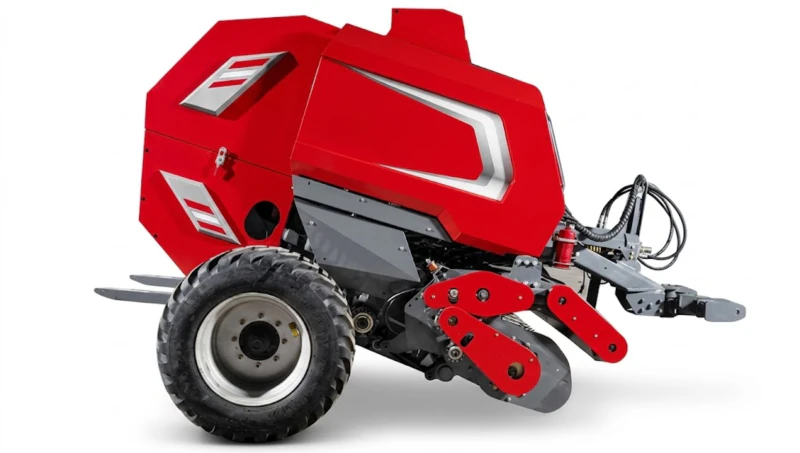
A commercial round baler is one of the most mechanically active implements in the agricultural equipment fleet — during a 10-hour baling day it may complete 600 bale cycles, drive a pickup rotor through several hundred tonnes of material, apply net wrap to every bale, and transmit full engine torque through its gearboxes and drive chains continuously. The components that perform all of this work operate at high stress levels, in abrasive environments, and are typically inspected infrequently because the baling season is short and the production pressure during it is high.
The result is a predictable pattern: balers that work well for the first two to three seasons on minimal maintenance, then develop cascading failures as wear reaches critical thresholds across multiple components simultaneously — a worn pickup bearing that accelerates tine damage, a loose drive chain that hammers the gearbox input, a degraded net wrap guide roller that causes application failures at the rate of five bales per hour. Each of these failures is individually preventable with a 10-minute inspection and a USD 20–150 part replacement. Together, they represent a baler that is unreliable in the field and expensive to return to service.
This checklist is structured around three phases: pre-season (the six weeks before first cut), in-season (daily and weekly checks during the baling period), and post-season (the actions that prevent off-season deterioration and set up the following year’s pre-season inspection with minimal rework). For the round baler models this checklist is designed to support, see our complete range of commercial round balers.
Phase 1 — Pre-Season (Six Weeks Before First Cut)
Pre-season maintenance is the investment that determines whether the baling season runs smoothly or is punctuated by avoidable breakdowns. Six weeks before first cut provides enough lead time to order parts, complete repairs at a manageable pace, and test the system before the production pressure of the first cutting window arrives.
Pickup Tine Inspection and Replacement
Inspect every pickup tine for bending, cracking, and wear at the tine-to-bar attachment point. A bent tine that sweeps unevenly through the windrow creates a pickup gap that consistently misses material in a strip across the full pickup width — the most common cause of unexplained field loss that operators attribute to windrow conditions rather than equipment. Replace any tine that is bent more than 10° from its original profile, cracked at the attachment weld, or worn below 80% of its original length.
Parts to have ready: One full set of replacement tines (the same number as on the pickup, so any damaged tine can be replaced immediately). Most commercial round balers use 60–80 tines across the pickup width.
Compression Chamber Roller or Drum Inspection
Rotate each compression roller or drum by hand and listen for grinding, uneven resistance, or bearing noise. A roller bearing that is rough to rotate under hand load will fail under operating load — typically during the highest-throughput section of the working day when the baler is under sustained compression demand. Check the roller surface for grooving or flaking that reduces the grip on bale material. Grooved rollers allow material to slip rather than compress, reducing achievable bale density even at maximum pressure settings. Replace any roller with more than 3mm of surface wear depth or any bearing that produces audible grinding under hand rotation.
Maintenance action: Grease all roller bearing lubrication points. Check the baler operator manual for the bearing grease specification — mixing grease types causes soap incompatibility that accelerates bearing deterioration.
Drive Chain and Gearbox Inspection
Check all drive chains for stretch, stiffness, and lubrication. A chain that is stretched beyond its wear limit runs loose on its sprockets, causing impact loading at every tooth engagement that accelerates both chain and sprocket wear and generates torsional vibration that loads the gearbox input shaft. Measure chain stretch against the manufacturer’s specification using the standard pin-count deflection method — most agricultural chains require replacement when they have stretched 2–3% from their nominal pitch. Check all sprockets for hook-shaped tooth profiles (indicating extreme wear) and replace worn sprockets simultaneously with the chain — installing a new chain on worn sprockets accelerates the new chain’s wear to the worn chain’s rate within one season.
Gearbox check: Drain and refill the main input gearbox oil if it has not been changed in the last two seasons, or if the oil appears dark or contaminated. Check gearbox housing for cracks and the output shaft seals for leaks.
Net Wrap System — Guide Rollers, Dispenser, and Solenoid
Clean the entire net wrap path of accumulated crop dust and stem debris — material that packs into the guide roller tracks during operation and hardens between seasons into a dense plug that prevents the net from feeding correctly. Rotate each guide roller by hand to confirm it turns freely; replace any that have seized or that show flat spots from crop material compacted around the bearing surface. Test the dispenser solenoid by activating it from the operator console and confirming it triggers cleanly with no hesitation or partial engagement. A solenoid that triggers slowly causes net wrap application to start late in the bale rotation cycle, leaving the bale end uncovered — the most common source of edge-moisture penetration in outdoor storage.
Test roll: Load a roll of net wrap and complete three consecutive wrapping cycles on a bale formed from a test windrow. Confirm coverage reaches the bale edge on both ends and that the net cuts cleanly without tearing or leaving a trailing tail.
Hydraulic System — Hoses, Cylinders, and Fluid
Inspect all hydraulic hoses for cracking, chafing, and bulging at crimp ends. A hose that develops a pinhole leak at operating pressure (typically 200–250 bar) on a compression cylinder creates a hydraulic fluid injection hazard — fluid injected through skin by a high-pressure pinhole causes serious medical emergencies that are not immediately apparent from the entry wound. Replace any hose with visible cracking in the outer sheath, any hose older than five years regardless of appearance, and any hose that has been chafed by contact with rotating components to less than 75% of its original outer diameter.
Fluid check: Check hydraulic fluid level and condition. Dark or milky fluid indicates contamination — flush the system and refill with the specification fluid before operating. Confirm the hydraulic filter was replaced at the last service interval; a blocked filter causes system pressure loss that directly affects density control performance.
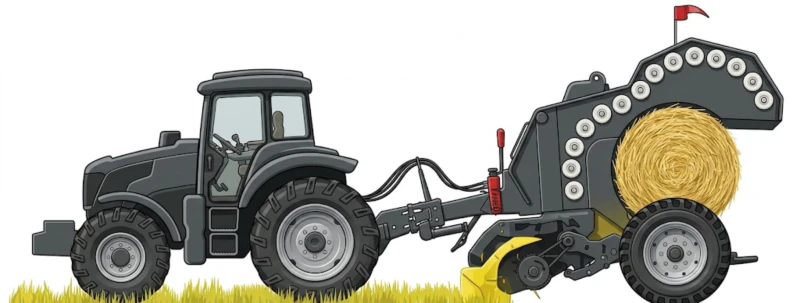
Phase 1 Continued — PTO Shaft and Sensor System
PTO Shaft — Guard, Joints, Splines, and Overload Device
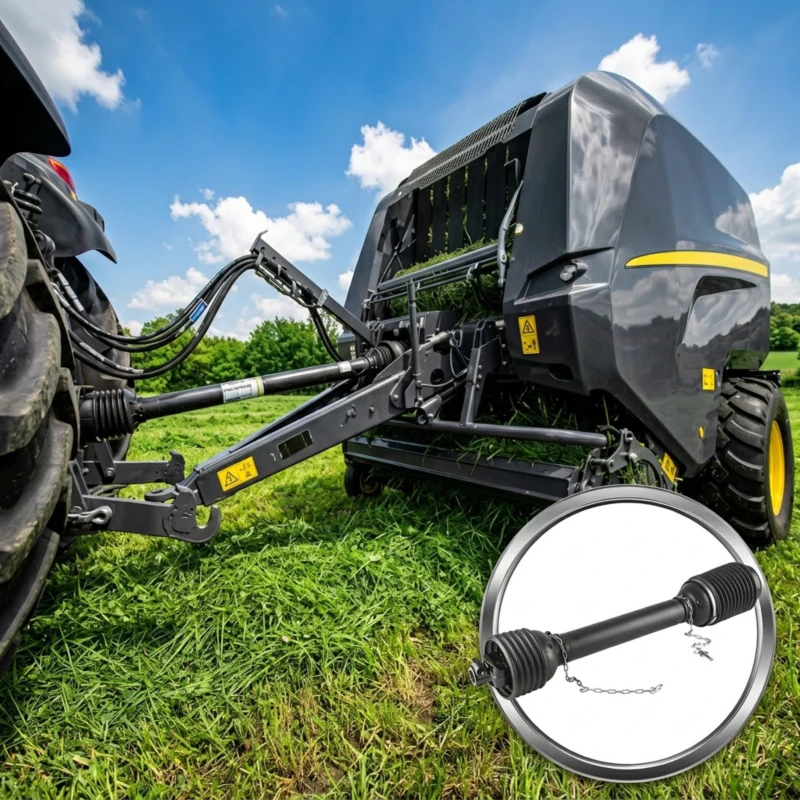
The PTO driveshaft connecting your tractor to the baler is the single most failure-critical component in the forage harvest system from a downtime risk perspective — a shaft that fails at 11am on the first day of a narrow weather window can mean two days of downtime while a replacement is sourced. Inspect the full guard length for cracks exceeding 30mm; rotate the outer guard by hand to confirm it turns independently of the inner shaft (guard bearing functioning); check universal joint cups for radial play (more than 2mm of movement in any direction indicates replacement-level wear); extend and retract the telescoping spline to confirm it moves freely without binding or catching; confirm the friction clutch or shear bolt overload device is correctly adjusted to the specification in the baler operator manual.
Stock a spare: For operations more than two hours from a parts supplier, carry a complete replacement pto shaft in the field vehicle throughout the baling season. The cost of the spare shaft is a fraction of the cost of 48 hours of weather-window downtime.
Sensor Density System Calibration Verification
If your baler is equipped with sensor-controlled density, verify the system calibration before the first production baling day. Produce 10 consecutive bales on a test windrow, weigh each bale on a calibrated scale, and calculate the average density from weight and known bale dimensions. If the measured average density differs from the setpoint by more than 5%, the system requires recalibration — a procedure detailed in the baler’s service manual or available from your dealer’s service department. Also clean all pressure transducer connectors and sensor wiring connections with electrical contact cleaner to remove dust and moisture that can increase contact resistance and produce false low-pressure readings that cause the system to over-compress.
Document the result: Record the measured density versus setpoint and the date of calibration verification. This documentation is useful for diagnosing mid-season density drift and for identifying whether a year-on-year density decline is sensor calibration drift or equipment wear.
Phase 2 — In-Season Checks (Daily and Per-Cut)
In-season maintenance is not about detailed inspections — it is about the five-minute checks at the start of each shift that catch the developing problems before they become production stoppages. The following three checks take under 10 minutes combined and cover the most common sources of in-season failure.
Daily Pre-Shift Inspection (10 Minutes Each Morning)
Run through the following points before engaging the PTO on the first bale of each day:
- PTO guard: full length check for new cracks from previous day. Confirm guard bearings at tractor and implement end are still rotating freely. Confirm both safety chains are attached.
- Net wrap: confirm roll is correctly seated on the roll holders and that the leading edge is threaded through the guide path correctly. A net roll that is off-centre on its holders causes edge-skipping wrap coverage on the first 3–5 bales of the day.
- Pickup: walk the pickup width and confirm no debris has wrapped around the pickup shaft overnight. Field mice and other small animals sometimes nest in the pickup assembly during overnight breaks — clearing the pickup before engagement prevents jam events on the first bale.
- Hydraulic system: check for any puddle or drip below the baler that was not present the previous evening. A new drip indicates a seal or hose failure that occurred under pressure during the previous day’s work and requires repair before operating.
- Tyre pressures: check both transport tyres are at specification. An underinflated tyre on a heavy baler causes uneven terrain tracking that affects windrow following and increases the bale ejection instability on slopes.
Per-cut addition: At the start of each new cut (typically 3–4 times per season for alfalfa), grease all universal joint nipples and the telescoping spline on the PTO shaft. In-season greasing at 50-hour intervals prevents the bearing deterioration that pre-season greasing alone cannot cover across a full commercial season.
In-Field Quality Monitoring — Bale Shape and Weight Sampling
Bale shape and weight are the most accessible in-field indicators of equipment performance across the working day. A cylindrical bale with flat ends and even circumference across its width is a healthy baler. Deviations from this shape indicate specific developing problems: barrel shape (wider in the middle than the ends) suggests excess chamber pressure or uneven roller wear; cone shape (tapered from one end) indicates a misaligned pickup that is feeding more material to one side of the chamber than the other; soft ends that collapse under hand pressure suggest the net wrap is not reaching the bale edge — the solenoid trigger or guide roller is developing a fault.
Weigh three random bales per half-day against the expected weight for the set density target. More than ±10% variation from expected weight on consistent windrows indicates that the density control system, compression chamber, or PTO input is developing an issue that requires attention before it becomes a production failure.
Phase 3 — Post-Season (Within Two Weeks of Last Bale)
Post-season maintenance is both the close-out of the current season and the preparation for the next. The work done in the two weeks after the last bale of the season determines whether next year’s pre-season inspection starts from a clean baseline or has to address six months of corrosion, hardened residue, and moisture-damaged bearings that formed during off-season storage without end-of-season preparation.
Post-Season Clean-Down, Lubrication, and Storage Preparation
Complete the following post-season procedure within two weeks of the final baling day, before the baler enters off-season storage:
Crop residue removal (2–3 hours):
- Remove all crop material from the compression chamber, pickup assembly, and net wrap guide path. Hay dust and stem fragments that remain in the net wrap mechanism compact into a hard mass over winter that prevents net feed on the first bale of the following season.
- Clean between pickup tines and confirm no stems are wrapped around pickup shaft bearings. Wrapped stems hold moisture against bearing seals and accelerate corrosion that would not occur on a clean bearing surface.
- Clear all crop material from chain and sprocket assemblies. Residue that packs into chain links holds moisture that causes rapid rust pitting in off-season storage.
Lubrication (1 hour):
- Grease all bearing points, including points that were greased at the last in-season service. Off-season greasing displaces the water-contaminated grease that has accumulated at bearing seals during the final weeks of operation and replaces it with fresh grease that prevents corrosion during storage.
- Apply chain lubricant to all drive chains after cleaning. A lubricated chain in storage does not rust; an unlubricated chain in a humid storage environment can develop surface rust that needs to be removed before the following season.
- Apply light rust-inhibiting oil to all exposed cylinder rods. Retract cylinders to their storage position before applying oil — oil applied to an extended rod is scraped off the first time the cylinder retracts in the following season, leaving the rod unprotected during the period when corrosion risk is highest.
Documentation and next-season notes (30 minutes):
- Record any components that showed signs of wear or developing problems during the season — bearings that sounded rough in the last week, pickup tines that were replaced mid-season, net wrap guide rollers that fed unevenly. These notes become the starting point for next year’s pre-season inspection, ensuring the identified issues are the first things checked rather than discovered during the production season.
- Record total bales produced this season. Most manufacturers publish recommended service intervals in bale counts (for example, replace compression roller bearings every 15,000 bales) as well as operating hours. Tracking cumulative bale count allows these interval-based service items to be scheduled accurately.
Storage environment: Store the baler under cover if possible. A baler stored outdoors without cover accumulates moisture inside the compression chamber, wetting the bearing surfaces and electrical connectors that the clean-down and lubrication were designed to protect. If covered storage is not available, cover the baler with a tarpaulin that is secured to prevent wind lifting but allows air circulation at ground level to prevent condensation accumulation inside the cover.
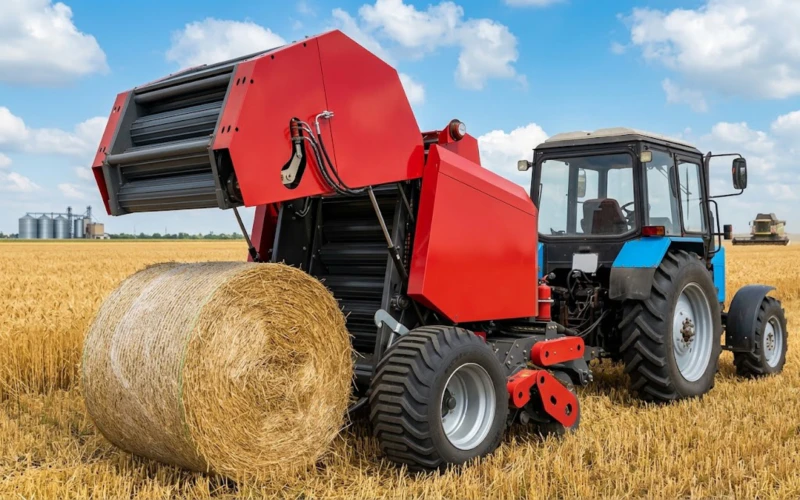
Quick Reference: The 10-Item Maintenance Schedule
| # | Item | Phase | Time Required | Failure Prevented |
|---|---|---|---|---|
| 1 | Pickup tine inspection | Pre-season | 45 min | Pickup loss, blockages |
| 2 | Compression roller inspection | Pre-season | 60 min | Bearing failure, density loss |
| 3 | Drive chain and gearbox | Pre-season | 45 min | Chain snap, gearbox damage |
| 4 | Net wrap system | Pre-season | 30 min | Wrap failures, bale losses |
| 5 | Hydraulic hoses and fluid | Pre-season | 30 min | Hose burst, injury risk |
| 6 | PTO shaft full inspection | Pre-season | 20 min | Shaft failure, safety risk |
| 7 | Sensor calibration verification | Pre-season | 45 min | Density drift, spec failure |
| 8 | Daily pre-shift inspection | In-season | 10 min/day | All in-field failures |
| 9 | Bale quality monitoring | In-season | 5 min/shift | Density drift, wrap failures |
| 10 | Post-season clean and store | Post-season | 3–4 hours | Off-season corrosion, next-year failures |
Need Parts, Technical Support, or a New Round Baler?
Whether you need a maintenance consultation for your existing baler or are evaluating a new commercial round baler with improved reliability features, our team is ready to help you reduce unplanned downtime and maximise seasonal productivity.