Buyer’s Guide 2025
What separates a good round baler from the right round baler for your operation — the specifications that matter for commercial production, the trade-offs between models, and the questions every buyer should answer before committing to a purchase.
The best round baler is not the one with the highest-rated throughput or the most advanced electronics. It is the one whose specifications match your crop, your scale, your tractor, and your market — while delivering the density consistency and mechanical reliability that commercial production requires season after season.
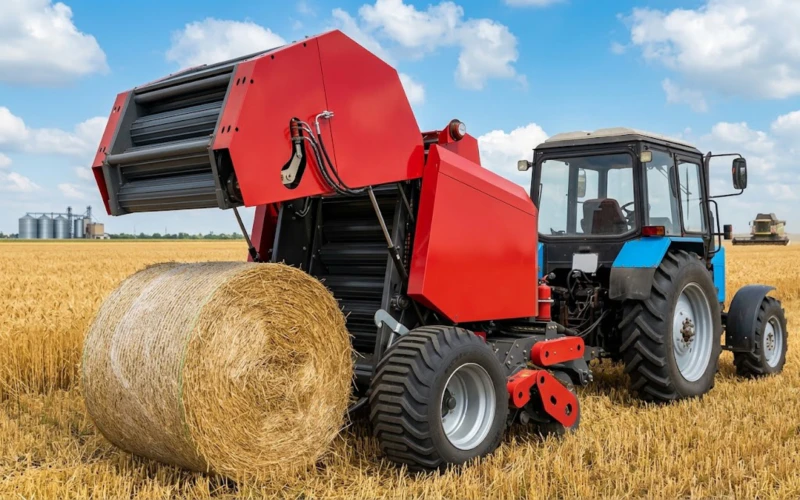
The commercial round baler market in 2025 has consolidated around a clear technology standard for serious operations: sensor-controlled density, drum or roller compression chambers, automatic net wrap, and 2m+ pickup widths. These are no longer premium features — they are baseline requirements for any baler intended for commercial production where bale weight consistency, density specification compliance, and operating reliability across a full production season determine the financial outcome. The question for buyers in 2025 is no longer whether to specify these features, but which configuration of them best matches their specific operational requirements.
This guide evaluates round balers for commercial hay, straw, and crop residue applications using six evaluation criteria: compression chamber design and density range, pickup width and crop compatibility, density control system type and accuracy, tractor power requirements, PTO driveshaft and overload protection specification, and per-bale operating cost. It is structured as a buyer’s decision framework rather than a simple product listing — because the right baler for a 200 ha alfalfa operation in Inner Mongolia is not the right baler for a 50 ha grass hay farm in Victoria, Australia, and treating every buyer’s decision as if they have the same requirements produces guidance that is useful to no one.
For the current model range and specifications referenced throughout this guide, see our complete commercial round baler range with full technical specifications and configuration options.
1. The Six Criteria That Define a Commercial-Grade Round Baler in 2025
Criterion 1 — Compression Chamber Design
The compression chamber is the baler’s most fundamental specification because it determines the achievable density range, the density consistency from core to surface, and the structural integrity of the finished bale. Fixed-chamber drum or roller designs — where the compression elements are arranged in a ring of fixed diameter around the forming bale — produce the most consistent density from bale core to outer surface because the full ring of drums contacts the bale’s growing circumference simultaneously from an early stage. Variable-chamber belt designs produce adequate density on uniform windrows but show more core-to-surface density variation because the belt tension changes as the bale grows and the curvature of the belt path changes accordingly.
For export alfalfa and premium dairy hay markets where density specifications are enforced and core integrity affects container loading performance, the 16–18 drum fixed-chamber design is the correct specification. For general-purpose grass hay and straw where density variation within the typical 130–165 kg/m³ range is commercially acceptable, either design performs adequately. The 18-roller drum chamber in the S9000 series produces densities from 100 to 200 kg/m³ with core-to-surface density variation below 8% — the benchmark that most export contract density specifications are written around.
Criterion 2 — Pickup Width and Crop Compatibility
Pickup width must match or slightly exceed the windrow width produced by your raking system for consistent single-pass collection. For operations producing windrows at 1.5–1.8m width, a 1900mm pickup collects cleanly with 50–100mm of margin on each side. For operations using wide-swath mower conditioners at 2.0–2.2m swath width, a 2240mm pickup is the minimum required for single-pass collection without lateral field loss at windrow edges. Crop type also determines pickup specification: alfalfa and fine-stemmed legumes benefit from cam-less ground-following pickup designs that minimise aggressive tine contact that causes leaf shatter; corn stover and heavy straw require the hammer-claw or heavy-duty tine designs that can engage standing or densely lodged material without bridging blockages.
Criterion 3 — Density Control System Type
Manual pressure settings produce density distributions with ±20–25% variation around the target — meaning 20% of bales in a production run fall outside the ±10% band that most export specifications require. Sensor-controlled density systems reduce this to ±4–8% variation, eliminating below-floor bales that trigger export price penalties and producing the consistent bale weights that simplify container loading and ration management. In 2025, sensor density control should be specified for any baler whose output will be sold into export markets or large domestic buyers with density specifications. For fully domestic, farm-gate sale where buyers purchase by the bale without density inspection, manual pressure is a viable cost-reducing option — though the throughput benefit of sensor control (fewer stops for manual adjustment) makes it compelling even without the density specification driver.
Criterion 4 — Tractor Power Requirement and Match
Select a baler whose recommended tractor power range matches your existing tractor fleet at 130–150% of the baler’s minimum specification. A baler that requires 75 kW minimum should be matched to a 95–110 kW tractor for commercial production — not to the minimum-specification tractor that produces density inconsistency on peak load events and degrades sensor system accuracy through PTO speed variation. The tractor’s hydraulic flow capacity at the remote valve with PTO engaged must also be confirmed against the baler’s density control system requirements — typically 25–35 litres per minute at 180–200 bar system pressure.
Criterion 5 — PTO Shaft and Overload Protection
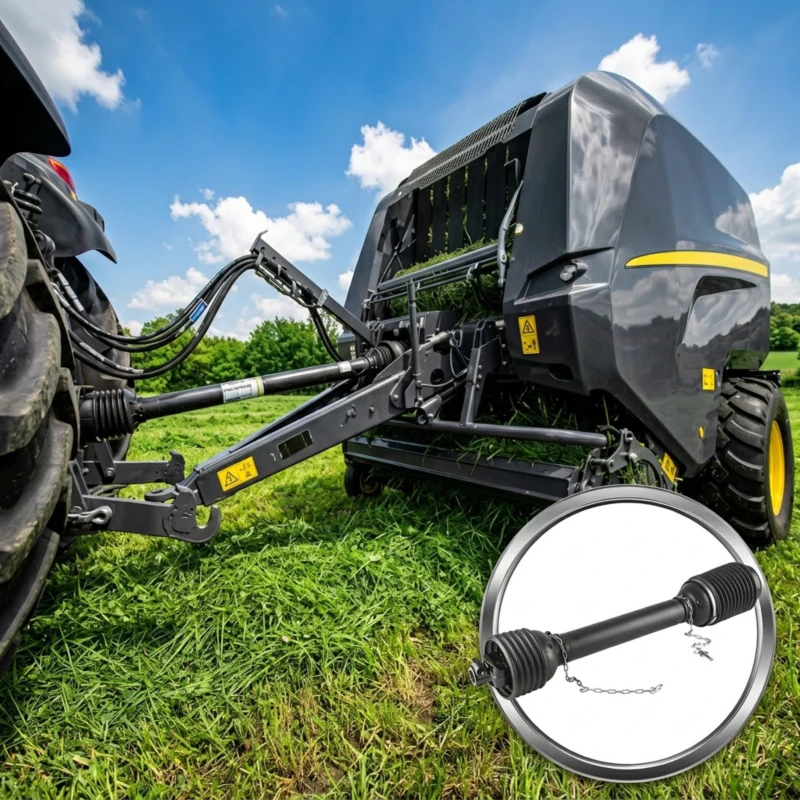
The PTO driveshaft connecting the tractor to the baler must be rated for the baler’s full torque range including peak events, dynamically balanced for smooth operation at the operating PTO speed, equipped with a friction-clutch overload device for commercial operations where overload events occur frequently, and fitted with a full-length guard in serviceable condition. For commercial operations in remote locations, a replacement pto shaft stocked on-site as a commissioning spare eliminates the downtime risk of in-season shaft failure when sourcing a replacement takes 2–3 days from a remote location. This is not a premium practice — it is standard risk management for commercial operations where a single day of downtime during a weather window costs more than the spare shaft.
Criterion 6 — Per-Bale Operating Cost
Per-bale operating cost includes fuel (tractor consumption per bale at rated PTO load), consumables (net wrap at USD 0.80–1.20 per bale depending on wrap type and supplier), maintenance (scheduled service parts divided by annual bale count), and annualised capital cost (purchase price divided by expected productive life in bales — typically 80,000–150,000 bales for a commercial drum-chamber baler). At 60,000 annual bale production, the annualised capital cost difference between entry-level and premium models is typically USD 0.30–0.80 per bale — a figure that is rapidly outweighed by the density consistency and throughput advantages of the premium model on operations where export specification compliance generates USD 3–7 per bale in avoided penalty revenue.
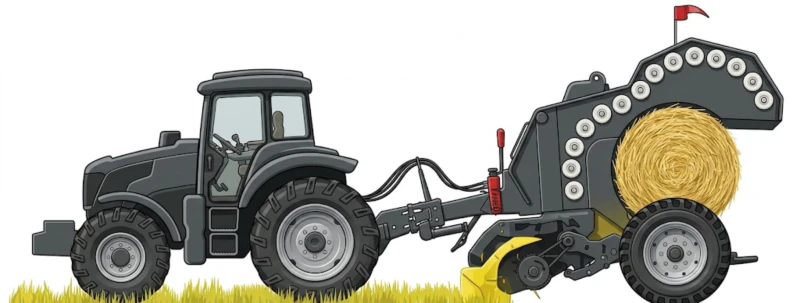
2. Model-by-Model Evaluation: Which Configuration for Which Application
For Small Farms (20–150 ha/season): 9YG-1.0 Series
The 9YG-1.0 series is the entry-level commercial baler in the range — not a toy or a compromise, but a purpose-designed machine for farms where the tractor fleet tops out at 55–75 kW and annual bale production is 2,000–8,000 bales. The 1900mm pickup width handles windrows from standard 1.5–1.7m rake settings cleanly. The 16-drum fixed chamber produces densities from 115 to 200 kg/m³ — the full commercial range. Sensor density control is available as a factory option, making this model capable of export-grade density consistency in a package that a 60 HP tractor can operate sustainably at full working rate. The 9YG-1.0 with sensor control and net wrap is the correct specification for small commercial alfalfa operations producing up to 150 ha per season for domestic dairy or export markets where the required bale density is below 180 kg/m³.
For Commercial Farms (150–500 ha/season): 9YG-1.25 Series
The 9YG-1.25 steps up with a 2240mm pickup width — the standard for operations where windrows from 3.2m mower conditioners produce 2.0m swaths that a 1900mm pickup cannot cover completely. At 55–90 kW tractor power, the 9YG-1.25 delivers 40–80 bales per hour at 150–200 kg/m³ with sensor density control — the commercial production rate for 150–500 ha annual alfalfa or grass hay operations. The 2240mm pickup covers the full windrow width from a standard mower conditioner setup without leaving edge material on the field, eliminating the leaf-rich margin loss that a narrower pickup produces on alfalfa. For commercial farms producing export-grade hay with a single operator and a 75–90 kW tractor, the 9YG-1.25 with sensor density and net wrap is the most cost-effective configuration in 2025.
For Large Commercial Operations (500+ ha/season): S9000 Classic and S9000 Beyond
The S9000 series is the commercial flagship — designed for operations where maximum throughput, sensor density precision, and multi-season mechanical reliability at 60,000+ annual bales are the primary requirements. The S9000 Classic at 75+ kW tractor minimum (recommended 95–120 kW) produces the 40–100 bales per hour that makes large-scale alfalfa and grassland operations commercially viable. The S9000 Beyond adds enhanced sensor capability — a wider density setpoint adjustment range and a faster hydraulic response rate that maintains the same ±4% density distribution on the densest and most variable windrow conditions where the Classic’s slower response produces slightly wider variation. For export-oriented operations producing above 500 ha per season in alfalfa or high-value grass hay, the S9000 Beyond’s enhanced sensor performance pays back in fewer below-floor export bales within one to two seasons.
For Corn Stover and Heavy Residue: 9YG-1.0C Hammer-Claw
The 9YG-1.0C is a specialised configuration for corn stover and heavy standing or lodged crop residue collection — a market segment that standard hay balers cannot serve commercially because standard spring-tine pickups cannot engage standing stalks, lodged mats, or the interlocked stover structures that remain after combine harvest. The 20 hammer-claw elements across the 2400mm pickup width engage standing and lodged material directly without a preliminary windrowing pass — eliminating one complete field operation that standard-pickup stover collection requires. At 71+ kW tractor power (recommended 90–115 kW for sustained stover collection), the 9YG-1.0C achieves 40–80 bales per hour at 115–200 kg/m³ on corn stover — commercially viable economics that standard-pickup balers cannot match because of their 20–35% field loss rate and frequent blockage downtime on this material type.
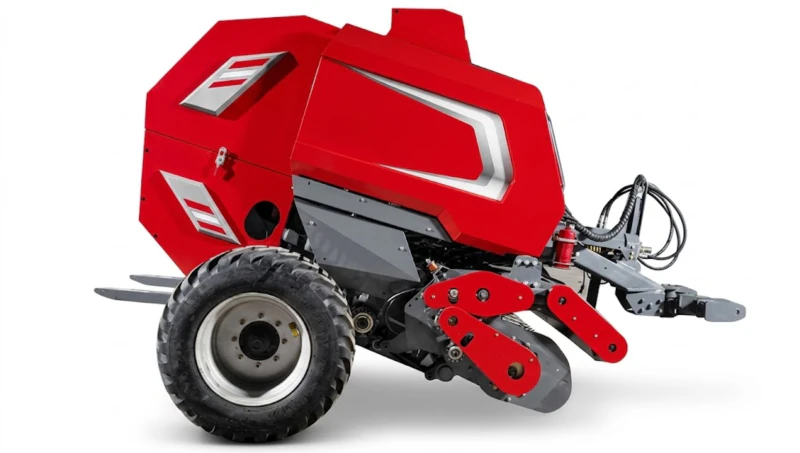
3. The 2025 Buyer’s Comparison Table
| Specification | 9YG-1.0 | 9YG-1.25 | S9000 Classic | 9YG-1.0C |
|---|---|---|---|---|
| Pickup width | 1900mm | 2240mm | 2240mm | 2400mm (claw) |
| Compression chamber | 16-drum fixed | 16-drum fixed | 18-drum fixed | 16-drum fixed |
| Density range | 115–200 kg/m³ | 115–200 kg/m³ | 100–200 kg/m³ | 115–200 kg/m³ |
| Sensor density | Optional | Optional | Standard ✓ | Optional |
| Net wrap | Standard | Standard | Standard | Standard |
| Min tractor power | 48 kW (65 HP) | 55 kW (75 HP) | 75 kW (100 HP) | 71 kW (95 HP) |
| Rated throughput | 40–70 bales/h | 40–80 bales/h | 40–100 bales/h ✓ | 40–80 bales/h |
| Primary application | Small farm alfalfa / grass | Commercial alfalfa / export | Large-scale commercial ✓ | Stover / straw / residue |
4. Five Questions Every 2025 Buyer Must Answer Before Selecting a Model
What is your primary crop — and what density does your market specify?
Export alfalfa markets specify 150–200 kg/m³. Domestic grass hay markets typically accept 130–165 kg/m³. Biomass straw markets require 120–150 kg/m³ minimum. Your market density specification is the primary filter that determines whether sensor density control is essential or optional, and whether the S9000’s 100–200 kg/m³ full range is necessary or whether the 9YG’s 115–200 kg/m³ range is sufficient. Confirm your specific buyer’s specification document before finalising the model — not the market average, but your specific contract.
What tractor power and hydraulic capacity do you actually have — not what the dealer says is adequate?
Confirm your tractor’s actual PTO power output from the operator manual — not the engine flywheel rating. Confirm the remote valve flow rate at 180–200 bar with PTO engaged — not the hydraulic pump’s rated maximum flow at zero pressure. These two real-world numbers, compared to the baler’s specifications, determine whether the tractor-baler match is correct for commercial operation or whether the tractor needs an upgrade alongside the baler purchase.
What is your annual production volume — and how many bales justify the capital cost difference between models?
At 5,000 bales per season, the capital cost difference between a 9YG-1.0 and an S9000 Classic is approximately USD 1.50–2.50 per bale in additional annualised depreciation. At 20,000 bales, it drops to USD 0.40–0.80 per bale. If the S9000’s additional throughput and density precision generates USD 3–7 per bale in avoided export penalties and higher sale prices, the payback is clear at any volume above 5,000 bales. Calculate your own version of this arithmetic before deciding that the premium model is more than your operation needs.
What is your windrow width — and does the baler’s pickup match it?
Measure your actual windrow width from three different sections of a representative field and confirm it is within the baler’s pickup width minus 10%. If your windrow consistently produces 2.1m-wide swaths from a 3.2m mower conditioner, a 1900mm pickup will miss 100mm of material on each side of every windrow — concentrated in the leaf-rich edge material that migrates laterally during raking. Upgrade to 2240mm pickup before accepting this field loss as unavoidable, because it is entirely avoidable by selecting the correct pickup width.
How far are you from parts supply — and what does in-season downtime cost per day?
In remote locations where the nearest dealer is 3–4 hours away and emergency parts take 2–3 days to arrive, the cost of in-season mechanical failure is far higher than the cost of pre-season inspection and spare parts stocking. Calculate your actual downtime cost per day during the baling window — missed bales at market price — and use that figure to justify the pre-season maintenance investment and the commissioning spare parts inventory that prevents downtime from becoming a financial disaster.
5. What Has Changed in Round Baler Technology in 2025
Sensor System Accuracy Has Improved Significantly
The density control systems available in 2025 commercial round balers represent a meaningful advancement over the first-generation sensor systems of the mid-2010s. Modern pressure transducers operate at higher sampling rates (up to 50 measurements per second versus 10–20 in early systems), the hydraulic adjustment response time has been reduced through faster proportional control valves, and the control algorithms now incorporate forward speed as an additional input to pre-compensate for the material feed rate changes that speed variation produces. The practical outcome is density distributions that are 20–30% tighter than equivalent systems from five years ago — a genuine quality improvement that has not been universally adopted by operations that purchased sensor-capable balers early and have not updated their understanding of current system performance.
Net Wrap Material and Application Systems Have Evolved
Net wrap materials in 2025 offer better UV resistance and longer outdoor storage performance than products available a decade ago. Baler manufacturers have also improved the net wrap guide systems — the guide rollers and dispenser solenoids that control wrap coverage from edge to edge — reducing the incidence of edge-short application that was the most common source of net wrap quality failures in earlier systems. For buyers evaluating 2025 models, confirm that the net wrap system uses sealed guide roller bearings (not open bearings that accumulate crop dust and seize) and a solenoid trigger with a documented 500,000-cycle service rating.
Connectivity and Data Logging Are Now Mainstream
The S9000 series and upper 9YG-1.25 configurations now include data logging of bale count, average density per session, density distribution per shift, and operating parameter history — data that supports pre-season calibration verification, in-season performance monitoring, and post-season maintenance scheduling based on actual usage rather than calendar intervals. For operations that must document bale traceability for export contracts, this built-in data logging provides the lot-level production records that buyers increasingly require as part of supply chain compliance documentation.
Ready to Select the Right Round Baler for Your 2025 Season?
Our technical team can match the correct model, pickup width, density control configuration, and tractor specification to your specific crop, market, and production volume — and confirm that the complete system from tractor through PTO shaft to baler will perform at commercial standard throughout your season.