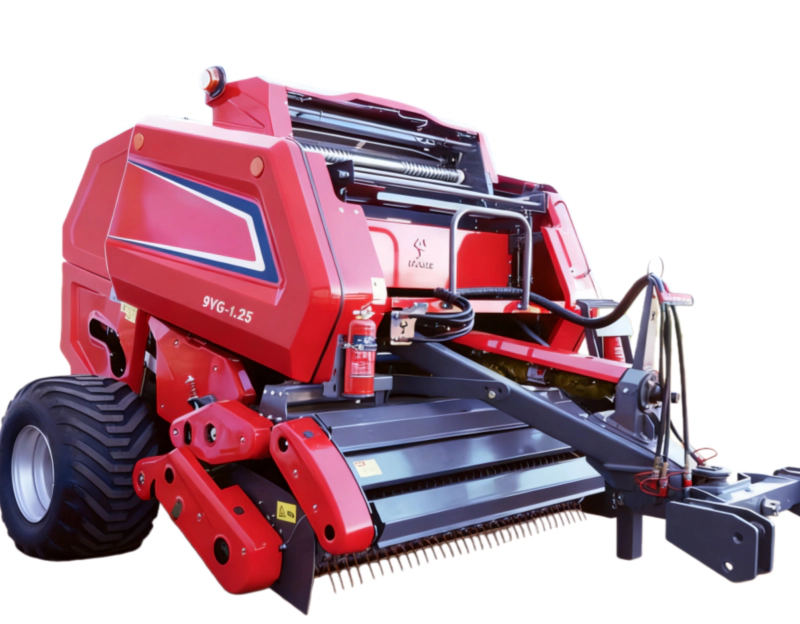
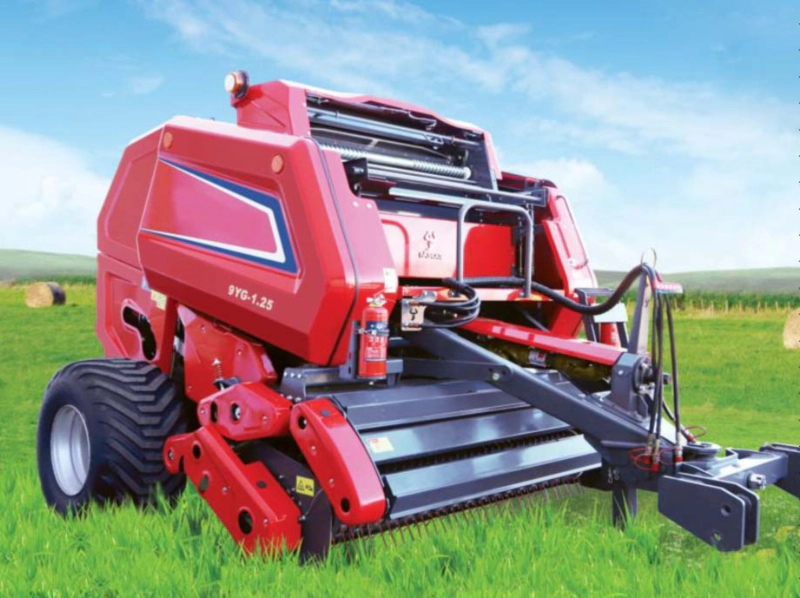
9YG-1.25 Round Baler
9YG-1.25 Round Baler — 2240mm pickup, 18-roller drum chamber, sensor density 100–200 kg/m³, auto net wrap, 40–100 bales/h. Suits ≥75kW tractors. Hay, straw & alfalfa.
9YG-1.25 Round Baler: The High-Efficiency Mid-Size Forage Baler Built for Large-Scale Hay and Straw Operations
Featuring a 2240mm spring-tooth pickup, triple-stage auger and tine roller feeder, 18-roller drum compression chamber, sensor-controlled bale density, and fully automatic net wrap — delivering 40–100 bales per hour at 100–200 kg/m³ with minimal operator intervention.
1. Introduction: Mid-Size Commercial Baling with Professional-Grade Automation
The 9YG-1.25 Round Baler occupies a distinct position in the commercial forage baler market: it delivers large-scale pickup width, professional-grade sensor density control, and fully automatic net wrap in a structural package matched to the power range of mid-size agricultural tractors. While compact mini balers serve smallholder applications and ultra-large balers target corporate-scale estates, the 9YG-1.25 is designed for the farms, cooperatives, and contractors that form the backbone of commercial forage production — operations needing maximum daily throughput from tractors in the 75 kW and above power class.
The machine’s defining structural feature is its triple-stage feeding system — auger, tine roller, and drum — that delivers material to the compression chamber in a controlled, even flow that standard single-mechanism feeders cannot match. This feeding architecture directly prevents the bridging and slug-feeding that cause density variation and blockages in competing machines, particularly when processing high-moisture materials or dense windrow rows. The result is a baler that maintains consistent 100–200 kg/m³ density output across full working days on diverse crop types without demanding continuous operator attention. Compare specifications across our complete round baler product range to identify the model best matched to your tractor and annual production volume.
Field feedback from cooperative operators, ranch managers, and farm contractors across diverse operating environments consistently highlights three practical advantages: the wide pickup enables completion of large acreages within tight harvest windows; the sensor density control produces commercially standardized, high-density bales that carry premium market value; and the heavy-duty 4060 kg structure sustains the continuous high-intensity operation that commercial baling requires without the unplanned downtime that undermines lighter-built alternatives.
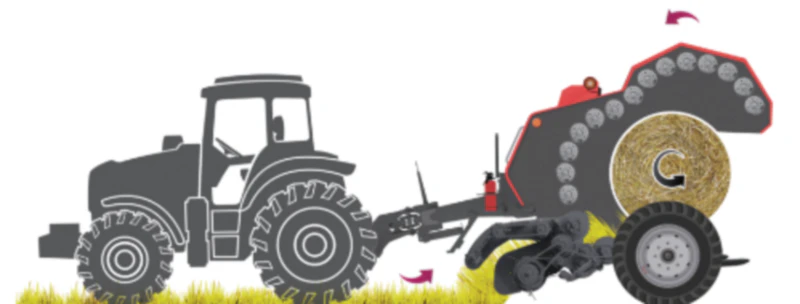
2. How the 9YG-1.25 Works: Three-Stage Baling Cycle
Stage 1 — Pickup and Feeding
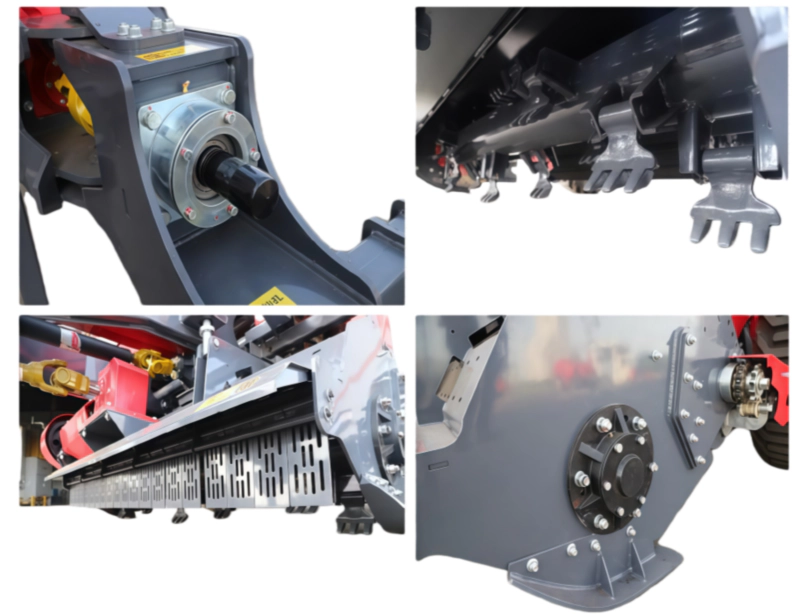
As the tractor pulls the baler forward, the 2240mm spring-tooth pickup reel sweeps crop material from the field surface in a wide, clean arc. Spring tines mounted on the rotating reel lift windrowed hay and straw smoothly without aggressive mechanical contact that shreds delicate leaf material. Material enters the triple-stage feeding system in sequence: a transverse auger first gathers and initially consolidates the incoming material, converging it toward the centre of the intake channel. Tine rollers then grip and lift the consolidated material, maintaining positive control through the transition into the compression chamber inlet. This staged approach prevents the lateral spread and bridging that cause slug-feeding in machines relying on a single-mechanism intake, delivering material to the chamber in a consistent, even flow that supports uniform bale formation from the first revolution to the last.
Stage 2 — Rolling and Compression
Material enters the annular compression chamber formed by 18 rolling drums, each 222mm in diameter, arranged around a 1200mm chamber perimeter within a 1250mm wide baling space. Driven by the tractor’s PTO at 720 r/min, these drums rotate synchronously in the same direction, creating a tumbling, compressive motion that builds a tight cylindrical core from the inside outward. As material continues to feed in, the growing bale core expands against the drum perimeter, increasing chamber pressure progressively. The integrated sensor network monitors this pressure in real time and communicates continuously with the hydraulic control system to maintain bale density precisely within the operator-set target — anywhere in the 100–200 kg/m³ range. This automated feedback loop eliminates the manual pressure monitoring that burdens operators on machines without sensor integration and prevents the bale-to-bale density variation that standard mechanical-control systems inevitably produce over a long working day.
Stage 3 — Automatic Net Wrap and Ejection
When the bale reaches the preset diameter of approximately 1300mm and the sensor confirms target density, the fully automatic net wrap system activates without operator input. The baling net — supplied from a 2000m roll, 1.25m wide — wraps the outer surface of the spinning bale in a precisely tensioned spiral pattern. The spacing and tension are controlled by the system to ensure secure, uniform coverage across the full bale face. Each bale consumes approximately 25–30 metres of net, allowing one standard roll to produce 65–80 complete bales. After wrapping completes, the hydraulic rear door opens and the finished bale rolls cleanly onto the field. The door closes automatically and the machine immediately enters the next cycle — supporting continuous operation without field stops between bales.
Most competing round balers in this class use a single roller or simple tine feed mechanism. The 9YG-1.25’s auger + tine roller + drum three-stage feeding system is the primary reason it maintains lower blockage rates than competitors when processing high-moisture materials or dense, tangled windrows. The auger manages lateral convergence; the tine rollers handle vertical lifting; the drum controls entry speed into the chamber. Each stage performs a distinct function that single-mechanism systems combine imperfectly. For operations processing diverse crop types or working in challenging moisture conditions, this feeding architecture represents a genuine performance advantage over simpler alternatives. Learn more at our large round baler selection guide.
3. Complete Technical Specifications
The following table contains the verified engineering specification sheet for the 9YG-1.25 Round Baler, transcribed from factory test documentation under standard operating conditions at rated power input.
| No. | Item | Unit | Specification |
|---|---|---|---|
| 1 | Model Name | / | 9YG-1.25 Round Baler |
| 2 | Hitch Type | / | Trailed |
| 3 | Pickup Width | mm | 2240 |
| 4 | Pickup Type | / | Spring Tooth Type |
| 5 | Feeder Type | / | Auger + Tine Roller + Drum |
| 6 | Baling Chamber Type | / | Drum Type |
| 7 | Baling Chamber Width | mm | 1250 |
| 8 | Baling Chamber Diameter | mm | 1200 |
| 9 | Number of Rolling Components | pcs | 18 |
| 10 | Rolling Drum Diameter | mm | 222 |
| 11 | Tying Method | / | Automatic Net Wrap |
| 12 | Required Power | kW | ≥75 |
| 13 | Structural Weight | kg | 4060 |
| 14 | PTO Speed | r/min | 720 |
| 15 | Overall Dimensions (L×W×H) — Working State | mm | 4400 × 2850 × 2400 |
| 16 | Bale Density Control | / | Sensor Control |
| 17 | Bale Size (Diameter × Width) | mm | φ1300 × 1250 |
| 18 | Bale Density | kg/m³ | 100–200 |
| 19 | Productivity | bales/h | 40–100 |
| 20 | Wheel Track | mm | 2450 |
| 21 | Working Speed | km/h | 5–35 |
| 22 | Net Specification (Length × Width) | m | 2000 × 1.25 / bale |
4. Four Core Product Advantages
Advantage 1: Superior Bale Formation Quality
The 18-roller compression chamber combined with the sensor-linked density control system produces bales of 100–200 kg/m³ with a tight, uniform core and consistent outer geometry. The bales formed by the 9YG-1.25 maintain their φ1300 × 1250mm shape during long-distance road transport and open-air stack storage. Compared to traditional mechanical-control balers, shape retention rate during transportation and outdoor storage is improved by over 30%, which directly reduces material loss from bale loosening, surface weathering, and structural collapse during handling. For commercial hay operations where bale presentation affects buyer pricing decisions, this consistency translates into tangible premium market value.
Advantage 2: Wide-Pickup High-Efficiency Field Operation
The 2240mm spring-tooth pickup provides one of the widest coverage spans in its class, capable of processing twin windrows in a single pass on most crop types and eliminating the secondary merging runs that add machine hours and fuel cost per hectare. Combined with the 5–35 km/h working speed range and an output ceiling of 100 bales per hour, the 9YG-1.25 enables operators to cover substantially more ground per working day than narrower-pickup alternatives. Field feedback from a pastoral farm in Inner Mongolia confirms the practical impact: harvesting over 1,000 acres of hay before the rain arrived in a single season — a completion timeline the previous narrower machine could not support.
Advantage 3: Intelligent Automation for Single-Operator Efficiency
The integrated fully automatic net wrap system completes the wrapping cycle without operator intervention from the point the density sensor triggers the sequence to the point the wrapped bale ejects onto the field. The intelligent control system continuously monitors feed rate and automatically adjusts winding and pressing speed to match incoming material flow — preventing the blockages caused by surge feeding when windrow density varies along the field row, and avoiding the core loosening that occurs when feed rate drops below the chamber compression threshold. This automation reduces operator labor intensity and technical skill requirements simultaneously, enabling a single operator to achieve commercial throughput rates that previously required two-person crews on simpler machines.
Advantage 4: Heavy-Duty Structure with Industry-Leading Uptime
The 4060 kg structural weight of the 9YG-1.25 reflects a deliberate engineering philosophy: critical load-bearing components are built to a heavier specification than minimum functional requirements demand, providing structural reserve that translates into a mean time between failures significantly exceeding the industry average for this machine class. The compression chamber rollers and transmission system are dimensioned and heat-treated for continuous high-intensity operation — matching the duty cycle of commercial operations that run the machine for multiple consecutive seasons at hundreds of hours per year. Field-verified uptime of over 500 hours without structural failures in demanding Australian alfalfa conditions confirms that this structural philosophy produces measurable reliability advantages over lighter-built competitors.
5. How the 9YG-1.25 Compares to Market Alternatives
The following comparison table evaluates the 9YG-1.25 against typical market competitors across five dimensions that directly determine commercial baling profitability and operational reliability.
| Comparison Dimension | 9YG-1.25 Round Baler | Typical Market Competitors |
|---|---|---|
| Bale Quality |
✓ Advantage
Sensor-controlled density 100–200 kg/m³. Consistent bale geometry; shape retention improved over 30% vs. manual-control alternatives. |
✗ Disadvantage
Mostly mechanical or manual adjustment. Uneven density across working day; prone to loosening in transport. |
| Operational Efficiency |
✓ Advantage
2240mm extra-wide pickup. 40–100 bales/hour peak output. Covers large acreages within tight harvest windows. |
✗ Disadvantage
Pickup width typically below 2000mm. Lower hourly output; narrower daily coverage requires more field passes. |
| Automation Level |
✓ Advantage
Fully automatic net wrap + intelligent density control. Single-operator efficiency at commercial throughput rates. |
✗ Disadvantage
Most offer automatic net wrap only. Density requires manual experience-based adjustment throughout the working day. |
| Feeding System |
✓ Advantage
Auger + tine roller + drum three-stage feeding. Smooth, even material flow without blockages in diverse and high-moisture crops. |
✗ Disadvantage
Mostly simple single-roller feeding. Higher blockage rate in high-moisture materials and dense windrows. |
| Structural Reliability |
✓ Advantage
4060 kg heavy-duty frame. Reinforced rollers and transmission. MTBF exceeds industry average for this class. |
✗ Disadvantage
Lighter structural design. Higher failure rates under continuous heavy-load commercial operation. |
6. Customer Feedback from Commercial Field Operations
“Our cooperative purchased two 9YG-1.25 Round Balers last year. What we are most satisfied with is how tightly they produce bales. Before, we used an old-fashioned round baler — the bales were loose, and we could only carry a few at a time, making transportation uneconomical. Now, with this machine, the bale density is much higher, and we can carry almost 30% more bales per truck, reducing the transportation cost per bale. Plus, the automatic netting is very convenient; we do not need to manually follow it at all.”
— Captain Wang, Large Agricultural Machinery Cooperative, Heilongjiang Province
“On my farm, this 9YG-1.25 Round Baler has been working efficiently for over 500 hours. Its heavy-duty structure and stable hydraulic system are impressive; even when processing our large alfalfa fields, there have been almost no downtimes. Compared to the brands we used before, this round baler performs exceptionally well in terms of durability and cost-effectiveness.”
— John Smith, Rancher, New South Wales, Australia
“This 9YG-1.25 Round Baler is indeed fast, with a wide pickup width. Driving a high-horsepower tractor along, bales come out one after another. Its efficiency is estimated to be 40% higher than our old machine. Last year, we managed to bale over a thousand acres of hay before the rains arrived, which was a huge help. This round baler is now our main machine.”
— Manager Zhang, Pastoral Farm, Inner Mongolia
7. Related Product: PTO Drive Shaft Selection and Maintenance
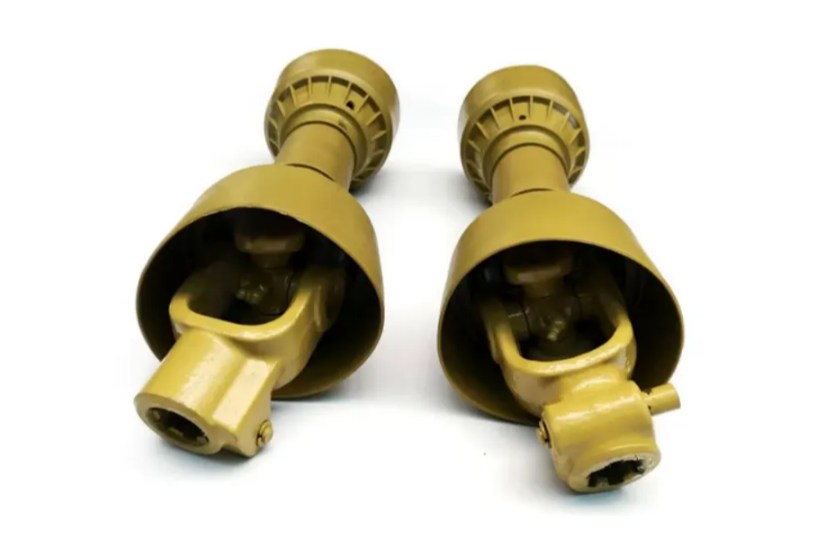
The 9YG-1.25 is a tractor-powered trailed implement: all mechanical energy driving the pickup reel, the three-stage feeder, the 18 compression rollers, the hydraulic density control circuit, and the automatic net wrap system originates at the tractor engine and travels through a single critical connection — the pto shaft. This machine requires a 720 r/min PTO input. Selecting a driveshaft rated for full torque at 720 r/min with spline configuration fully compatible with your tractor’s PTO output is a prerequisite for the sensor control system to operate accurately and for the compression rollers to deliver their specified density output.
Three Core Functions of the PTO Drive Shaft
Power Delivery: The driveshaft transmits tractor engine rotational energy directly to the baler’s input gearbox. The internal gear and chain system then distributes this power to the pickup cam drive, feeder mechanism, compression roller chain, and hydraulic pump. Any power loss from worn splines or mismatched specifications reduces energy available to the compression system and causes density output to fall below the sensor-set target.
Terrain and Steering Compensation: Universal joints at both shaft ends allow smooth power delivery across changing angular relationships during field operation, particularly during headland turns and slope transitions. The telescoping spline centre section accommodates distance variation between tractor and baler. A safety clutch or shear-pin device provides instantaneous disconnection when the compression chamber encounters a sudden hard obstruction — protecting the gearbox, rollers, and tractor PTO from impact damage.
Operational Safety: The full-length plastic safety guard enclosing the rotating shaft prevents clothing and limb contact. Inspect the guard before every working shift and replace immediately if cracked, deformed, or missing. Disengage PTO and confirm shaft is completely stationary before any inspection, blockage clearing, or net wrap change operation. Never approach a rotating driveshaft from any direction.
8. Frequently Asked Questions (FAQ)
A minimum of 75 kW (approximately 100 HP) is required. For high-moisture material processing or sustained maximum-efficiency operation, a tractor of 90 kW or above is recommended. Higher power reserves prevent overheating during continuous high-density baling, reduce the risk of intake jamming on dense windrows, and extend equipment service life by avoiding sustained peak-load operation. Your tractor must also provide 720 r/min at the PTO output and have at least two hydraulic output circuits.
Yes — sensor-controlled bale density adjustment is one of the core features of the 9YG-1.25. Operators set the target density on the controller; the hydraulic system then automatically adjusts compression pressure to maintain that target throughout the baling cycle. The adjustable range is 100–200 kg/m³, covering requirements from lightweight bedding bales to maximum-density commercial export hay.
The machine handles a wide range of forage crops including alfalfa, oat hay, ryegrass, and Leymus chinensis, and crop straws including wheat straw, rice straw, and corn stalks. Its three-stage feeding system maintains even material flow across both dry and slightly damp materials, and the adjustable density settings accommodate the different compression requirements of each crop type. Optimal material moisture for dry hay baling is 12%–20%; reduce working speed above 25% moisture.
The machine is equipped with automatic alarms for net rope exhaustion and net breakage events. Most net jams — the most common failure mode — can be resolved by manually reversing the net dispenser after stopping the machine and removing the obstruction. Consult the emergency handling section of the User Manual for step-by-step jam clearing procedures and fault code interpretations. Remote technical support is available for more complex net system issues.
Not necessarily. The 9YG-1.25 operates at 5–35 km/h, but optimal speed must be calibrated to crop yield and moisture content. In dense, high-moisture windrows, reduce speed to 5–8 km/h to maintain smooth feeding and consistent bale quality. In light, dry windrows, higher speeds are appropriate. Excessive speed in heavy windrow conditions overloads the intake, causing blockages or loose core formation — the opposite of the machine’s designed performance advantage.
Daily maintenance is straightforward. After each working session: clear crop debris and dirt from the machine frame, pickup, and net dispenser. Every 8–10 operating hours: lubricate all bearing points through the centralized grease nipple bank — a task achievable in 10–15 minutes without component removal. Regularly inspect spring tines, drive belts, and gearbox oil level. Modular component design makes wear part replacement — particularly spring tines — quick and tool-accessible.
The 9YG-1.25 requires 720 r/min PTO speed. Tractors with 540 r/min or 1000 r/min PTO must have a 720 r/min engagement setting to operate this machine. Spline interface compatibility (6-spline or 21-spline) must be confirmed against your tractor’s PTO coupling specification. If uncertain about your tractor’s PTO configuration, provide the tractor model number to our technical team for confirmation before coupling.
Based on the bale size of φ1300 × 1250mm and the default wrap count, each bale requires approximately 25–30 metres of baling net. The standard net specification used by the machine is 1.25m wide × 2000m per roll, enabling one roll to produce approximately 65–80 complete bales. Net consumption can be slightly reduced by decreasing the number of wrap turns, or increased for extra-secure baling in conditions where bales will be handled roughly or stored outdoors long-term. For pricing and purchasing, contact our team directly.
Ready to Upgrade Your Forage Harvest with the 9YG-1.25?
Get 2240mm wide-span pickup, 18-roller sensor-controlled baling, and fully automatic net wrap — in a 4060 kg heavy-duty frame proven across commercial hay, alfalfa, and straw operations on three continents. Request your customized technical specification and quote today.