Hay Production Knowledge
The choice between net wrap and twine is not a simple cost-per-bale calculation — it is a decision that affects dry matter retention, outdoor storage performance, baling cycle speed, and the total cost of the hay you produce from field to feedbunk.
The binding method that saves you USD 0.60 per bale on consumables can cost you USD 7 per bale in storage losses — or it can be the right choice for your operation. Understanding the trade-off is the only way to know which side of that equation you are on.
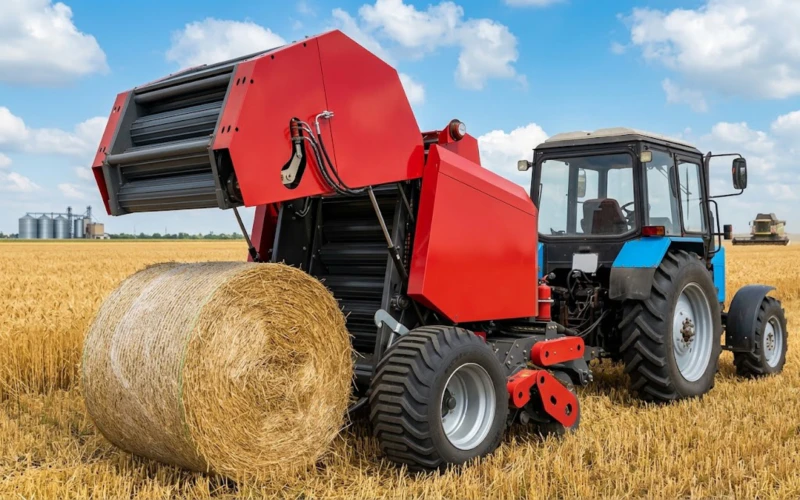
The debate between net wrap and twine has run through the hay industry since net wrap became commercially available in the 1980s and steadily displaced twine as the default binding method for commercial operations. The net wrap advocates cite better outdoor storage performance, faster baling cycle times, and lower dry matter loss. The twine defenders cite lower consumable cost per bale and adequate performance for operations with good covered storage. Both sides are right for their specific situation — the problem is that most producers making this decision do not have a clear picture of their own situation, and end up choosing based on price rather than total cost.
The total cost framework for the net wrap versus twine decision includes five variables: consumable cost per bale, baling cycle time difference, dry matter loss during outdoor storage, nutritional quality preservation, and buyer or market requirements. Most cost comparisons stop at the first variable and ignore the other four — which is exactly the analysis that leads to the wrong decision for the majority of commercial hay operations whose bales spend more than 30 days in outdoor storage before sale or feeding.
This article works through all five variables systematically, provides the calculations needed to apply them to your specific operation, and identifies the conditions under which twine genuinely is the better economic choice. For the round balers and net wrap systems referenced throughout this guide, browse our complete hay baling equipment range.
1. How Each Binding Method Works — and Why the Mechanics Matter
Twine: The Original Round Bale Binding Method
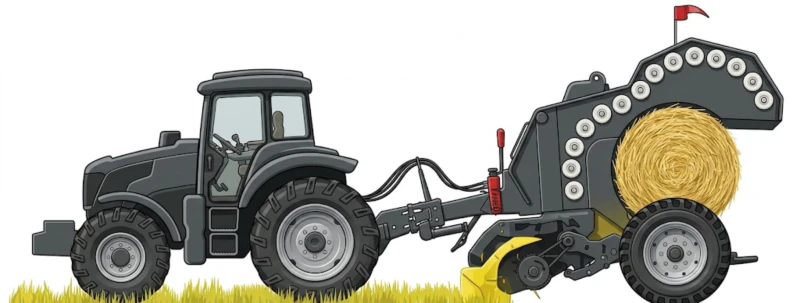
Twine binding applies two or more parallel strands of synthetic or sisal twine around the circumference of a completed round bale. The twine is fed from spools mounted on the baler frame, guided by a mechanical arm that traverses the bale width during the binding cycle, and tied at a fixed number of wraps determined by the baler’s timing mechanism. The result is a bale held together by parallel twine strands spaced across its width — typically at 150–200mm intervals — that resist the bale’s outward spring pressure but do not seal the bale face against weather penetration.
The binding cycle for twine takes 15–25 seconds on most modern balers — the time required to complete the wrapping traversal and tie the knots. During this period the baler must stop accumulating new material into the chamber (the pickup is typically disengaged or the baler continues forward without adding material), which represents productive time lost per bale. On a baler producing 60 bales per hour with 20-second twine cycles, approximately 20 minutes per hour — one third of the working hour — is consumed in binding, not baling.
Net Wrap: Sealed Surface, Faster Cycle
Net wrap is a open-mesh polypropylene netting applied across the full width of the bale face in a helical spiral as the bale rotates inside the chamber. Two to three overlapping spiral passes of net wrap seal the bale’s full cylindrical surface — including the two flat ends — against rain penetration, UV radiation, and physical contact damage. The net wrap feed mechanism is simpler than the twine traversal mechanism (the net unrolls directly from a roll mounted in the bale chamber as the bale rotates), and the application cycle takes 5–10 seconds — 60–75% faster than twine binding on most baler models.
The faster binding cycle produces a measurable throughput advantage on identical windrows. A baler producing 60 bales per hour with 8-second net wrap cycles uses approximately 8 minutes per hour in binding — versus 20 minutes for twine — allowing 12 additional minutes of productive baling time per hour. Over a 10-hour baling day, this is 2 additional hours of productive baling time, or approximately 10–15% more bales per day from the same tractor, operator, and fuel cost. The throughput advantage of net wrap is largest when binding cycle time is the constraint on production rate — which it is on well-formed, consistent windrows where the pickup and compression system are not the limiting factors.
2. The Outdoor Storage Performance Difference — Where the Real Money Lives
How Moisture Enters Twine-Bound Bales
A twine-bound round bale has open face surfaces — the cylindrical area between the twine strands — that are exposed to rain, dew, and UV radiation throughout the storage period. Rain falling on the upper surface of a twine-bound bale penetrates the open bale face and wets a shell of material on the outer 50–100mm of the bale circumference. This wetted material does not dry quickly — it is insulated by the dry bale interior and has limited air movement over its surface due to the bale’s own mass pressing it against the ground contact point. The wetted outer layer undergoes aerobic microbial activity as it alternately wets and partially dries through the storage period, consuming fermentable carbohydrates and producing the brown discolouration that characterises weather-damaged hay.
The rate of dry matter loss from this mechanism depends on rainfall, temperature, and storage duration. In wet climates (above 600mm annual rainfall) with outdoor storage periods of 90–180 days, twine-bound bales consistently lose 15–25% of dry matter from the outer layer — a loss concentrated in the 50–100mm shell around the full bale circumference. In drier climates with shorter storage periods, the loss is lower but rarely below 8%. The inner core of the bale is protected by the insulating effect of the outer material and typically loses very little dry matter — which means the total bale loss is dominated by the surface shell loss and scales with the ratio of surface area to bale volume.
How Net Wrap Limits This Loss
Net wrap’s open mesh does not create a waterproof seal — water can pass through the mesh openings on direct impact — but it fundamentally changes how water behaves on the bale surface. The mesh creates a surface tension barrier that causes rain to sheet across the bale face rather than penetrating directly into the hay fibres at the point of impact. More importantly, net wrap’s primary protection mechanism is the way it holds the outer bale layer compressed against the bale core, preventing the loose outer fibres from wicking moisture inward by capillary action. The physical compression of the outer surface by net wrap reduces capillary moisture uptake by 60–70% compared to unbound or twine-bound bale surfaces — this compression effect, rather than waterproofing, is the main mechanism of net wrap’s storage performance advantage.
In controlled outdoor storage comparisons at equivalent sites and weather conditions, net-wrapped bales consistently lose 5–8% of dry matter over 90–180 day outdoor storage periods versus 15–25% for twine-bound bales. The difference — 7–17 percentage points of dry matter loss — represents the financial advantage of net wrap in outdoor storage applications. At USD 150 per tonne hay value on a 300 kg bale, a 10 percentage point storage loss difference represents USD 4.50 per bale in avoided loss — significantly more than the USD 0.50–1.00 consumable cost premium of net wrap over twine.
The outdoor storage break-even calculation: Net wrap costs approximately USD 0.60–1.00 more per bale than twine. The net wrap storage advantage of 10 percentage points of dry matter at USD 150/tonne hay value on a 300 kg bale is worth USD 4.50 per bale. Break-even occurs at approximately 13–22% of the dry matter loss advantage being realised — meaning net wrap is financially superior to twine in outdoor storage conditions with more than approximately 2 percentage points of additional dry matter loss relative to twine. Almost every outdoor storage scenario exceeds this threshold, which is why the financial case for net wrap in outdoor applications is so robust.
3. Nutritional Quality Preservation: The Variable Most Comparisons Overlook
Why Dry Matter Loss Is Only Part of the Storage Quality Story
Dry matter loss figures — 8% for net wrap versus 18% for twine — measure the weight of material lost during storage. But the material lost is not a random sample of the bale’s composition — it is disproportionately the most digestible, highest-nutritional-value fraction. The microbial activity that consumes the weather-damaged outer layer preferentially degrades the soluble carbohydrates and digestible proteins that are most available to microorganisms under the temperature and moisture conditions of the storage environment. The structural fibre — the cellulose and lignin that makes up the bulk of the straw and stem material in the bale — is less digestible by rumen microorganisms but also less digestible by storage-stage bacteria and fungi. The result is that a bale losing 18% of its dry matter in outdoor storage loses substantially more than 18% of its digestible energy and crude protein — the nutritional fractions that determine the bale’s feeding value.
For grass hay sold domestically to beef cattle operations, this nutritional degradation may have limited practical consequence — beef cattle can utilise weathered, high-fibre material as a low-quality maintenance roughage. For alfalfa sold to dairy farms where crude protein directly determines milk production response, or for equine hay where palatability and digestibility determine whether the horse eats it at all, the nutritional quality difference between well-stored net-wrapped hay and weather-damaged twine-bound hay can be the difference between a marketable product and an unsaleable one.
UV Protection: The Secondary Quality Mechanism
UV radiation bleaches the carotene (beta-carotene, a precursor to Vitamin A) and destroys heat-labile vitamins in exposed hay within days of sun exposure. Net wrap’s physical coverage of the bale surface creates shade that reduces UV exposure on the outer bale layer, preserving carotene content and hay colour through the storage period. Colour — the green to light-gold standard for premium hay — is heavily influenced by UV exposure during outdoor storage. A twine-bound bale stored for 90 days outdoors typically has a bleached, grey-yellow outer surface that affects visual grade and therefore price, even if the inner material retains its original green colour. Net-wrapped bales stored for the same period retain green colour to within 20–30mm of the bale surface, producing a visually superior product that commands premium pricing at markets where colour is assessed on delivery.
4. When Twine Is the Better Economic Choice
The financial analysis above strongly favours net wrap for outdoor storage applications. But twine is not an irrational choice in every context — there are specific operational situations where twine genuinely delivers better total economics. Understanding these situations prevents the reflexive switch to net wrap that some producers make without evaluating whether it applies to their operation.
Situation 1: Full Covered Storage, Short Hold Period
If every bale produced is moved immediately into covered storage — a hay shed or barn that protects from rain and limits UV exposure — and consumed or sold within 60 days of baling, the outdoor storage loss mechanism that justifies net wrap’s premium does not apply. In covered storage without direct rain or sun exposure, twine-bound bales lose similar dry matter fractions to net-wrapped bales over equivalent periods. The net wrap premium cost generates no storage performance advantage under these conditions, and the twine’s lower cost per bale is a genuine saving. This scenario applies most precisely to small on-farm operations producing hay entirely for their own livestock, where the baling-to-feeding cycle is short and all storage is under cover.
Situation 2: Biomass and Industrial Straw Applications
For straw bales destined for biomass combustion, composting, or substrate production — where nutritional quality and hay colour are irrelevant, and dry matter loss affects only energy content per tonne — the net wrap premium may not be justified by the end market price. Biomass straw typically sells at USD 30–60 per tonne, significantly below hay prices. At these price levels, the dry matter loss avoided by net wrap generates less financial return per bale, and the break-even dry matter loss difference that justifies net wrap’s premium occurs at higher percentage losses than for hay applications. For short-cycle biomass straw collection where bales are transported to the processing facility within 2–4 weeks of baling, twine can be the cost-appropriate choice — confirm with your specific buyer and storage timeline before deciding.
Situation 3: Processing Facilities That Cannot Handle Net Wrap
Some pellet mills, mushroom substrate operations, and TMR mixer systems are configured for twine-bound bales and cannot efficiently remove net wrap at scale. A TMR mixer that can cut and remove twine from the feeder chain in 30 seconds may take 3–4 minutes to remove and dispose of net wrap — a difference that at 50 bales per day feeding cycle adds hours to the daily feeding operation. Processing facility buyers in these contexts often specify twine-only supply and will either reject net-wrapped bales or discount them to cover the additional handling cost. Confirm the binding specification with industrial and processing buyers before committing to either method as a supply standard.
5. Practical Comparison: The Numbers Side by Side
The following comparison applies to a commercial hay operation producing 2,000 bales per season on grass-legume mixed sward, with bales stored outdoors for 90 days before sale at USD 150 per tonne, and a baling rate of 50 bales per hour on typical windrows. All figures are illustrative estimates — apply your own costs and prices to the same framework.
| Cost / Performance Item | Twine | Net Wrap |
|---|---|---|
| Consumable cost per bale | USD 0.40 ✓ Lower | USD 1.10 Higher |
| Total consumables (2000 bales) | USD 800 ✓ Lower | USD 2,200 Higher |
| Baling cycle time per bale | 20 sec (slower) | 8 sec ✓ Faster |
| Effective daily output advantage | Baseline | +10–15% bales/day ✓ |
| Outdoor DM loss (90 days) | ~15% of bale weight | ~6% of bale weight ✓ |
| Storage loss cost (2000 bales @ 300kg) | USD 13,500 lost | USD 5,400 lost ✓ |
| Net storage advantage of net wrap | — | USD 8,100 saved ✓ |
| Net total cost advantage | USD 12,700 worse overall | ✓ USD 6,700 net saving |
The table makes the outdoor storage case clearly: even after paying the higher net wrap consumable cost, the operation saves USD 6,700 net across the season — equivalent to USD 3.35 per bale. The consumable cost saving of twine at USD 0.70 per bale is outweighed by the storage loss saving of net wrap at USD 4.05 per bale, for a net advantage of USD 3.35 per bale in the outdoor storage scenario. The arithmetic changes in covered storage: replace the storage loss line with near-zero loss for both, and net wrap’s only remaining advantage is the baling speed increase — which may or may not offset the higher consumable cost depending on the value of the additional daily bale output.

6. Making the Right Choice for Your Operation
The net wrap versus twine decision reduces to four questions that, answered honestly, identify the better choice for your specific situation:
How long do your bales sit outdoors before they are consumed or sold?
If the answer is more than 30 days in a climate with regular rainfall or dew, net wrap’s storage loss advantage almost certainly outweighs its consumable cost premium. If the answer is less than 30 days in a dry climate with immediate covered storage, twine may be the better economic choice.
What is the value per tonne of the hay you are producing?
Higher hay value makes the dry matter loss cost of twine storage proportionally larger. At USD 80/tonne straw for biomass, a 10% storage loss difference costs USD 8/tonne — modest against the backdrop of gross margins. At USD 250/tonne premium alfalfa, the same 10% loss costs USD 25/tonne — substantial and clearly worth preventing with net wrap.
Do your buyers specify or prefer net wrap?
Export buyers for premium hay, large domestic feedlots, and equine hay suppliers almost universally specify net wrap or offer a price premium for net-wrapped product. If your market has a binding preference or specification, that requirement determines the choice regardless of the cost comparison between storage scenarios.
Is your baling season constrained by cycle time or by windrow availability?
If your baling days are limited by the number of hours with suitable windrow conditions and your baler is the throughput constraint (not waiting on windrows), the faster net wrap cycle time generates more daily output — a production advantage that has financial value independent of the storage comparison. If the baler regularly waits on windrow formation or on the operator’s schedule, the cycle time difference has no practical value.
Choosing Between Net Wrap and Twine for Your Hay Operation?
Our technical team can help you run the total cost comparison for your specific operation — storage period, hay value, annual volume, and market requirements — to identify which binding method delivers the better annual economics for your situation.