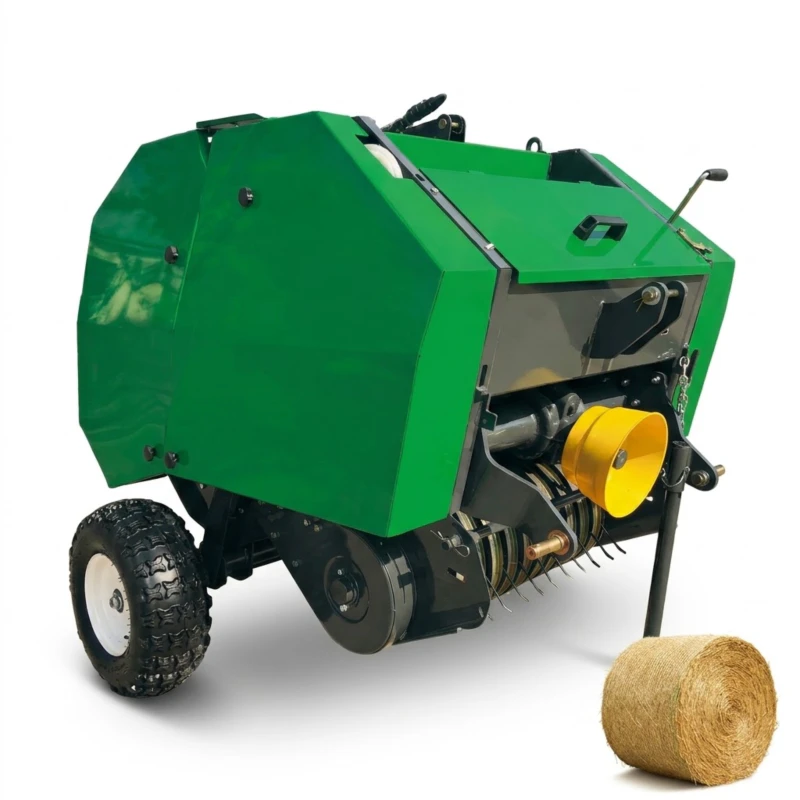
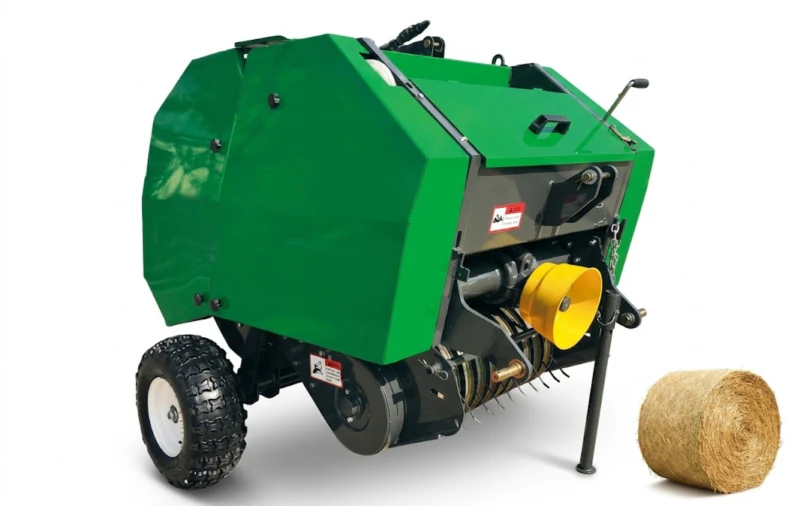
9YK-870 Round Baler
Discover the 9YK-870 Round Baler. Built with an 800mm direct-feed pickup, 440kg agile chassis, 25-50 hp power match, and cost-effective automatic rope wrapping.
The Definitive Technical Guide to the 9YK-870 Round Baler: Ultra-Compact Engineering for Nimble Forage Management
Revolutionize your smallholding, orchard, or mountain forage operations with an agile 800mm direct-feed pickup, rigid roll drum chamber, and high-efficiency low-horsepower tractor optimization.
1. Introduction to Mini Round Baling Architecture
While the agricultural mainstream frequently spotlights massive industrial baling equipment built for vast corporate fields, a silent revolution is occurring on smallholdings, terraced farms, alpine slopes, orchards, and vineyards worldwide. Smaller parcels of land, narrow rows, and steep terrains present distinct geographic barriers that render large macro-balers completely unusable. Heavy field machinery weighing multiple tons creates destructive soil compaction, requires massive capital layout, and struggles to maneuver without clipping fences or destroying tree roots. To overcome these logistical barriers, modern agricultural design focuses heavily on extreme structural optimization. The 9YK-870 Round Baler (also widely known as the Model 870) represents the pinnacle of this ultra-compact, high-density focus, providing small-scale farm managers with a masterfully condensed fixed-chamber baling tool.
The underlying issue of residue recovery—whether you are dealing with premium alfalfa, grain straw, pine needles, or grapevine prunings—remains identical regardless of property scale. Loose residue left rotting on the field ground absorbs moisture, invites insect infestations, and blocks subsequent soil prep. However, transporting loose biomass is economically unfeasible due to its sheer volume. Compaction is the only viable option. The 9YK-870 answers this requirement by compressing scattered biomass into small, easily handled round bales featuring a strict diameter of Φ630 mm and a width of 700 mm. Weighing an incredibly nimble 440 kg, this trailed implement floats effortlessly over fragile ground beds and slips cleanly between dense orchard lines where standard baling machinery would stall or slide dangerously.
What truly separates the 9YK-870 from overly complex variable baling platforms is its focused mechanical elegance. Rather than utilizing complicated, friction-heavy gathering augers or secondary packing arms that invite component failure, this mini round baler relies on a streamlined Direct Feed by Spring Tooth mechanism. Loose crop fibers are swept from the field floor and delivered straight into the rolling compression chamber in a single, fluid mechanical path. This design dramatically minimizes moving parts, slashes daily maintenance times, and permits an incredibly accessible power requirement of just 25 to 50 horsepower. This guide serves as an extensive breakdown of the 9YK-870, detailing its core mechanics, technical specifications, and field optimization strategies.
2. Streamlined Gathering: Direct-Feed Intake Mechanics
The continuous processing efficiency of the 9YK-870 relies entirely on a linear, uninhibited material flow path. In traditional large-scale baling implements, material is forced to transition through multiple turns and cross-augers before entering the chamber, which increases the likelihood of crop wrapping and sudden blockages—especially when handling damp, wiry residues. The 9YK-870 solves this by ensuring the material moves in a straight path from the field surface right into the rolling drums.
The 800mm Cam-Driven Pickup Header
The harvest begins at ground level with a specialized 800 mm wide pickup reel. This compact span is meticulously engineered to trace small utility windrows without collecting overlapping trash or spilling crop material from the margins. The reel utilizes a Spring Tooth Type structure, consisting of curved, high-tensile spring steel tines positioned uniformly along a central rotating drum. Guided by an internal mechanical cam track, these teeth sweep downward toward the soil surface, cleanly lifting scattered straw, native pastures, and pine needles. The built-in spring action allows the tines to deflect safely when striking roots or ridges, maintaining clean intake without gouging the field surface.
Direct Feed Feeder Advantage
Upon being lifted by the spring teeth, the biomass bypasses secondary feed mechanisms and enters the chamber via a Directly Feed by Spring Tooth framework. Because the 800mm gathering reel aligns closely with the 700mm compressing chamber width, the crop flows into the machine with almost zero cross-funneling resistance. The rotational momentum of the pickup tines acts as the primary stuffer, injecting consistent flakes of material into the chamber at an optimized operating speed of 2 to 5 km/h. This straight, unrestricted intake throat handles wet, coarse residues or exceptionally slick straw without the component wrapping or jamming common in complex feeding designs.
3. Fixed Chamber Physics: Roll Drum Compaction
The core compaction mechanism within the 9YK-870 is its heavy-duty Roll Drum Type Compress Bale Chamber. Unlike large variable round balers that employ long rubber belts and hydraulic tracking arms under tension, this mini implement forms a permanent concentric circle using rigid steel rollers. This ensures exceptional mechanical simplicity, minimal maintenance, and a highly predictable outer-density compaction profile.
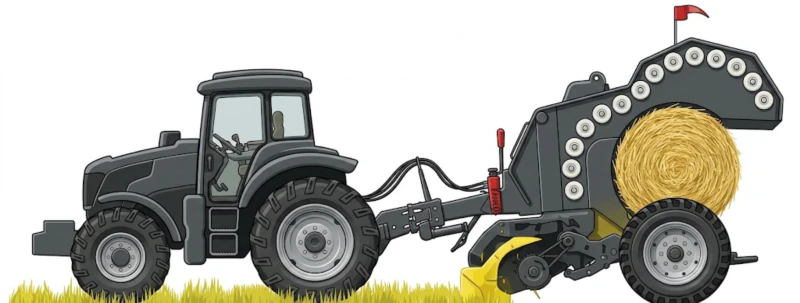
The perimeter of this 700mm wide compressing chamber is formed by a series of heavy-duty steel rollers driven synchronously by a centralized chain drive. As the direct feed pickup sweeps material into the core of the chamber, these spinning rollers continually roll the stalks upon themselves, forming a small rotating core. As more material is continually packed into the center, the growing bale eventually fills the fixed chamber volume completely, pressing tightly against the spinning steel rollers.
The extreme resistance applied by these non-yielding rollers packs the biomass from the outside inward, forming a tight outer boundary around a uniform core. This outside-in compaction curve builds an ultra-dense, weather-resistant shell around the round bale, ensuring it retains its solid shape, resists moisture rot, and remains structurally sound. The final bale size of Φ630 × 700 mm is exceptionally convenient for smallholder logistics; these mini round bales can be easily lifted manually by farm staff, loaded onto compact flatbeds, or stacked inside low-overhead storage sheds without requiring heavy skid steers or industrial frontend loaders.
4. Verified Technical Parameters & Structural Metrics
The compact physical architecture and high power efficiency of the 9YK-870 Round Baler are fully quantified by its strict mechanical metrics. The table below represents the complete, verified technical profile of this compact trailing implement, transcribed directly from our engineering data:
| Serial Number | Item Parameter | Unit | Specification Value |
|---|---|---|---|
| 1 | Model Name | / | 9YK-870 Round Baler (Model 870) |
| 2 | Hitching Method | / | Trailed |
| 3 | Picking Width | mm | 800 |
| 4 | Picker Structure | / | Spring tooth type |
| 5 | Feeder Structure | / | Directly feed by spring tooth |
| 6 | Operating Speed | km/h | 2 ~ 5 |
| 7 | Type of compressing bale chamber | / | Roll drum type |
| 8 | Width of compressing room | mm | 700 |
| 9 | Diameter of compression | mm | Φ630 |
| 10 | Bundling type | / | Rope wrapping |
| 11 | Bale Size (Diameter × Width) | mm | Φ630 × 700 |
| 12 | Overall Dimensions (Length × Width × Height) | mm | 1300 × 1300 × 1350 |
| 13 | Tire Size | / | 18×6.50-8-4PR |
| 14 | Weight | kg | 440 |
| 15 | Matching Power Range | hp | 25 ~ 50 |
| 16 | Match the PTO Speed | rpm | 540 |
Analyzing the technical dimensions of the 9YK-870 highlights an exceptionally efficient profile for smallholder operators. A total unladen mass of just 440 kg makes this machine uniquely featherweight compared to larger rolling platforms that routinely exceed several tons. Paired with high-flotation wide-profile agricultural tires sized at 18×6.50-8-4PR, this structural footprint distributes the machine’s mass evenly across the terrain. This low ground-pressure design ensures that the implement can roll smoothly over wet paddy soils, fragile grass turf, or delicate orchard cover beds without sinking, getting stuck, or gouging deep ruts into the organic topsoil layer.
5. Power Transmission Mastery: Driveline Security
Even though the 9YK-870 is designed with a lightweight, space-saving frame, driving a series of internal compressing rollers under continuous rotational friction requires stable, uniform power delivery. Because it functions as a trailed field implement, all mechanical energy must be drawn straight from the tractor’s engine and transferred directly to the baler’s primary gear sets through a reliable mechanical link.
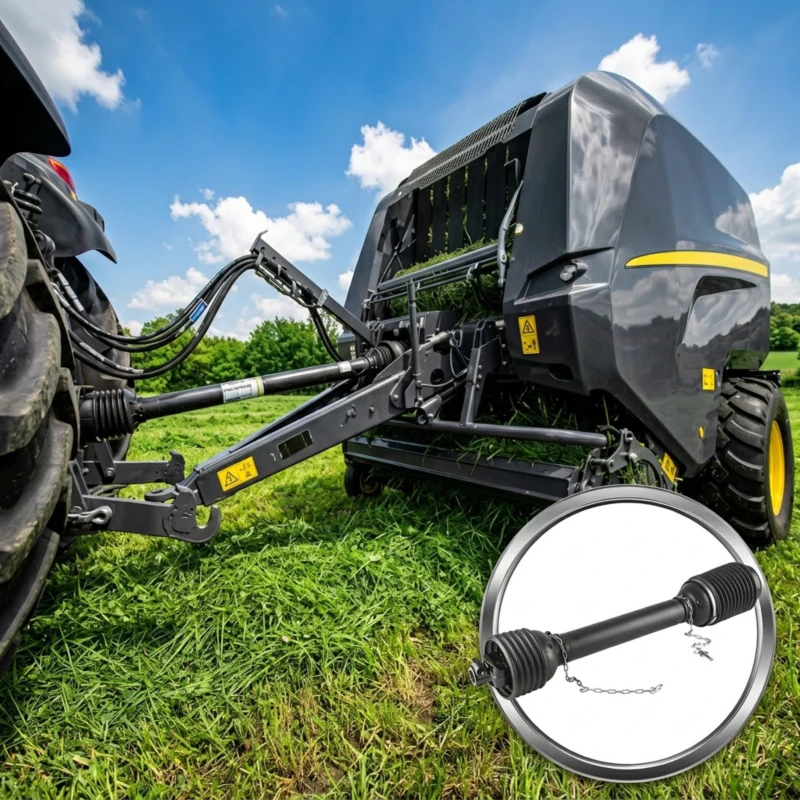
The 9YK-870 operates across an extremely economical matching power spectrum of 25 to 50 hp, making it perfectly compatible with the small utility and sub-compact tractors commonly found on boutique farms and lifestyle blocks. Mechanical energy is drawn via a standard 540 rpm PTO speed setting. As the compressed biomass fills the fixed chamber, back-torque resistance compounds against the gear teeth. To guarantee continuous uptime and shield the tractor’s internal drive teeth from sudden mechanical stress, establishing an uncompromising link is essential. Deploying a premium, high-torque pto shaft ensures uniform energy transfer, minimizes localized vibrations, and protects internal sprockets via integrated safety clutches.
6. Economical Packaging: Automated Rope Wrapping
While ultra-large industrial baling implements deploy complex and expensive net-wrapping mechanisms, the 9YK-870 prioritizes operational economy and user simplicity by utilizing a highly reliable Rope Wrapping system. Net wrap can be prohibitively expensive, hard to find in remote regions, and easily torn when bales are hauled across brambles or coarse stubble tracks. High-tensile baling twine or rope, by contrast, is highly accessible, extremely cost-effective, and possesses incredible durability.
The rope wrapping cycle on the 9YK-870 is fully automated. When the internal mechanical sensors indicate that the compacted bale has reached its full Φ630 mm dimension, a trip lever automatically engages the rope feeding arm. The arm sweeps smoothly across the width of the spinning bale, applying an even spiral of protective twine to secure the edges. The operator can easily customize the spacing between the twine spirals to suit different crop characteristics. For example, dry, springy wheat straw may require tight rope spirals to prevent expanding, while dense native hay can be secured with fewer wraps. Once the cycle wraps to a close, an internal razor cuts the rope cleanly, allowing the hydraulic tailgate to lift and drop a perfectly bound round bale.
7. Multi-Crop Adaptability in Tight Environments
The core field value of the 9YK-870 stems from its incredible multi-crop versatility. It is engineered to excel across distinct biological residue types, allowing operators to generate new revenue lines from materials that were once considered field waste.
Orchard Floor Clearing & Vineyard Vine Management
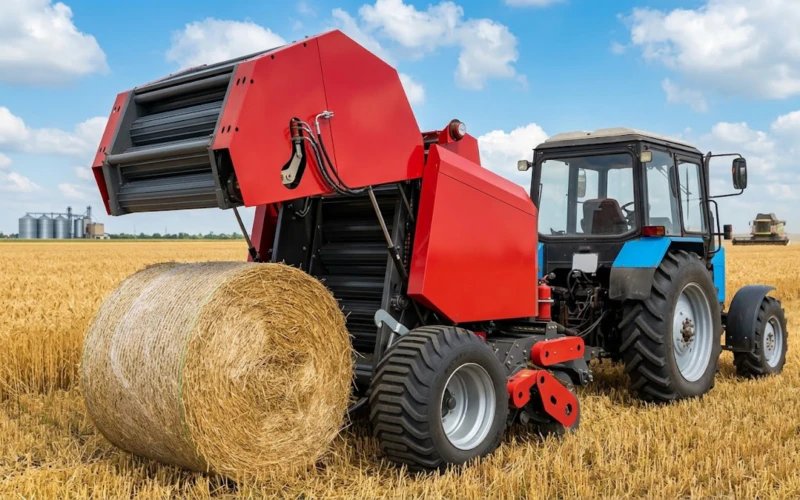
With overall machine dimensions measuring just 1300 × 1300 × 1350 mm, the 9YK-870 is exceptionally compact. In standard commercial fruit orchards and closely planted grape vineyards, pruning leaves behind thousands of stray twigs and branches that obstruct tractor paths and harbor fungal blights. The 9YK-870 drives cleanly down these narrow rows without brushing branches or bruising premium fruit. Its spring tooth pickup lifts cover crop clippings and shredded prunings smoothly, compressing them into tight bundles that are easily hauled out for composting or bio-fuel heating.
Pine Straw Collection & Boutique Haylage
In forestry and landscaping, pine straw (fallen pine needles) represents a premium mulch commodity. However, collecting it manually with rakes is incredibly slow and labor-intensive. The 9YK-870 has become a highly sought-after tool for commercial pine straw harvesters, rolling beneath pine canopies to pack loose needles into dense, uniform bundles. For small livestock operations, it handles clover and native pastures with equal ease, allowing managers to cure high-quality winter haylage using small-scale, fuel-efficient utility tractors.
8. Precision Manufacturing & Material Quality
To survive the brutal reality of multi-crop harvesting—enduring coarse dust, hard terrain impacts, and high internal friction—a mini baler must be constructed with structural durability in mind. The 9YK-870 is built inside cutting-edge manufacturing facilities where every assembly is monitored to ensure strict quality standards.
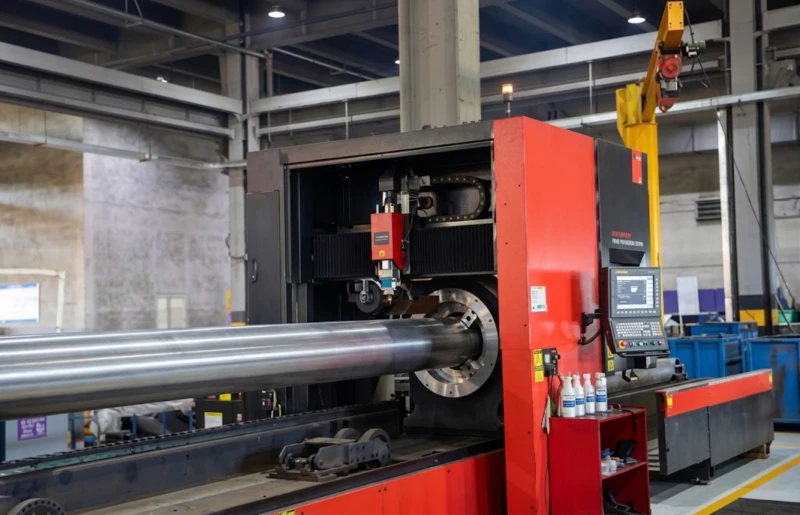
The structural backbone of the baler begins with its heavy carbon-steel frame, cut using automated CNC lasers and welded on computerized jigs. This precise process ensures flawless axial alignment, keeping the compressing rollers completely square to prevent uneven chain tracking or premature bearing failure over years of operation. The rolling cylinders undergo specialized surface heat treatments, ensuring their steel surfaces resist abrasive wear when processing dry, rigid straw stalks. By sourcing heavy-duty bearings, sprockets, and automated rope trip arms from premier global component brands, the 9YK-870 guarantees consistent, trouble-free field operation from day one.
9. Preventative Maintenance & Best Practices
Maintaining your 9YK-870 according to a regular schedule is the most effective way to protect your equipment investment and ensure reliable field performance season after season. Dusty, high-vibration harvesting fields introduce severe wear if basic maintenance parameters are neglected.
10. Real-Time Field Troubleshooting Guide
Varying windrow sizes, changing moisture levels, and uneven ground require real-time operator adjustments to maintain perfect round bale formation and protect the machinery drivetrain.
Issue 1: Asymmetrical or Lopsided Round Bales
If bales emerge larger or denser on one side, the crop windrow is likely too narrow, or the tractor is drifting off-center. Fixed-chamber balers need material to be distributed evenly across the full 700mm width of the compressing room. If windrows are narrow, weave the tractor slightly back and forth across the windrow line to distribute material evenly into both sides of the feed chamber.
Issue 2: Rope Fails to Separate Cleanly
If the wrapping rope drags or frays instead of parting cleanly at the end of the binding cycle, the cutting razor has lost its edge or is obstructed by debris. Open the wrapping guard, clean out packed chaff, and inspect the blade. Sharpen the razor using a fine whetstone or replace it with an OEM spare blade immediately to maintain smooth cycle times.
Issue 3: Material Wrapping Around Pickup Reel
When baling extremely damp, green pasture grass or overgrown cover crops, stalks can occasionally wrap around the pickup reel bar instead of sliding into the chamber. This indicates your ground speed is too low relative to the volume of the windrow. Increase your tractor’s forward speed or wait until the sun dries out surface dew to maintain clean, crisp feeding.
11. Economic & Environmental Return on Investment
Integrating the 9YK-870 Round Baler into a small-to-medium agricultural operation creates immediate economic value. By utilizing a cost-effective rope wrapping system over expensive net options, material overhead per bale drops significantly. This makes the machine highly profitable for standard utility operations, custom contractors, and livestock lifestyle blocks.
From an environmental perspective, the outside-in density profile of fixed-chamber round bales acts as an effective shield against moisture. Water rolls off the circular surface naturally, allowing bales to be safely stored outdoors without requiring expensive tarps or indoor barns. This weather resilience eliminates storage losses, preserving feed quality for livestock operations and maintaining low moisture levels for biomass fuel processing.
12. Ten In-Depth Frequently Asked Questions (FAQ)
A: The fixed roll drum chamber yields mini round bales with a constant width of 700 mm and an uniform finished diameter of Φ630 mm.
A: The 9YK-870 requires a highly efficient matching tractor power range of 25 to 50 hp, making it exceptionally compatible with compact utility tractors.
A: This compact baler features a total weight of 440 kg, with physical overall dimensions measuring 1300 × 1300 × 1350 mm.
A: Because the 800mm pickup width matches the chamber closely, the crop flows in a straight path into the rollers. This eliminates the need for lateral feed augers or packer forks, minimizing parts and clogging risks.
A: It utilizes an automated rope wrapping system, which uses highly cost-effective, high-tensile baling twine to bind the finished bales securely and economically.
A: The engineered operating speed range is 2 to 5 km/h, allowing the operator to match ground speed to windrow density perfectly.
A: It features wide flotation tires sized at 18×6.50-8-4PR, which distribute the low 440 kg weight evenly to prevent ruts on wet or fragile fields.
A: The baler requires a standard 540 rpm PTO speed to drive its internal roller assemblies with consistent mechanical timing.
A: Yes, absolutely. With a narrow width of 1300 mm, it passes easily down tight orchard rows and vineyard tracks without clipping trunks or damaging crops.
A: The compact Φ630 × 700 mm dimensions yield highly dense bales that remain light enough to be manually lifted and stacked by farm staff without heavy machinery.
Command Your Harvest with the 9YK-870
Equip your farm with nimble, high-density mini round baling technology. Turn scattered residues into tightly bound, weather-resistant commodities with maximum structural simplicity and low operating costs.