9LZY-9.0 Finger-Wheel Rake
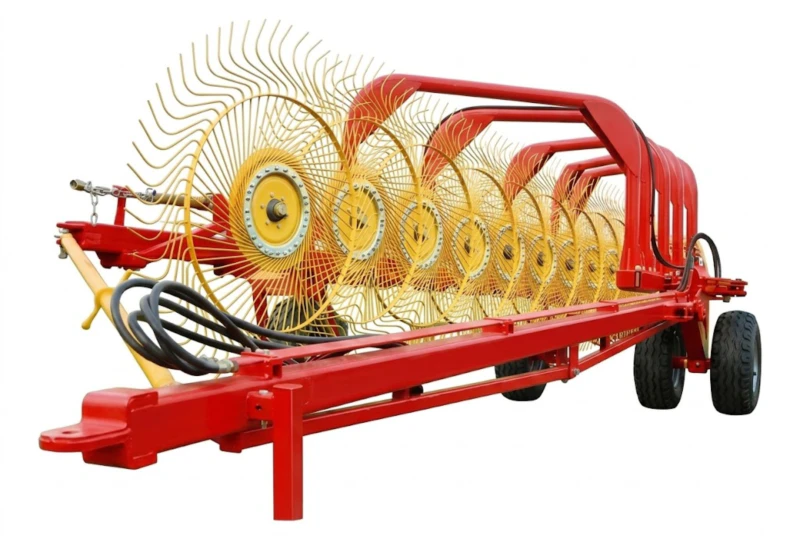
9LZY-9.0 Finger-Wheel Rake — 9m working width, 15 wheels, 900 tines, ≤2% loss rate, 7.2–9 ha/h. Adjustable 0.8–1.2m windrow. No PTO. Suits 50–55kW tractors.
9LZY-9.0 Finger-Wheel Rake: Nine-Wheel Wide-Swath Raking for High-Efficiency Commercial Hay Windrow Formation
15 finger wheels carrying 900 tines across a 9m working width, trailed side-pull design, 0.8–1.2m adjustable windrow width, ≤2% raking loss rate, 7.2–9 ha/h productivity — delivering fast, gentle, low-loss windrow formation from 50–55 kW tractors with a single operator.
1. Introduction: Why Windrow Formation Quality Determines Baling Efficiency
A baler can only work as efficiently as the windrow it follows. Uneven windrow density causes the baler to cycle between overload and underload conditions that reduce average output, increase blockage risk, and produce inconsistent bale density. Windrows placed too wide for the pickup width force the baler to make secondary passes or leave uncollected material on the field. Windrows that scatter leaf material during formation — through aggressive tine action or excessive travel speed — reduce the dry matter yield per bale and degrade the protein and energy content of the finished hay. The windrow rake is therefore not a secondary field operation: it is the critical quality control step between mowing and baling, and its performance directly determines the economic outcome of the entire hay production cycle.
The 9LZY-9.0 Finger-Wheel Rake addresses these requirements with a nine-wheel trailed design spanning a 9m working width, carrying 15 finger wheels with 60 tines each — 900 tines total — that gather and consolidate mowed material gently into a 0.8–1.2m windrow with a documented raking loss rate of ≤2%. The finger-wheel mechanism’s fundamental advantage over power-driven rake designs is the absence of an external drive source: finger wheels are ground-driven, rotating through the friction of tine contact with the crop rather than through a PTO or hydraulic motor. This passive rotation mechanism is inherently gentle on fragile dry leaf material, minimises the aggressive tine impact that drives leaf shatter loss in power-driven rakes, and eliminates the mechanical complexity and maintenance requirements of a driven conditioning rotor. Explore our complete range of forage harvesting equipment including the round balers that pair with this rake for a complete one-pass-per-operation harvest system.
At 7.2–9 ha/h productivity, the 9LZY-9.0 is sized for operations where the raking pass must keep pace with high-output mower conditioners covering 3+ metres per pass. A single operator working at 8–10 km/h transport speed can rake the output of a 3.2m mower conditioner without creating a raking bottleneck that extends the crop’s time between cutting and baling — the window during which weather risk accumulates and leaf material continues to dry past optimal baling moisture.
2. How the 9LZY-9.0 Works: Finger-Wheel Ground-Drive Raking Principle
The Finger-Wheel Mechanism
Each of the 15 finger wheels in the 9LZY-9.0 consists of a central hub mounted on a castor-angled spindle, with 60 spring-steel tines radiating from the hub in a star pattern. As the implement advances, the tines contact the mowed material on the field surface and their engagement with the crop drives the wheel to rotate — no external power source required. The rotation sweeps tines through the crop layer in a consistent rearward arc, lifting and conveying material laterally toward the windrow centre position. Each wheel operates independently on its own spring-loaded arm, allowing individual wheels to follow ground undulations without lifting adjacent wheels from the crop surface — maintaining consistent tine-to-ground clearance across the full 9m width even on uneven terrain.
Nine-Wheel Array and Windrow Formation
The 15 wheels are arranged in the 9m-wide array at angles and spacings that create a cascade of lateral crop movement — each wheel receiving material partially gathered by the wheel ahead of it in the array and passing it further toward the windrow centre. This cascade arrangement means that crop near the outer edges of the 9m working width travels the greatest lateral distance, while crop near the windrow centre travels the least — but each wheel handles only a fraction of the total material movement, keeping individual wheel tine loading within the range that minimises leaf shatter. The final windrow width of 0.8–1.2m is determined by the angle setting of the outer wheels, which is adjusted before field operation to match the target windrow width for the baler following.
Ground-Drive Advantages for Low Loss Rate
The ≤2% raking loss rate specification is the direct result of the finger-wheel ground-drive mechanism’s inherent gentleness. Because wheel rotation speed is governed by forward travel speed rather than an external drive motor, the tine tip speed relative to the crop is always proportional to forward speed — preventing the over-speed tine action that causes aggressive leaf stripping in power-driven rakes when travel speed drops below the rate at which the rotor was designed to run. Constant tine-speed-to-travel-speed ratio means the same gentle tine action at 8 km/h as at 10 km/h. This gentleness is most commercially significant with high-leaf-fraction crops like alfalfa and clover, where leaf represents 60–70% of the hay’s nutritional value and aggressive raking can reduce dry matter yield by 5–15% per pass compared to finger-wheel alternatives.
With 15 wheels at 60 tines each, the 9LZY-9.0 provides 900 tine contact points across the 9m working width — approximately 100 tines per metre of width. This high tine density ensures that no material is missed between adjacent tine paths even at working speeds toward the upper end of the 8–10 km/h range. At lower tine densities, gaps between tine paths at higher speeds leave unraked strips that must be collected in a secondary pass or remain on the field as loss. The 60-tine-per-wheel design closes these gaps across the full working width, maintaining the ≤2% loss rate specification at all working speeds within the rated range. For the round balers that follow, see our complete hay baler product range.
3. Complete Technical Specifications
The following table contains the verified engineering specification sheet for the 9LZY-9.0 Finger-Wheel Rake, derived from factory test documentation under standard operating conditions.
| No. | Item / Parameter | Unit | Specification / Value |
|---|---|---|---|
| 1 | Model Name | / | Model 9LZY-9.0 Finger-Wheel Rake |
| / | Structural Type | / | Finger-Wheel Type |
| 2 | Hitch Type | / | Trailed |
| 3 | Model Designation | / | 9LZY-9.0 |
| 4 | Required Power | kW | 50–55 |
| 5 | Overall Dimensions (L×W×H) — Working State | m | 8.4 × 11 × 1.75 |
| 6 | Machine Weight | kg | 1100 |
| 7 | Working Width | m | 9 |
| 8 | Working Speed | km/h | 8–10 |
| 9 | Transport Speed | km/h | 12 |
| 10 | Number of Finger Wheels | pcs | 15 |
| 11 | Number of Tines | pcs | 900 (15 wheels × 60 tines/wheel) |
| 12 | Operator(s) | person | 1 |
| 13 | Windrow Width | m | 0.8–1.2 (Adjustable) |
| 14 | Raking Loss Rate | / | ≤2% |
| 15 | Productivity | ha/h | 7.2–9 |
The 9LZY-9.0’s 9m working width combined with 8–10 km/h working speed delivers 7.2–9 ha/h — sufficient to rake the daily output of two 3.2m mower conditioners operating simultaneously. The 1100 kg machine weight provides structural stability at 12 km/h transport speed without imposing excessive drawbar load on 50–55 kW tractors. The ≤2% raking loss rate specification directly protects the dry matter yield and nutritional quality of every hectare raked.
4. Five Core Advantages
Advantage 1: 9m Working Width for Industry-Leading Hectarage Rate
At 9m working width and 8–10 km/h working speed, the 9LZY-9.0 delivers 7.2–9 ha/h — productivity that matches or exceeds wide-swath mowing operations and ensures the raking pass never creates a bottleneck in the hay production sequence. For operations running multiple mower conditioners simultaneously, this throughput rate means one 9LZY-9.0 and tractor combination can service the output of two 3.2m mower conditioners without losing ground. The wide working width also reduces the number of field passes required per hectare compared to narrower rakes, compressing the time window between last mowing pass and baling start — directly reducing weather exposure risk for the already-cut crop waiting in swath.
Advantage 2: ≤2% Raking Loss — Protecting Nutritional Value and Dry Matter Yield
The ≤2% raking loss rate specification is the 9LZY-9.0’s most commercially significant performance guarantee. In commercial hay production, raking loss is not simply a quantity loss — it is a quality loss concentrated in the leaf fraction. Leaves are the lightest and most fragile component of cut forage; they also contain 60–80% of the plant’s crude protein and a disproportionate share of digestible energy. Aggressive rakes that shatter and scatter leaf material produce windrows that weigh the same as the unraked swath but with significantly lower nutritional content per tonne — a quality degradation that is invisible in the field but measurable in the feed analysis that determines market price and livestock performance. The finger-wheel ground-drive mechanism maintains gentle tine action at all working speeds, consistently achieving ≤2% total dry matter loss across the speed range without the leaf-fraction bias of powered rakes.
Advantage 3: No PTO Drive Required — Reduced Power Demand and Mechanical Simplicity
The ground-drive finger-wheel mechanism requires no PTO power input — all wheel rotation energy comes from tine-crop engagement as the implement advances. This eliminates the PTO driveshaft, intermediate gearbox, and power distribution system that powered rake designs require, removing the mechanical complexity that is the primary source of in-field breakdowns for this implement type. The 50–55 kW power requirement reflects only the drawbar load of pulling the 1100 kg implement at working speed, not the additional power demand of driving a conditioning rotor — making the 9LZY-9.0 accessible to mid-range tractors that could not run a comparably wide powered rake within their power budget. With no PTO components to inspect, lubricate, or replace, the daily maintenance routine reduces to tine condition inspection and wheel bearing greasing — achievable in under 10 minutes.
Advantage 4: 0.8–1.2m Adjustable Windrow Width for Baler Compatibility
The 0.8–1.2m windrow width adjustment range covers the pickup width range of round balers from compact models in the 9YG-1.0 class up to mid-size commercial machines. Setting the windrow width to closely match the baler’s pickup width maximises baling efficiency — the baler pickup lifts the full windrow in a single pass without leaving material at the windrow margins that would require a second pickup pass or remain as field loss. A windrow that is too wide for the baler’s pickup causes overflow and incomplete collection; too narrow causes underfill that extends the bale cycle time and reduces throughput. The 9LZY-9.0’s field-adjustable windrow width allows fine-tuning to match the specific baler being used — a flexibility that matters when the same rake services multiple baler models across different operations.
Advantage 5: Single-Operator Trailed Design with 12 km/h Transport Speed
The 9LZY-9.0’s trailed hitching configuration and 12 km/h rated transport speed allow rapid field-to-field movement between the mowing and baling operations that the rake must service in a full harvest day. A single operator manages the complete raking operation from the tractor cab, including transport between fields, windrow width adjustment, and tine height setting — without additional field personnel requirements. The 1100 kg machine weight and trailed hitch geometry maintain stable straight-line transport at 12 km/h on farm tracks and public roads, reducing travel time between field sections that can otherwise consume a significant fraction of the working day on dispersed farm layouts.
5. Field Application Scenarios
Commercial Alfalfa and High-Protein Legume Hay Production
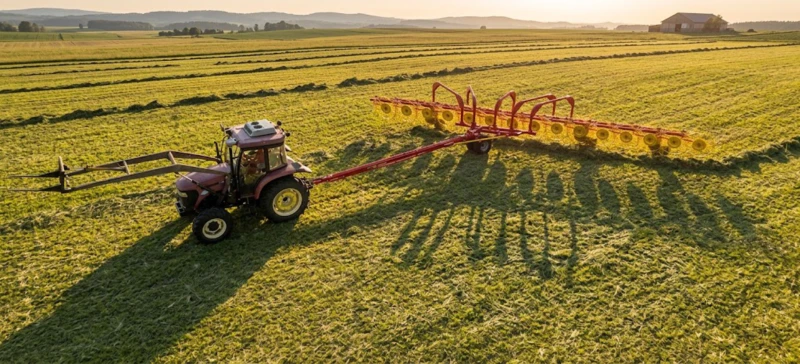
Alfalfa and other legume hays are the highest-value forage crops in commercial hay markets, with prices reflecting crude protein content that depends almost entirely on leaf retention through the cutting-raking-baling cycle. Operations producing export-grade alfalfa for dairy markets — where buyers specify minimum crude protein levels of 18–22% — cannot afford the leaf loss that aggressive raking causes. The 9LZY-9.0’s ≤2% loss rate and gentle finger-wheel mechanism specifically preserve the delicate alfalfa leaf while still consolidating wide mower conditioner swaths into compact windrows that match baler pickup widths. The 9m working width allows raking to keep pace with high-cut-rate mowing systems, preventing the scenario where cut alfalfa waits in wide swath through an additional drying period while the rake catches up — a delay that causes over-drying and leaf shatter even before the rake arrives.
Dairy and Livestock Farm Hay Supply Operations
Farm-scale hay operations typically follow a tight three-implement sequence: mower conditioner, rake, baler. The 9LZY-9.0’s ability to keep pace with 3.2m+ mower conditioner output at 7.2–9 ha/h means a single rake-and-tractor combination services the mowing output without creating a field bottleneck that extends the total harvest time per field. This matters because extending harvest time extends the period during which cut crop in the earliest swaths continues to cure past optimal baling moisture — the risk of inconsistent bale moisture across a field that leads to fermentation failures in wrapped silage or spoilage in dry hay storage. Consistent raking pace also improves baler operator efficiency by ensuring uniformly formed windrows arrive at the baler in consistent condition throughout the day rather than varying between freshly raked and over-cured.
Multi-Mower Coordinated Harvest Systems
Large commercial hay operations often deploy multiple mower conditioners simultaneously on the same field to maximise cutting rate during the available weather window. A single 9LZY-9.0 at 7.2–9 ha/h can rake behind two 3.2m mower conditioners working in parallel, consolidating their parallel swaths into a single windrow pattern that the following baler can collect in a continuous circuit. This multi-mower coordination capability means the raking operation scales to match cutting intensity without requiring proportional rake fleet expansion — one additional rake investment services a significant increase in cutting capacity.
Grass Hay, Mixed Sward, and Natural Forage Raking
Permanent grassland, mixed grass-legume swards, and natural meadow hay operations involve diverse material types — fine-stemmed grasses, broad-leaf legumes, coarse mature seedheads — that respond differently to raking action. The finger-wheel mechanism’s inherent adaptability to varied material density means tine loading adjusts automatically as material density changes across the field, without operator intervention or speed adjustment. Fields that transition from dense grass areas to sparse patches to tall coarse-stemmed areas all receive consistent, gentle raking action that consolidates the windrow without the tine bounce and material scattering that occurs when a fixed-speed powered rake moves through variable-density crop.
6. Integration with a Complete Hay Harvest System
The 9LZY-9.0 is designed as one element in an integrated three-implement hay harvest system. Understanding how the rake specification connects to the mowing and baling stages helps operators optimise the full system performance rather than optimising each implement in isolation.
Pairing with Mower Conditioners
The 9LZY-9.0’s 7.2–9 ha/h productivity capacity at 9m working width matches the output of two 3.2m mower conditioners such as the 9GQY-3.2 operating simultaneously at 10 km/h. The mower conditioner’s swath width output (set to 1.5–2.2m per pass) and the rake’s windrow width setting (0.8–1.2m) should be coordinated so the rake is consolidating swaths to a width that matches the specific baler being used. A common system design: two 9GQY-3.2 mowers creating 2m swaths, one 9LZY-9.0 raking those swaths into 1.0–1.1m windrows, followed by a round baler with 1.9–2.2m pickup working the finished windrows. This three-implement system completes the full cut-rake-bale cycle within the weather window that determines hay quality.
Windrow Width Setting for Common Baler Models
7. Related Product: PTO Shaft for Tractor-Implement Connections
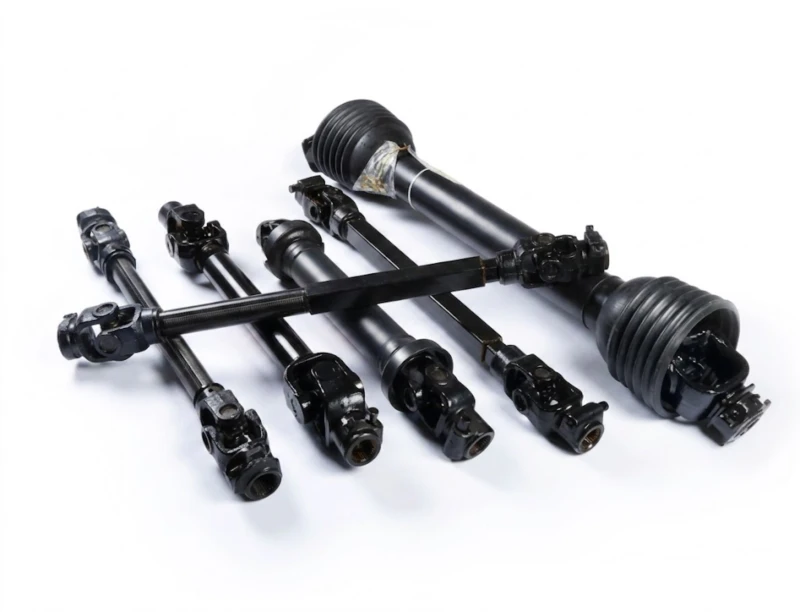
The 9LZY-9.0 itself does not use a PTO drive — its finger wheels are ground-driven by tine-crop engagement. However, when the 9LZY-9.0 operates as part of an integrated hay harvest system alongside a mower conditioner such as the 9GQY-3.2, the mower conditioner requires a correctly specified pto shaft for its disc cutterbar and conditioning rotor drive. Similarly, round balers following the rake require a PTO driveshaft matched to their power input specification. For a complete and efficient hay harvest system, ensuring every powered implement in the chain is connected with a properly rated, dynamically balanced, and guarded driveshaft is as important as specifying the implements themselves.
8. Manufacturing Quality and Long-Term Reliability
The 9LZY-9.0’s 9m working width places high demands on frame rigidity: the implement must maintain consistent tine-to-ground clearance across the full width on uneven terrain without the frame flex that causes outer-wheel ground contact loss on one side of a cross-slope. The main frame, fold joints, and wheel-arm mounting points are fabricated to dimensional tolerances that maintain alignment through the vibration and terrain loading of commercial-intensity raking operation.
9. Frequently Asked Questions (FAQ)
The finger-wheel mechanism is ground-driven: the tines contact the crop material and the resulting drag friction rotates each wheel as the implement advances. No external power input is required because the energy for crop movement comes from the forward travel of the implement rather than a driven rotor. This design is possible because finger-wheel rakes move crop laterally with gentle progressive tine sweeps rather than the high-energy impact mechanisms that powered tedders and powered rakes use to lift and scatter material. The result is lower mechanical complexity, reduced power demand, and — critically — gentler crop handling that preserves the leaf fraction responsible for hay nutritional quality.
The outer wheel sections fold hydraulically (or mechanically, depending on configuration) from the 9m working position to a transport configuration that reduces the road transport width to within legal limits for farm track and public road travel. The transport speed rating of 12 km/h applies only in the folded transport configuration. Always confirm the implement is fully folded and all transport locks engaged before moving on public roads. The working-state overall dimensions of 8.4 × 11 × 1.75m apply to field operation; confirm the folded transport dimensions match your specific route requirements before moving between remote field locations.
Set windrow width 10–15% narrower than your baler’s rated pickup width as a starting point. For a baler with 1900mm (1.9m) pickup, try 1.1–1.2m windrow width; for 2150–2240mm pickup balers, 1.1–1.2m windrow width concentrates material cleanly within the pickup span. Observe the first several bales: if the pickup is missing material at the windrow edges, narrow the windrow slightly; if the baler is frequently stopping or surging on heavy windrow sections, the windrow may be too heavy per unit length and working speed should be reduced. Fine-tuning the windrow width for each baler and crop combination improves baling throughput and bale density consistency.
Four practices minimise alfalfa leaf loss during raking: (1) Rake when crop moisture is above 35–40% — at lower moisture, leaves are extremely fragile and any tine contact causes shattering; if the crop has over-dried, raking at dawn when overnight humidity has slightly re-moistened the leaf surface reduces loss significantly. (2) Operate at the lower end of the 8–10 km/h speed range — slower tine tip speed means less impact force on leaf junctions. (3) Set tine height to just clear the ground surface — excessive ground clearance misses material; excessive soil contact scatters gathered material backward. (4) Avoid raking in conditions above 20 km/h wind — lateral wind deflects scattered leaf material away from the forming windrow.
Daily: inspect all 900 tines for bending, breakage, or loosening; a bent tine contacts adjacent tines during rotation and causes progressive secondary damage. Check that all 15 wheel arms move freely on their pivot points. Remove any crop material wrapped around wheel hubs or spindles. Every 50 hours: grease all wheel hub bearings and fold joint pivot bearings through the marked grease nipples. Inspect fold joint locking mechanism for wear. At season end: wash off all crop residue and soil from the frame and wheel assemblies; apply corrosion protection to bare metal surfaces; store in a covered, dry location with wheel arms in the folded position to reduce wind load on the tine assemblies.
No — the 9LZY-9.0 is a raking machine designed to consolidate wide swaths into narrower windrows, not a tedder designed to spread windrows into wider, thinner swaths for drying. The wheel angle settings that produce the 0.8–1.2m windrow width are configured for lateral gathering movement. Tedding requires the opposite action — spreading material outward from the windrow — which requires a different wheel angle geometry and, typically, a powered rotor that throws material rather than sweeping it. If tedding is required in your operation, a separate tedder implement is needed; the 9LZY-9.0 should only be applied after tedding is complete and the crop has reached target raking moisture.
The 9LZY-9.0 requires at least one tractor hydraulic remote valve for implement lift control (raising the finger wheels for headland turns and transport). If the fold function is hydraulically operated (confirm in the product specification for your specific unit), a second hydraulic remote valve is required for folding and unfolding. The hydraulic demand is low — only occasional actuation for lift and fold rather than continuous flow — so the 50–55 kW tractors specified for this implement typically provide adequate hydraulic capacity from their standard remote valve system.
Powered rotary rakes of 9m working width require 75–100+ kW tractors to drive the rotor, versus 50–55 kW for the ground-driven 9LZY-9.0 — a significant tractor cost and fuel economy advantage. Powered rakes offer higher speed capability (some rated to 12–15 km/h) and can be used for tedding as well as raking. For operations where leaf retention is the primary quality priority — particularly alfalfa and high-protein legume hay — the finger-wheel mechanism’s ≤2% loss rate consistently outperforms powered rotary rakes at equivalent working speeds. For operations processing primarily grass hay where leaf loss is less critical and maximum raking speed is the priority, powered rakes may be preferred despite their higher power requirement and operating cost. Contact our team for a system recommendation matched to your specific crop mix and operation scale.
Rake 9 Metres Wide, Lose Less Than 2% — The Low-Loss High-Throughput Windrow Solution
The 9LZY-9.0 Finger-Wheel Rake delivers 7.2–9 ha/h across a 9m working width with 900 ground-driven tines — gentle enough for ≤2% leaf loss on premium alfalfa, fast enough to match multi-mower cutting systems, and economical enough for 50–55 kW tractors. Request your quote today.